Insight
Tapps were one of the most distinctive Canadian Hi-NRG and synth-pop acts to emerge from Toronto’s early-1980s club scene, a studio-centered dance project whose original 12-inch singles developed a much larger international afterlife than their modest domestic profile might initially suggest. Built around the songwriting and production nucleus of Allan Coelho and Tony DaCosta, and fronted by vocalist Candy Berthiaume, Tapps helped define a sleek, club-driven strain of Canadian dance-pop that moved between Toronto’s disco underground, the emerging Hi-NRG market, and the international remix culture that kept their records in circulation long after their original release cycle.
The group’s roots lay in the Toronto-area Portuguese-Canadian community, where Allan Coelho, Tony DaCosta and Paul Silva first played together in a weekend wedding and event band called French Kiss. Coelho, a part-time DJ and constant clubber, was already envisioning something more contemporary and dancefloor-oriented, hoping to merge the polish of the band’s live work with the pulse and immediacy of the records he was hearing in clubs. When the group shifted toward original electronic dance music, a new name followed: Tapps, formed from the first letters of Tony, Allan and Paul, with an extra “p” added before the name was pluralized. Candy Berthiaume was then brought in as lead vocalist, completing the lineup most closely associated with the band’s breakthrough recordings.
Tapps made their first recorded impact in 1983 with ‘My Forbidden Lover’, a 12-inch single issued on Toronto’s Power Records, the label operated by Vincent Degiorgio. Produced by Bob Rudd, the record immediately established the group’s core formula: insistent electronic rhythm, dramatic melodic hooks, strong female lead vocals, and extended club-oriented arrangements tailored to the 12-inch format. Written by Allan Coelho, Tony DaCosta, Jean Zevers, Bolton and Vince Degiorgio, the single quickly became the foundational Tapps track and remains their signature release. It also travelled early. In September 1983, James Hamilton’s influential dance column in Record Mirror singled out ‘My Forbidden Lover’ as a notable Canadian 12-inch, evidence that the record had already entered the British import and club circuit while the band was still in its earliest phase.
A second 1983 Power Records single, ‘Burnin’ With Fire,’ followed, again under the supervision of Bob Rudd and Rudd Productions, reinforcing Tapps as an emerging presence in Toronto’s dance underground. Though some surviving discographic data around the release is inconsistent, the record clearly belongs to the same formative period in which Coelho and DaCosta were developing the band’s early studio identity. By this point, Tapps were already functioning less like a conventional live band and more like a purpose-built recording act designed for DJs, dancefloors and the extended-mix marketplace.
That approach sharpened with ‘Runaway (With My Love)’ in 1984, another 12-inch Power Records release and one of the defining records of their early catalog. Produced for Nightworks Entertainment by Peter Frost and recorded at Kensington Sound in Toronto, the single showcased a more polished and fully realized studio vision. Coelho and DaCosta handled composition, drum programming and keyboards, while Candy Berthiaume took the lead vocal, supported by male backing vocals credited to “Da Boyz.” Recorded and mixed by Marc Lappano, with percussion by Norman Jones, ‘Runaway (With My Love)’ strengthened the group’s reputation as one of the more sophisticated Canadian dance acts working in the Hi-NRG format. Like ‘My Forbidden Lover,’ the record moved beyond Canada, appearing in European circulation during the band’s active years and helping establish Tapps within the wider international club and import market.
The band’s most important phase began in 1985 when they entered the Boulevard Records orbit. Their first major Boulevard release, ‘Hurricane,’ marked a significant step forward in both presentation and ambition. Produced and computer-programmed by John Forbes, with engineering by George Semkiw and Forbes and vocals by Allan Coelho, Tony DaCosta and Candy Berthiaume, ‘Hurricane’ refined the Tapps sound into something cleaner, bigger and more overtly commercial without sacrificing club impact. It quickly became one of the group’s most enduring songs and was presented as a fully Canadian package, complete with MAPL symbols indicating 100% Canadian content.
Later that same year, Tapps issued ‘In The Heat Of The Night,’ another essential Boulevard 12-inch. The single is especially notable because John Forbes was credited not only as producer and engineer but also as the sole songwriter on the title track, underscoring how fluid the project had become in the studio. The B-side, ‘Hurricane (Mega Storm Mix),’ remixed by Allan Coelho, George Semkiw and Tony DaCosta, showed how quickly Tapps material was being repurposed for the remix market. In the mid-1980s Hi-NRG world, that ability to rework, extend and repackage tracks for DJs was central to a record’s lifespan, and Tapps were increasingly fluent in that language.
By 1986, Allan Coelho had clearly emerged as the dominant internal creative force. The 7-inch ‘Don’t Pretend To Know / Hurricane’ and the 12-inch ‘Don’t Pretend To Know’ both placed Coelho in the lead producer and remixer role, with the 12-inch version written by Coelho, John Forbes and John Savage. Recorded at Amber Studios and remixed at Metalworks, the single bridged Tapps’ earlier club-driven 12-inch style with a more polished, commercially minded synth-pop sound. Around the same time, Boulevard issued ‘My Forbidden Lover / Runaway (With My Love) (Remixes)’, a 12-inch pairing that revisited the group’s two foundational Power Records-era songs in updated form. Rather than abandoning their early material, Tapps and Boulevard actively reintroduced it to a newer mid-1980s dance audience, folding the Power Records catalog into the Boulevard era and reinforcing those tracks as the center of the band’s identity.
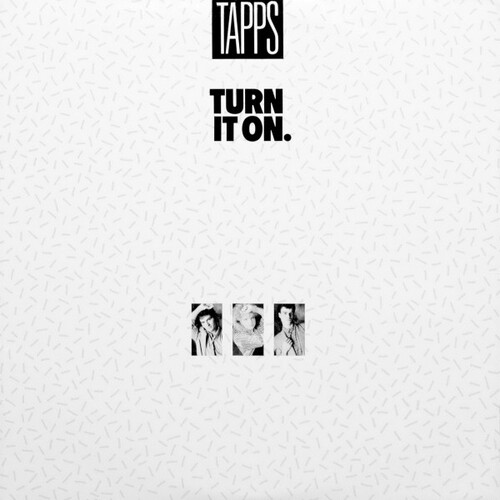
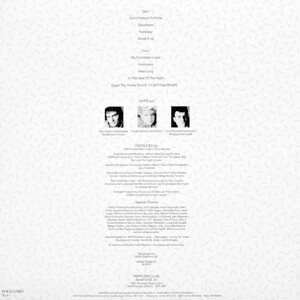
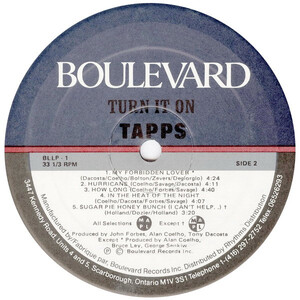
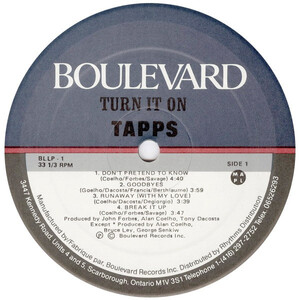
That strategy culminated in Turn It On, the group’s only full-length LP, released by Boulevard in 1987. The album gathered new material and reworked signature songs into the most complete statement of the Tapps sound. Tracks such as ‘Don’t Pretend To Know,’ ‘Goodbyes,’ ‘Runaway (With My Love),’ ‘Break It Up,’ ‘My Forbidden Lover (’86 Version),’ ‘Hurricane,’ ‘How Long,’ ‘In The Heat Of The Night,’ and ‘Sugar Pie Honey Bunch (I Can’t Help...)’ presented a polished blend of Hi-NRG, synth-pop and disco-inflected dance music. Candy Berthiaume remained the principal lead vocalist, while Allan Coelho and Tony DaCosta supplied backing vocals and keyboards. Production was shared among Coelho, John Forbes and Tony DaCosta on most of the LP, with Bruce Ley and George Semkiw co-producing ‘My Forbidden Lover (’86 Version).’ The album’s dense network of Toronto studio collaborators—Amber Studios, Forbes Studios, Metalworks, George Semkiw, Hugh Cooper, Carolynne Saxton and Bruce Ley—places Tapps squarely within the professional dance-pop infrastructure that was operating in Toronto during the period.
Also in 1987, Tapps issued 4 Play, a four-track 12-inch EP that further underlined their international club credibility. The release included a Razormaid remix of ‘Don’t Pretend To Know,’ credited to Joseph Watt. This was a significant marker: Razormaid was one of the most influential U.S. remix services of the 1980s, deeply embedded in synth-pop, Hi-NRG and DJ culture. Tapps’ appearance in that context strongly suggests that their records had moved well beyond local or national circulation and were being taken seriously within the wider North American and international club network. The EP also featured a remix of ‘My Forbidden Lover’ and a Tapps reading of ‘Sugar Pie, Honey Bunch,’ illustrating how comfortably the group could move between original material, catalog refreshes and dancefloor reinterpretations of familiar pop standards.
Although Tapps never became a mainstream pop household name in Canada, their records developed the kind of long second life that matters just as much in dance music history. Their core 12-inch singles remained in circulation among DJs, import buyers and Hi-NRG collectors long after the original release cycle ended. That longevity was formally acknowledged in 1995 when Boulevard issued Greatest Hits, a CD compilation that gathered key tracks including ‘My Forbidden Lover,’ ‘Runaway,’ ‘Crazy For You,’ ‘Hurricane,’ ‘Burning With Fire,’ ‘Don’t Pretend To Know,’ ‘Sugar Pie Honeybunch,’ ‘How Long,’ and a lengthy ‘Tapps Medley.’ For a Canadian act whose prime activity had centered on the 12-inch club era, the appearance of a dedicated mid-1990s CD retrospective was a meaningful sign that the catalog still had value well after its original moment.
That afterlife only grew stronger. By the 2000s and 2010s, original Tapps vinyl had become increasingly sought after by collectors of Canadian disco, Hi-NRG and synth-pop, while the group’s best tracks continued to circulate in DJ sets, collector communities and reissue circles. The clearest proof of their enduring international reputation came in 2019, when the UK/European label VR issued The Best Of, a limited-edition remastered CD built around the extended 12-inch versions that collectors prize most. Featuring ‘Hurricane,’ ‘Runaway (With My Love),’ ‘Don’t Pretend To Know,’ ‘My Forbidden Lover,’ ‘Crazy For You,’ ‘In The Heat Of The Night,’ ‘Break It Up,’ and ‘I Can’t Help Myself (Sugar Pie Honey Bunch),’ the release confirmed what collectors had known for years: Tapps had become one of Canada’s most enduring Hi-NRG exports, a Toronto studio dance act whose records outlived their original commercial window and found lasting life in the broader international synth-pop and club underground.
-Robert Williston
Musicians
Candy Berthiaume: vocals
Alan Coelho: backing vocals, keyboards
Tony DaCosta: backing vocals, keyboards
Carlos Borges: backing vocals on ‘My Forbidden Lover (’86 Version)’
Sandy St. Alban: backing vocals on ‘My Forbidden Lover (’86 Version)’
Junior St. Omer: percussion on ‘My Forbidden Lover (’86 Version)’
Bruce Ley: Fairlight programming
Songwriting
‘Don’t Pretend To Know’: written by Allan Coelho, John Forbes, John Savage, Francis
‘Goodbyes’: written by Allan Coelho, Tony DaCosta, Candy Berthiaume
‘Runaway (With My Love)’: written by Allan Coelho, Tony DaCosta, Degiorgio
‘Break It Up’: written by Allan Coelho, John Forbes, John Savage
‘My Forbidden Lover (’86 Version)’: written by Allan Coelho, Tony DaCosta, Zevers, Bolton, Degiorgio
‘Hurricane’: written by Allan Coelho, Tony DaCosta, John Savage
‘How Long’: written by Allan Coelho, John Forbes, John Savage
‘In The Heat Of The Night’: written by Allan Coelho, John Forbes, John Savage, Tony DaCosta
‘Sugar Pie Honey Bunch (I Can’t Help...)’: written by Holland / Dozier / Holland
Production
Produced by Alan Coelho, John Forbes and Tony DaCosta on tracks A1 to A4, B2 to B5
Co-produced by Bruce Ley and George Semkiw on ‘My Forbidden Lover (’86 Version)’
Engineered and mixed by George Semkiw and John Forbes
Assistant engineers: Carolynne Saxton, Dave Ronstedler, Gary Fishman, Steven Traub
Additional remixing by Hugh Cooper on ‘Don’t Pretend To Know’ and ‘Runaway (With My Love)’
Additional editing by Hugh Cooper
Recorded and mixed at Amber Studios, Toronto and Forbes Studios, Toronto
Additional remixing and editing at Metalworks Studios, Toronto
Manufactured by Boulevard Records Inc.
Distributed by Rhythms Distribution
℗ & © Boulevard Records Inc.
Artwork
Design by Borys
Typography by Alpha Graphics Ltd.
Gallery
Images
4 images
Tapps – Turn It On (4)
Tapps – Turn It On (2)
Tapps – Turn It On (3)
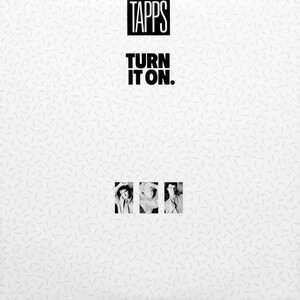
Turn It On
Media
Videos
0 videos
No videos available for this title.
Credits
In Transit
No Comments