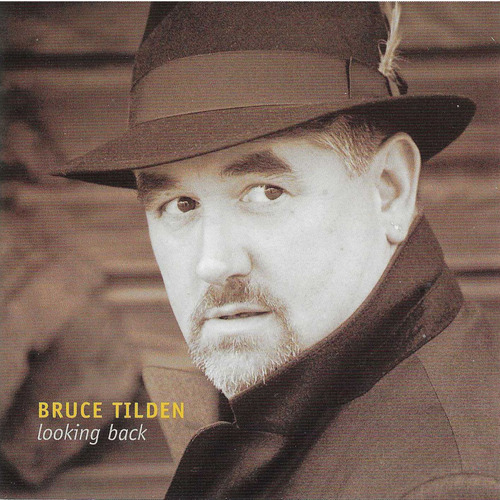
Insight
Looking Back is a rare Bruce Tilden album preserved and presented here as a Museum of Canadian Music exclusive, not currently available anywhere else. The album captures Tilden in a reflective mood, pairing his familiar warmth as a vocalist and pianist with a personal selection of material that highlights both his entertainer’s instincts and his gift for storytelling.
A central piece is Tilden’s own composition ‘The Stranger’, a gentle, story-driven original about loneliness, uncertainty, faith, and spiritual renewal. The song follows a man named Lyle, who encounters a mysterious stranger beneath an alder tree and is guided toward trust, openness, and a deeper sense of purpose. Tilden later explained that the song was written as the final project for a spiritual course connected to the Science of Mind religious movement, which he described as being closer in philosophy to Unity than to Christian Science. Because he was playing piano for the church services each Sunday, he was able to take the course without cost, and when asked to complete a final project, he chose to challenge himself by writing a song.
Although Tilden had written very little original material at that point, ‘The Stranger’ became one of the album’s most personal moments. He recalled that the song initially felt almost understated, but that it came fully alive once the guitarist suggested giving it a Spanish feel, an arrangement choice that, in Tilden’s words, made the song “fly.” The result is a quietly moving performance that shows him not only as an interpreter of songs, but as a songwriter capable of shaping a narrative from personal reflection, atmosphere, and spiritual feeling.
The album also includes ‘Dumfermline’, written by Tilden’s friend Rick McPhee, a successful immigration lawyer who had previously been part of the well-known 1960s Vancouver band High Flying Bird. Tilden was drawn to the song because of its Scottish history, its dramatic storytelling, and his own Scottish background. The track unfolds like a historical folk ballad, with images of soldiers, betrayal, court intrigue, and revenge, adding a darker and more theatrical dimension to the album.
Tilden also brought personal connections into the recording of ‘Dumfermline’. The track features an actual bagpiper, adding to its Scottish character, while Connie Russell, an old friend of Tilden’s and a singer he greatly admired, performs the woman’s part in the song’s dramatic narrative. Through these contributions, ‘Dumfermline’ becomes more than simply a cover of a friend’s composition; it becomes a carefully staged performance rooted in friendship, heritage, and story.
Together, ‘The Stranger’ and ‘Dumfermline’ give Looking Back much of its character. One song reaches inward toward spiritual understanding, while the other looks outward toward history, legend, and inherited cultural memory. Placed within the broader context of Bruce Tilden’s career as a Vancouver pianist, vocalist, and live entertainer, the album stands as a deeply personal document — intimate, reflective, and now preserved by MoCM as a rare Canadian recording that might otherwise remain unheard.
Bruce Tilden is a Vancouver pianist, vocalist, and seasoned entertainer whose career has taken him from Western Canada’s hotel piano bars to cruise ships, charity recordings, theatrical productions, and decades of live performance built on a formidable songbook and a deeply audience-driven style.
Born and raised in Vancouver, Tilden began singing in church choirs at age eight and was studying both voice and piano by his early teens. From the beginning, music and theatre developed side by side: he sang, played, acted, and appeared in school productions, eventually pursuing formal post-secondary studies in music and theatre and earning a Bachelor of Arts with a major in Music-Theater.
Although his 1978 LP Together Ensemble remains his best-known surviving release, Tilden’s career was built first and foremost on live performance. As a young musician, he entered the piano bar circuit at just 18, landing his first major hotel engagement at the International Plaza Hotel in Calgary. That initial experience proved formative. After being dismissed only days into the engagement for repeating too many of the same songs, Tilden responded by radically expanding his repertoire, teaching himself hundreds of additional titles outside his natural comfort zone. It was a turning point he still recalls as a difficult but formative lesson: from that moment forward, versatility became central to his identity as a performer.
His repertoire eventually grew into the hundreds, allowing him to take requests freely and move with ease between jazz standards, pop, country, and even occasional classical pieces depending on the room. From Calgary, Tilden worked steadily across Alberta and beyond, playing venues in Red Deer, Edmonton, Fort McMurray, and eventually returning west to establish himself more fully in Vancouver. Those early years on the hotel and lounge circuit helped shape the instinctive, highly adaptive performance style that would define the rest of his career. More than simply a singer-pianist, he became the kind of entertainer who could read a room instantly and build an evening around the audience in front of him.
As he later put it, “One of the things I do all the time, whenever I was performing… I was always asking for requests. What do you want to listen to? What do you want to hear?” That philosophy — rooted in versatility, spontaneity, and connection — remained central to his work in lounges, cruise ships, and later performances in seniors’ residences.
Tilden’s connection to the Vancouver music scene also brought him into the orbit of some of the city’s strongest players, including acclaimed guitarist Henry Young, whom he had known for many years. Young became an important collaborator, overseeing the musical direction of Tilden’s 1978 LP and later contributing to his 2000s CD project as well. Tilden speaks of Young with obvious admiration, describing him as a distinctive and highly recognizable guitarist whose phrasing was unmistakable after only a few notes. Their collaboration also places Tilden’s recordings firmly within the orbit of Vancouver’s professional music scene at a particularly fertile moment.
Recorded live in Vancouver on May 10, 1978, Together Ensemble captured Tilden where he was strongest: in front of an audience, leading a trio in a hotel setting. The album was taped during a four-hour performance at the Rembrandt Hotel on Davie Street, with Tilden and his team later reviewing the entire evening’s recordings and selecting the strongest performances for the final LP. The released album represented only a fraction of what was actually captured that night, and Tilden has confirmed that additional unreleased material from the session may still survive among his tapes. The finished LP, featuring Bruce Tilden on piano and vocals with Stan Price on bass and Daryl Miller on drums, remains a compelling snapshot of late-1970s Vancouver lounge and jazz-inflected cabaret performance — sophisticated, personable, and rooted in the art of entertaining live.
That same instinct for direct audience connection later made Tilden a natural fit for cruise ship work, which became a major chapter of his career. Performing with his own ensemble, often billed as the Bruce Tilden Quartet (B.T.Q.), he spent roughly a decade on the cruise circuit, traveling widely before stepping away around 2012. Though he valued the chance to see the world, the lifestyle eventually wore thin, and after years away he chose to return home to Vancouver, preferring the city where he had been born and raised to the constant movement of shipboard life. The cruise years represented both a high-profile extension of his hotel-entertainer roots and a practical culmination of the repertoire-first, request-friendly format he had been refining since his teens.
Around 2003, Tilden also issued a later CD release, created specifically for sale aboard cruise ships. Like the 1978 LP, it reflected the same broad repertoire and featured players from the Vancouver scene. Though modestly distributed, it served as both a souvenir for passengers and a useful document of his later performing style. Tilden has estimated that he sold roughly 100 to 200 copies during his years at sea.
Beyond clubs, lounges, and ships, Tilden’s voice found its way into a variety of special projects and broadcast work. He contributed vocals to radio and television commercials, including spots connected to Expo 86, British Columbia Cellular, and Saskatchewan tourism, and appeared in charitable and community-focused productions. Among the most notable was I Have a Voice, a multi-artist fundraising project for Vancouver Children’s Hospital built around a song by composer Brian Tate. Tilden initially sang the demo version of the song for Tate, who was shopping it to better-known singers, but when another intended vocalist failed to materialize, Shari Ulrich urged Tate to simply use the singer who had already delivered the song so effectively. The result was Tilden’s inclusion alongside a distinguished group of Vancouver performers in a production that received both airplay and television exposure. He also performed the opening song for the Variety Club Telethon and was a soloist on A Christmas Wish for Vancouver Children’s Hospital, further underscoring how often his voice was called upon for major local benefit and broadcast events.
In later years, after leaving the cruise ships, Tilden found a natural next chapter performing in seniors’ residences throughout the Vancouver area. Beginning around the mid-2010s, he brought the same expansive repertoire and request-based style to audiences whose tastes aligned perfectly with the standards, ballads, jazz favourites, country songs, and popular material he had long carried in his memory. In many ways, it was a natural continuation of the same career path: from hotel lounges to cruise ships to seniors’ homes, always centered on live connection, familiar songs, and a performer able to meet listeners exactly where they were.
Though Bruce Tilden’s recorded output was limited, Together Ensemble has quietly become one of those elusive Vancouver private press titles that now circulates more by reputation than by availability, with collectors in Japan and elsewhere actively seeking copies. More than just a scarce artifact, the album preserves what made Tilden such a compelling live performer: a polished, audience-responsive entertainer whose instincts were honed in hotel lounges, piano bars, and cabaret rooms long before such skills were easily documented. Drawn from a full evening’s performance at the Rembrandt Hotel, it remains not only a rare surviving record of his work, but a vivid snapshot of a style of Canadian live entertainment that once thrived in rooms like these across the country.
-Robert Williston
Gallery
Images
5 images
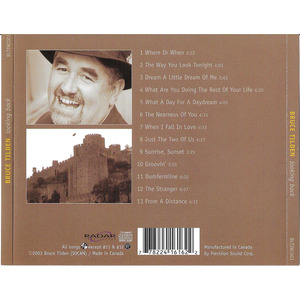
Bruce Tilden - Lookinn Back INLAY
Bruce Tilden - Lookinn Back BACK

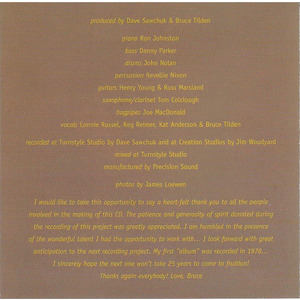
Bruce Tilden - Lookinn Back INSIDE
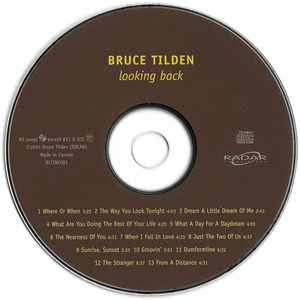
Bruce Tilden - Lookinn Back CD
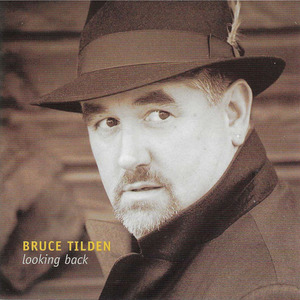
Looking Back
Media
Videos
0 videos
No videos available for this title.
Credits
Musicians
Ron Johnston: piano
Danny Parker: bass
John Nolan: drums
Revellie Nixon: percussion
Henry Young: guitars
Russ Marsland: guitars
Tom Colclough: saxophone, clarinet
Joe MacDonald: bagpipes
Connie Russel: vocals
Reg Reimer: vocals
Kat Anderson: vocals
Bruce Tilden: vocals
Songwriting
‘The Stranger’ written by Bruce Tilden
‘Dumfermline’ written by Rick McPhee
Production
Produced by Dave Sawchuk and Bruce Tilden
Recorded at Turnstyle Studio by Dave Sawchuk and at Creation Studios by Jim Woodyard
Mixed at Turnstyle Studio
Manufactured by Precision Sound
Artwork
Photos by James Loewen
Publishing
©2003 Bruce Tilden (SOCAN)
Notes
Made in Canada
BLTINC001
Radar Entertainment
Thanks
I would like to take this opportunity to say a heart-felt thank you to all the people involved in the making of this CD. The patience and generosity of spirit donated during the recording of this project was greatly appreciated. I am humbled in the presence of the wonderful talent I had the opportunity to work with... I look forward with great anticipation to the next recording project. My first “album” was recorded in 1978... I sincerely hope the next one won’t take 25 years to come to fruition!
Thanks again everybody! Love, Bruce
No Comments