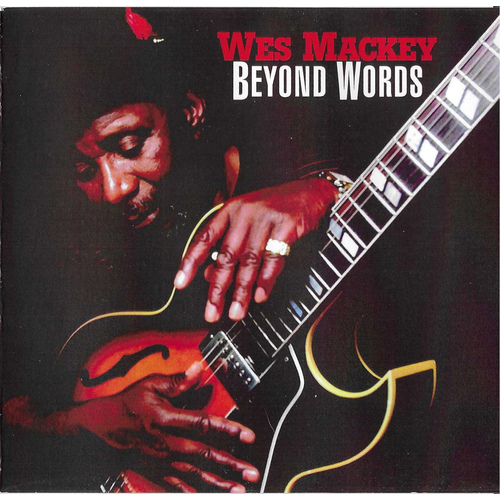
Album / Title
Beyond Words
By: Wes Mackey
Origin: Yemesse, South Carolina, 🇺🇸 → Halifax, Nova Scotia → Vancouver, British Columbia, 🇨🇦
Insight
Wes Mackey was a South Carolina-born blues singer, guitarist, songwriter and bandleader whose long road in music eventually made him a fixture of the Canadian blues scene. Born on December 12, 1942, in the Big State community near Yemassee, South Carolina, Mackey grew up around the Combahee River, where his father, a preacher, also worked as caretaker and guide at a fishing camp. The world he came from was rural, segregated and hard, but it was also full of music. Blues, gospel and the informal lessons of older Southern players formed the foundation of everything he later carried onto the stage.
At his father’s urging, Mackey left home as a young man and made his way to Augusta, Georgia. He bought his first guitar on credit, paying a dollar a week, and began learning from older musicians who had come out of the big-band and road-band tradition. Around Club Desoto on Ninth Street, those players taught him more than chords and songs. They showed him how to listen, how to carry himself on a bandstand, and how to survive the road as a professional musician. His first group, Guitar Wes and the Houserockers, played a juke joint gig that paid 50 cents and a chicken sandwich.
Those early Georgia years gave Mackey a working musician’s education. He later joined larger bands, including the Rock and Roll Kings, and played clubs across Georgia and the American South. In those settings he found himself around touring blues and R&B greats, and his own recollections and later profiles connect him with backing-band work for artists such as Muddy Waters, Jimmy Reed, John Lee Hooker, Stevie Wonder and others. It is best understood as the life of a sideman and road musician: learning fast, adapting to every room, and absorbing the older blues language first-hand.
Canada became the second great chapter of his life. Mackey first experienced the country during the Expo ’67 era and later made it his home, spending time in Halifax, Nova Scotia before eventually settling in Vancouver, British Columbia. There he became part of the West Coast blues community, working both as a solo act and with strong regional players. Toronto Blues Society later described him as a Vancouver bluesman with South Carolina roots who had restarted his solo career in Canada after years of sideman work in the United States.
On stage, Mackey had a style all his own. He could work as a bandleader, but he was also known as a one-man-band performer, singing, playing guitar and supplying his own steady rhythms on bass pedals. Reviewers often noted his seated stage posture, headset microphone, polished but unflashy guitar work and easy way of connecting with an audience. His singing was mellow and sincere, his guitar tone direct, and his approach was rooted more in feel than display. He could move through the room, draw people into the song, and make familiar blues material sound personal.
Mackey’s recording career in Canada began to gather strength with Second Chance, released in 2002 on Bluesline Entertainment & Music. The title was more than a slogan. It marked his return after difficult years away from music, and it presented him as a seasoned performer with a deep understanding of both traditional blues and contemporary R&B. The album included “Bluesman,” “Wham Bam,” “Solitary Midnight” and the title track, with songs written by Laura Fisher, Wes Mackey and others, and with contributions from musicians including Candus Churchill, Camille Henderson, Saffron Henderson, Peter Honeychurch, Robbie King, Jack Lavin, Darrell Mayes, David Say and Kenny “Blues Boss” Wayne.
Mr. Blues followed in 2005, placing Mackey’s identity plainly at the centre of the music. Its mixture of blues standards, soul-rooted material and original songs showed the range of a performer who could honour the older repertoire while still writing from his own experience. Songs such as “Born in Carolina,” “Who Do Da Voodoo?,” “Bright Lights Big City,” “A Change is Going to Come” and “In My Neighborhood” fit naturally into the larger story he was telling: the South, the road, memory, survival and the search for belonging.
By the time of Beyond Words in 2009, Mackey’s recordings were drawing more deeply on his Vancouver circle, with Laura Fisher continuing as a key creative partner. The album featured musicians such as Kenny “Blues Boss” Wayne, Dave “Hurricane” Hoerl, Christopher Allen, Loren Etkin, Chris Norquist, Sandy Scofield, Geoff Hicks and Dawn Pemberton. It also showed Mackey’s strength as a writer, with originals such as “Blues Shack,” “Beyond Words,” “Be A Man Boy” and “Full Moon In Lamanon.”
“Full Moon In Lamanon” carried a story of its own. In 2008, Mackey was honoured in Lamanon, Provence, receiving a “Citizen of Honor” medal connected to the song and his relationship with the town’s Festival des Alpilles. The honour underlined the unusual reach of his career. A musician who had begun in South Carolina juke joints had become warmly received in France, Germany, Luxembourg, Malaysia, Hong Kong and other international settings, while still remaining better known abroad than in much of North America.
Life Is a Journey, released in the early 2010s, brought the travelling theme fully into view. Songs such as “Thank You Carolina,” “Blue In Paris,” “Ganges Blues,” “Train,” “Blues Carry Me Home” and the title track looked back across the places, losses and turns that had shaped him. The album connected Carolina roots with international movement, including European imagery and wider world-music touches, while keeping Mackey’s blues voice at the centre. It was a mature late-career statement: reflective, soulful and personal.
In 2017, Back to the Shack: Retro Collection gathered material from his earlier recordings and underlined the part of his catalogue that Mackey considered closest to the blues. By then he was in his seventies, still recognized for his laid-back delivery, spare guitar phrasing and ability to make familiar blues forms feel lived-in rather than merely revived. Toronto Blues Society noted that the collection drew from four earlier discs and represented what Mackey called the “bluest of his blues.”
Wes Mackey died on February 15, 2019. He left behind a catalogue that deserves far more attention: a body of work rooted in the American South, rebuilt in Canada, and carried across the world by a musician who understood the blues not as a pose, but as experience, endurance and return.
-Robert Williston
Gallery
Images
3 images
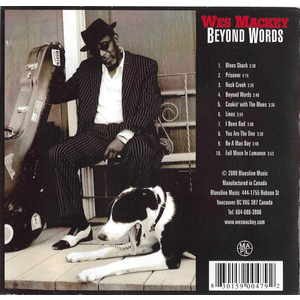
Wes Mackey - Beyond Words BACK
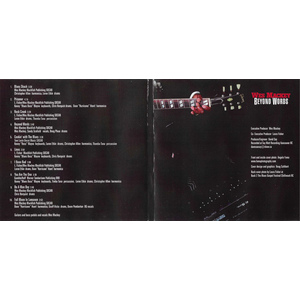
Wes Mackey - Beyond Words INSIDE FOLDOUT
Beyond Words
Media
Videos
0 videos
No videos available for this title.
Credits
Songwriting
“Blues Shack” written by Wes Mackey
“Prisoner” written by Laura Fisher and Wes Mackey
“Rock Creek” written by Laura Fisher and Wes Mackey
“Beyond Words” written by Wes Mackey
“Cookin’ with The Blues” written by Tom Lavin
“Lines” written by Laura Fisher
“I Been Bad” written by Laura Fisher and Wes Mackey
“You Are The One” written by Kenny Gamble and Leon Huff
“Be A Man Boy” written by Wes Mackey
“Full Moon In Lamanon” written by Wes Mackey
Musicians
Wes Mackey: guitars, bass pedals, vocals
Christopher Allen: harmonica
Loren Etkin: drums
Kenny “Blues Boss” Wayne: keyboards
Chris Norquist: drums
Dave “Hurricane” Hoerl: harmonica
Themba Tana: percussion
Sandy Scofield: vocals
Doug Ploux: drums
Loren Etkin: drums
Geoff Hicks: drums
Dawn Pemberton: background vocals
Production
Executive producer Wes Mackey
Co-executive producer Laura Fisher
Produced and engineered by David Say
Recorded at Say Watt Recording, Vancouver, British Columbia
Artwork
Front and inside cover photo by Angela Fama
Cover design and graphics by Doug Cuthbert
Back cover photo by Laura Fisher
Release Info
© 2009 Bluesline Music
Manufactured in Canada
Bluesline Music, 444-1755 Robson St., Vancouver, British Columbia, V6G 3B7, Canada
www.wesmackey.com
No Comments