Insight
Liner notes
Yiddish Glory
Life and Fate of Soviet Jewish Folk Music During World War II
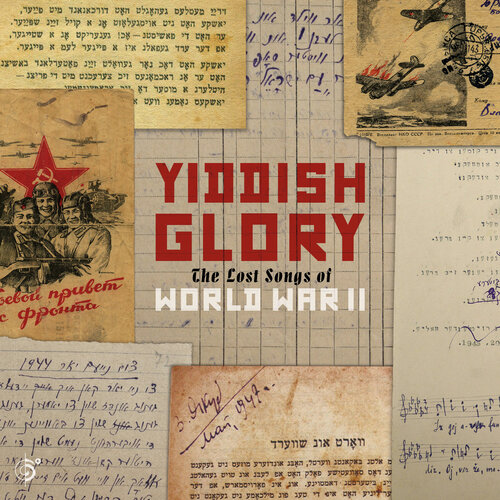
As World War II raged through Europe, a group of Soviet Yiddish scholars embarked on an ambitious goal to preserve Jewish culture of the 1940s. Soviet ethnomusicologists from the Kiev Cabinet for Jewish Culture, led by Moisei Beregovsky (1892 – 1961), recorded hundreds of new Yiddish songs: tunes that detailed Soviet Jewish wartime service in the Red Army, survival and death in Nazi-occupied Europe and stories from those working in the Soviet home front in Central Asia, Ural Mountains and Siberia. Beregovsky and his colleague Ruvim Lerner (1912 – 1972) hoped to publish an anthology of these songs, but the project was never completed as Beregovsky was arrested in the height of Stalin’s anti-Jewish purge. The documents were sealed. The scholars died thinking that their work had been lost and destroyed.
In the 1990s, librarians of the Vernadsky National Library of Ukraine found unnamed boxes with these documents. Librarian Lyudmila Sholokhova created the first catalogue since the original one was destroyed in the 1940s.
In the early 2000s, a lucky coincidence brought Anna Shternshis to Kiev where she found out that these songs had survived all of these decades following Beregovsky’s arrest. Quickly deteriorating, fragile documents, some typed, but most hand-written on paper, presented a challenge. But upon quick examination of the material, it turned out that these contained some of the most poignant and historically important Soviet Yiddish songs of World War II. None of them have been performed since 1947.
The archive was a bombshell that challenged the established wisdom of how Soviet Jews made sense of World War II. Many songs turned out to be the first grassroot testimonies of the German atrocities. Their authors used music and poetry to describe violence and destruction that could not be easily comprehended or described in prose. Some songs were written by Red Army soldiers fighting in the trenches (representing some experiences of the approximately 440,000 Jews enlisted during World War II), others by women and men who anxiously waited for these soldiers to return (about 1.4 million Soviet Jews survived the war in Soviet Central Asia and Siberia), yet others by Jews in occupied Ukraine and other parts of the Soviet Union (over 2.5 million Jews were killed in the European part of the Soviet Union).
Some songs in the archive did indeed have their melodies preserved, however most were simply lyrics. Shternshis and Dr. Pavel Lion, better known under his artistic name Psoy Korolenko, worked together to bring these songs to both academic and popular audiences in 21st century North America and Europe. Psoy Korolenko engaged in “musical archeology,” and analyzed the scarce supplementary notes, contextualized the lyrics and then took a leap of imagination in order to create or adapt music for the texts, all originally written by amateur authors. Violinist and composer Sergei Erdenko then created multi-instrument arrangements and composed original music for one song (“Kazakstan”). Producer Dan Rosenberg brought together an all-star band, which consisted of five vocalists (including Juno-award winner Sophie Milman), and five conservatory trained classical instrumentalists with decades of experience performing and researching folk music. The album “Yiddish Glory” is the fruit of this three-year-long process. For the first time, the public will hear the voices of the Soviet Jews who were thought to be silenced by Hitler and Stalin.
1. Afn Hoykhn Barg - On The High Mountain
Lyrics: Veli Shargorodskii, born in Odessa, 42 years old, recorded by Sholem Kupershmidt in the summer of 1944, in Krasnogvardeiskoe, Uzbekistan.
Music: Folk song with additional instrumental parts and arrangement by Sergei Erdenko.
The song comments on events of 1943-44, and satirizes Hitler’s failed attempts to seize the natural resources of Ukraine, such as coal and oil, as well as his failure to capture Crimea. The lyrics point to an old Yiddish “counting” riddle that sarcastically refers to impious Jews as taychalakh [Germans].* But in Veli Shargorodskii’s version, the daych is a real German, and the song fights against German fascism. The tune combines both this famous folk piece and a stylized part of an old German march, added by Sergei Erdenko, to accentuate the German word “kaput,” used at the end of the song (Hitler is Kaput!). This folk song was previously incorporated into Alexander Krein’s (1883-1951) version of “Afn hoykhn barg” (On the High Mountain).
Source: Vernadsky National Library of Ukraine, Manuscript Department, fond 190, delo 150, pp. 105-106.
*We thank Itzik Gottesman for pointing out the connection between the versions of the lyrics.
On the high mountains, and on the
green fields
The Germans are shuffling around with
their faces fallen.
“How have you been greeted, dearest
Germans, so esteemed?”
“Akh, [the Soviets] showed us the way out
from Crimea.”
“Stop with your sulking, don’t be so upset,
What happened in the Caucasus,
and what’s with Donbas?”
“Nu, Hitler had plans for businesses there:
Dig out the coal, pump out the oil,
Nu, but the Russians -- they blocked
our route,
And so we were forced to run away.”
“Tell us about Ukraine, what sent you
away [from there]?”
“We didn’t get a lick of honey
[in Ukraine] either.”
On the high mountains, and on the
green fields
The Germans are shuffling around with
their faces fallen.
“Look at what bumbling soldiers you
are now!”
“Ah, misery and woe are upon us from
all sides!
We’re out of options -- it’s not
looking good,
Germany is in trouble, Hitler is kaput!”
2. Shpatsir in vald - A Walk in the Forest
Lyrics: Klara Sheynis, a tailor from Odessa, 25 years old, Cheboksary, 1944.
Music: Folk song with intro and arrangement by Sergei Erdenko. Song includes fragments from “Amurskie Volny” (1903) by Maks Kyuss (1874 – 1942) and “Blue Hankercief (Sinii Platochek)” (1942) by Ezhi Peterburgsky (1895 – 1979).
A farewell love song, written as a dialogue between a young draftee, about to be sent off to war, and his sweetheart, who is staying behind to wait for him. This highly-charged erotic song calls for revenge against fascists with merciless fighting. The instrumental parts rely on both popular prewar love songs and war tunes. Merging the original Yiddish melody with Soviet ones transports the listener into the atmosphere of the Soviet 1940s. This folk song was discovered by Hersh Kleyner.
Source: Vernadsky National Library of Ukraine, Manuscript Department, fond 190, delo 150, p. 2.
“We went out for the first time yesterday
To collect berries in the forest.
Be well my beautiful beloved,
Soon I will leave [to fight] on the frontlines...”
“We went for a walk in the forest
To pick little blossoms and flowers.
Oh my dearest one, my darling,
Return from the frontlines in one piece.
“The day begins, my love,
The stars will soon extinguish,
I will attack Hitler until he’s wiped out
And then I will return home [to you].”
“See, the sun is already rising,
The world will soon be full of light.
Go, take revenge on the fascists,
My hero will come back with a badge
of honor...”
“I will return with a badge of honor,
And with a spring in my step...
Dearest! Enough with the goodbyes,
Go, and have a quick journey home.”
“I will go and return home,
And [there] I will remain faithful to you,
I only [ask], dearest love of mine,
That you write me letters...”
3. Yoshke fun Odes - Yoshke from Odessa
Lyrics: Berta Flaksman, Zhitomir, 1943
Music: Based on “The Skylark” (1840) by Mikhail Glinka (1804 – 1857), with additional sections composed by Sergei Erdenko.
Red Army songs were often written to help motivate soldiers to fight against the German Army. Yoshke from Odessa, the protagonist of the song, is exceptionally brave and brutal. He slices his enemies into pieces like a butcher. Yiddish songs like this one tried to debunk the antisemitic myth that Jews do not fight in war, but rely on others to defend them. It is also understood, although not too explicitly, that Yoshke is fighting to avenge his brutally murdered Jewish family.
The tune, “The Skylark,” originally composed in the 19th century, was chosen for a number of reasons. The compositions of Mikhail Glinka, who is often credited as the founder of the Russian classical school of music, enjoyed tremendous popularity in the 1930s. In particular, his song “The Skylark,” originally composed in 1840, was in the repertoire of many Soviet tenors, including Sergei Lemeshev. In the 1940s, Yiddish tenors, such as Zinovy Shulman, Solomon Khromchenko and Misha Alexandrovich, performed such songs as well. It was quite easy to imagine a Yiddish speaking amateur author incorporating “The Skylark” for a performance of Yoshke from Odessa.
Source: Kupershmid, Sh. Folkslider Vegn Der Felerlendisher Milkhome. Moscow: Melukhe-farlag “Der emes,” 1944, p.14.
I’ll sing songs about today’s battle
So the whole world will resound with [the] music.
How it played out there with Yoshke, from Odessa,
How he sparred with the Germans, knife [in hand].
When he saw for himself the murderous sorrow
He quickly swore: [he would] shorten their lines.
Oh, you Germans, you fancy yourselves as such
impressive butchers!*
We’ll slice strips from you,
as [we would] from a non-kosher animal!
For the nursing child, whom you’ve buried alive
You will, dirty scoundrels,
receive your final punishment.
Because you’ve desolated and destroyed our
beautiful city,
I will not guarantee your lives.
For three full days he hailed them down,
firing one after the other.
Yoshke didn’t stop firing bullets from his rifle,
He bashed those fascists without a care -- not a bit
of respect!
The mutilated bodies fell near the half-dead
covering the earth.
Yoshke only wanted to save his Fatherland.
Showing no mercy, he sorted things out
with the fascists,
Gave Hitler a strong lesson to remember him by.
Yoshke’s name will be praised and forever bring
[his enemies] shame.
*The Yiddish word translates to “non-kosher butcher”
4. Kazakhstan
Lyrics: Anonymous, recorded by Y. Merzon, Saratovka, Ala, Kazakhstan, in a letter, 15 May, 1946.
Music and Arrangement: Sergei Erdenko
Probably written by a refugee, or perhaps, one of 250,000 who survived the war in the Soviet Union, the song expresses gratitude to the land of Kazakhstan that became their home. Called by the Nazis to “Listen, you filthy Jews of Moscow,” evokes a verse from Jeremiah 30:10 and 46:27, meaning, “Have no fear, Jacob, my servant.” It is unusual that the phrase is rendered in Russian, and reads: “Have no fear Jacob my servant, do not be dismayed Israel.” A deconstruction of “I will surely save you out of a distant place, your descendants from the land of their exile” from Jeremiah articulates the emergence of a Soviet Jewish identity. The phrase is also the chorus of a well-known song of the Malevich Choir. The mountain might be a reference to Mount Ala in the Alatav mountains of Kazakhstan and Kyrgyzstan.
This is the only piece on the album that features a newly composed tune; it is one that combines Roma, Yiddish and Romanian styles, to reflect on the internationalism expressed in the original text. The original tune was probably familiar to Soviet Jews, and familiar to Isaac Babel’s Odessa Peace carries special significance to two vocalists: Sophie Milman’s grandmother survived the war as one of Soviet refugees in Kazakhstan. Milman wanted to draw attention to women’s contributions to the Soviet war effort. Sergei Erdenko wanted to address the plight of the Roma, who were persecuted and murdered alongside many other groups by the Nazis.
*We thank Tolke Felshtein for finding resonance with the Biblical verse.
Source: Vernadsky National Library of Ukraine, Manuscript Department, fond 190, delo 151, pp. 64 – 65.
It was a storm wind,
A storm wind
That brought me into Asia.
And by now I’ve learned very well,
Very well,
That this land exists, [called] Kazakhstan,
Kazakhstan.
What a land it is,
A land it is,
Surrounded by mountains, like a wall,
Like a wall.
Mountains with craggy tips and peaks,
Blanketed over with white snow.
There, thunder and lightning crackle out
And angry winds swirl loose from
[the peaks].
Tell me mountain, what you want from me,
Oh, from me?
Do you, [like the Germans] hate me too,
Oh, hate me too?
I’ve already suffered endlessly,
Oh, endlessly.
From the day I was born until this day,
Oh, until this day.
Look, I’ve arrived here naked and sickly,
Only with little pieces of scraps.
I run away from the murderers
and the slaughterers
From that cursed German, Hitler.
And the mountain speaks to me,
It speaks to me,
[Saying]: “Enough of this crying
and complaining,
Have no fear, Jacob, my servant, don’t
have any fears.
We are Soviet mountains, and we know
Lenin’s Torah.
All people are brothers,
From one father, and from one mother.
We are all a part of the same family,
Living in the shade of my shadow together.
A Kazakh and a Kalmyk,
An Uyghur and a Tajik,
Korean, Roma, Ukrainian,
Kyrgyz, Ossetian, and Georgian.
Now [that you’re here], the family has
another member.
Please be our welcome guest.
You are our brother, dear Jew,
Even though the enemy hates you
so much.
Oh, you will be a beloved brother
in our family,
Oh, and you will take a plow
[in your hand].
5. Mayn Pulemyot - My Machine Gun
Lyrics: Sent in a letter and written down (but does not say from whom) by Mendel Man (1916-1975), a teacher, Polish Yiddish poet, translator and artist, in Veliki Luk, Zhitomir region. (This is the location recorded in the document, but it is not clear whether this is an actual place or a mistake).
Music: Psoy Korolenko, based on traditional klezmer tunes, with instrumental parts and arrangement by Sergei Erdenko.
Written from the point of view of a Polish Jewish soldier in the Red Army, the song expresses pride in holding a machine gun, used to kill Germans. The author praises his ability to avenge destroyed houses, families, and shtetl. In preparing the song for intended publication in the 1940s, censors replaced the line “so that my people should live” with “so that our peoples should live,” thus erasing the overly nationalistic tone of the original. In order to honor both the author of the song, and the scholars who prepared it for publication, listeners will hear both versions within this track.
The klezmer tune was chosen for the song to highlight the importance of Jewish images, as well as hint at the tension between the Soviet and Jewish contexts of this song.
Source: Vernadsky National Library of Ukraine, Manuscript Department, fond 190, delo 322, p. 44.
I lie beside my machine gun
And softly sing a Yiddish tune.
All around me, everything is quiet,
The only sound is the swish of the grasses.
I remember the joy of my shtetl,
Who wouldn’t recognize it?
Now it’s been emptied out,
there are no people left,
Oh, all the houses have been burned.
But [luckily] the Red Army is here
And she gave me a machine gun.
I fire at the Germans, again and again,
So that my people can live freely.
(So that all people should be free.)
Oh, you vicious cannibals, feasting
on humans,
Oh, you German bandits!
Hey, machine gun, aim for the target,
Not a single German should be left alive.
6. Shelikhmonec Hitlern - Purim Gifts For Hitler
Lyrics: Anonymous, recorded by Y. Merzon, Alma-Ata, Kazakhstan, 1945
Music: Based on the song “Bin ikh mir a Shnayder” [I am a Little Tailor], by Zelig Bardichever (1903 – 1937) with instrumental parts and arrangement by Sergei Erdenko.
The song compares Hitler with other (failed) enemies of the Jewish people, such as Haman, the biblical figure described in the book of Esther, who plotted to kill all of the Jews in ancient Persia, Antiochus IV Epiphanes (born c. 215 BC - died 164 BC), known for his persecution of ancient Jews, a tale that is recounted during the Jewish holiday of Chanukah, Tomas of Torquemada (1420 – 1498), the head of Spanish Inquisition, and Pavel Krushevan (1860 – 1909), the alleged author of the Protocols of the Elders of Zion. The song relies on imagery of Purim, a Jewish holiday that celebrates the ultimate and miraculous victory over a king who plotted to destroy the Jews. Importantly, the song lists the atrocities committed against Jewish people, and promises cruel revenge. The last line of the song “Am Yisroel Hai” - “Let the People of Israel Live” - was originally added by Psoy, as the publisher-ready version that we used did not have it. We noticed that one final line that would rhyme with “say vi say” seemed to be missing. To our delight, when we later discovered the field version of the song, it turned out that “Am Yisroel Hai” was originally there, and was taken out by editors, probably due to censorship demands. In effect, we did not simply add the line to fix the verse, but de-facto restored the original song.
Source: Vernadsky National Library of Ukraine, Manuscript Department, fond 190, delo 151, p. 73.
You’re not my first enemy,
Before you I’ve had many others.
I only need to add your name
To this little note, the one that begins
with “Haman.”
Haman, Antiochus, Torquemada,
Krushevan,
Were provoking the world long before
you [arrived].
A longer note -- Haman’s -- already exists,
There wouldn’t be enough paper
[for yours]...
You all set a goal
To erase me from the world.
Except...[my fate] does not depend on you,
Stalin has already tied your hands.
You’ve burned my joyful home
And disgraced my daughters.
You’ve trampled my infants
And sworn to get rid of me too.
Your angry dreams are wild and silly.
We’re alive! And [we] will survive
no matter what.
Your bleary end will be on Haman’s tree
While the Jewish people live on and on!
7. Taybls Briv - Taybl’s Letter To Her Husband At The Front
Lyrics: Taybl Birman, a 28-year-old tailor, Minsk, recorded by Hersh Kleyner, 1944.
Music: Based on a song “Tachanka” (Tank) (1936), composed by Konstantin Listov (1900 – 1983), arrangement by Sergei Erdenko.
Almost seventeen million people, many of them women, worked 12 to 18 hour shifts in industries located in the Soviet rear -- they manufactured military equipment, clothes, anything that could be used to help the war effort. Written from the point of view of one such female worker, the song encourages her husband, a Red Army soldier, to kill as many Germans as possible. The words “kill them without mercy” resonate with the most influential piece ever published in the Soviet press, Ilya Ehrenburg’s article “Kill the German” (1942). In it, Ehrenburg stated that Germans were not humans, and should be killed without any hesitation. Quotes from this article were included in songs, sayings, riddles and ditties composed in almost all languages of the Soviet Union, including this Yiddish one. Another noteworthy image of the song is the sewing of a burial shroud for Hitler, which serves as a metaphor for a joint effort between the home front and those in combat in defeating fascism. The song relies on Soviet tunes that were written by Jewish composers, which were popular during the war. This version of the song includes fragments of “Ekh Dorogi” (Ah, Roads!) (1945), by Anatoly Novikov (1896 – 1984).
Source: Vernadsky National Library of Ukraine, Manuscript Department, fond 190, delo 151, p. 15
I’m sitting in the factory
Beside my beloved sewing machine,
While you, my husband, [are] among heroes
Out there attacking Berlin.
I’m sewing Hitler a burial shroud,
Singing a little song and darning.*
My Misha dearest, you will arrive
[in Berlin]
And split open all of their heads.
Slash them, smash them, have no mercy,
Take revenge for us all,
[So that] all the Germans may lie
Deep, deep in the earth.
Misha! Kill them all, until the last one [is dead].
Not a single [German] should come back.
[Then] we will have our free lives
once again.
Our joy and our peace, undisturbed.
*Darning is a form of sewing to repair holes with interwoven stitches
8. Misha Tserayst Hitlers Daytchland - Misha Tears Apart Hitler’s Germany
Lyrics: Taybl Birman, a 28-year-old tailor from Odessa, recorded by Hersh Kleyner. She told Kleyner that this song was written by her husband, who sent it in a letter from the front, as a response to her letter/song “I Sit in the Tailor Shop” (Track 7).
Music: Based on a combination of the folk song “Tum Balalayka” (exact date not known, first recorded in 1940) and “Katyusha” (1938), by Matvey Blanter (1903 - 1990) with instrumental parts and arrangement by Sergei Erdenko.
The song, like almost no other in this album, highlights the uniqueness of Soviet Yiddish wartime culture - it fully departs from lamenting and longing, and calls for direct violent action. Portraying Germans as poisoned mice and wild animals was common in Red Army songs and folklore, as was the graphic description of violence. The call for revenge is unapologetic and unambiguous, and it fits very well with the spirit of its time.
The decision to use the combination of “Tum Balalayka,” arguably the most popular Russian Yiddish folksong and “Katyusha,” a cult Soviet wartime song, was to highlight the Russian, Soviet and Yiddish elements of the piece. Written by Matvey Blanter, a Soviet composer of Jewish origin, the original “Katyusha” features a young woman, who writes a letter for her husband, a border guard. “Tum Balalayka,” although also a love song, is here because in some ways, it stands for what most Russian Jews perceive as Yiddish culture today. We have taken this association one step further and inserted it into a song that emphasizes the heroism of the Jewish Red Army soldiers. Besides, in the process, we were pleasantly surprised to discover that melodically, “Katyusha” and “Tum Balalayka” go really well together! This song also contains fragments of “Tachanka” (see track 7).
Source: Vernadsky National Library of Ukraine, Manuscript Department, fond 190, delo 151, p.17.
Taybele, my wife, please know,
I am now in East Prussia.
We will tear Hitler’s Germany apart
Very soon, into the tiniest pieces.
And we will surely destroy them
Just as they’ve caused great
destruction to us.
My Taybl, you will see
How they run just like mice.
They’ll run like poisoned mice
Into the holes and the cracks
[of the wall].
But we will search them [out]
And they won’t be able to hide.
We will quickly, quickly clear them out,
All the hatred, the brown plague
of fascists.
We will strike down Hitler
Like a wild animal in her burrow .
Then no one will disrupt
Our happiness and our peace.
Have patience, my dearest wife,
Wait just a little bit longer.
9. Chuvashter Tekhter - Daughters Of Chuvashia
Lyrics: Sonya Roznberg, a young Communist League member from Kharkov, 1942, Cheboksary, Chuvashia Region of Russia (approximately 700 km east of Moscow).
Music: Unknown, with instrumental parts and arrangement by Sergei Erdenko.
This was one of the few songs in the collection that included original sheet music. It describes Chuvashia, a region that did not have a significant Jewish community until 1941. “Daughters of Chuvashia” tells the story of the draft and service of women in the Red Army. About 900,000 Soviet women engaged in combat during World War II. Women served in medical and provision units, but also as pilots, spies and even infantry members. The soft melody does not mask the firm determination of women soldiers to fight against Hitler and his ideology. The final part is inspired by Rio Rita, an American song from the Broadway musical Rio Rita (1927), composed by Harry Tierney (1890 – 1965). Chuvashter Tekhter was first collected by Hersh Kleyner.
Source: Vernadsky National Library of Ukraine, Manuscript Department, fond 190, delo 151, pp. 21
The stars ask me [to speak]: “Tell us!
Who is marching so late at night?”
The answer: “Chuvash daughters
Preparing themselves to go into battle.”
“Only listen to the steadiness of their step,
How our victory rings in its rhythm,
How inspiring she is, their song,
How joyful she is, their chant!”
The stars wink above us:
“We haven’t seen anything like it.
Let us hear what they are singing,
And with courage [we’ll] enter
into battle.”
Up in heaven, the stars hear [the song]:
“We gave our promise
Not to rest nor catch one bit of sleep,
To spare nothing -- not even this life.”
“Our enemies must know
[That] we’ve lifted a hand
[To] the fascists -- a death for a death,
For Stalin, the fight, for the land!”
Just as the song was ending
The star’s light went out.
As quickly as it was heaven-sent
To greet the Chuvash daughters.
10. Mames Gruv - My Mother’s Grave
Lyrics: Valya Roylender, 10 years old, Bratislov, Ukraine, 20 August, 1945.
Music: Based on the folksong “Ver Zhe Klapt Do in Mayn Tir” (Itsik Fefer and Beregovsky, p. 132),* in a modified version by Valia Roylender, with instrumental parts and arrangement by Sergei Erdenko.
The song details the grieving of a young child who loses his mother. He walks away from her grave knowing he’ll never see her again and realizes that she will never be able to tuck him in at night. The song probably resonated not only with children, but also with soldiers and other adults who survived the war but lost their parents and grandparents to the violence. Soviet Jewish elders were among the first ones to be murdered by the German Army. The feelings of guilt and powerlessness are especially prominent in Soviet Yiddish songs of survivors. On the album, we decided to feature a 12-year-old singer to provide a more authentic listening experience.
*We thank Sasha Lurje for pointing out his original tune to us.
Source: Vernadsky National Library of Ukraine, Manuscript Department, fond 190, delo 321, p. 37; also published in Bret Werb, Fourteen Shoah Songbooks, p. 98.
I leave behind my mother’s grave.
Mama, I won’t return to you again.
Oh mama, who will wake me up
[in the mornings]?
Oh mama, who will tuck me in [at night]?
“The morningstar will wake you, [my child],
The rainbow will cover you [at nights].
I roam around, like the sheep in the field,
Yet I can’t ever arrive at any shore.”
I never saw my mother again.
They drove her to [her death];
to the other side.
But the bitter suffering will soon come
to an end,
The enemy will be snatched and defeated.
11. Babi Yar
Lyrics: Golda Rovinskaya, 73 years old, Kiev, 22 June, 1947, recorded by Hina Shargorodsky.
Music: Based on “In droysn geyt a regn,” a folk song, with instrumental parts and arrangement by Sergei Erdenko.
The song is likely based on eyewitness accounts of the massacre in Babi Yar, the ravine near Kiev, where 33,771 Jews were shot on September 29-30, 1941. Witnesses reported blood pouring through the streets, gunshots throughout the day and night, and other atrocities, which are described in the song. The song probably also tells us something about 1947, in addition to 1941. It hints at the immediate post-war ethnic tension between Jews, returning from the Soviet rear, and facing hostility from their former neighbors, who were not generally too happy about their return. The line “as long as they live, they will not see their victory in our land” probably signals the fear of a return of German-inspired antisemitism.
The tune of “In droysn geyt a regn” was chosen not only because it seemed to fit beautifully with the poignant lyrics, but also because it resonated with the original song, which lamented lost love. Rovinskaya’s song was also a lament but it mourned the loss of an entire community.
This melody was learned and recorded in New York by Michael Alpert (born in 1955), an American klezmer composer and performer, in the early 1980s, from Bronya Sakina (1910-1988), b. Olvanisk (Holovanivsky/Golovaneysk), southwestern Ukraine.
Source: Vernadsky National Library of Ukraine, Manuscript Department, fond 190, delo 150, pp. 11-12.
I am bursting with happiness as I leave the
front[lines],
[Overjoyed] that I am still alive,
Oh, but when I return to my city and ask
about my loved ones.
They answer me, “none are left [alive].”
I am left standing still; overcome with grief,
My heart splitting open with sadness.
Oh, no matter where I look, I just see
that pair,
My wife with my one and only child.
What hardships we’ve endured!
What kind of great evil decree is this?
Oh, from this misfortune, so many have
fled [the city],
The ones left are lying [dead] in Babi Yar.
By night and by day the gunshots shattered,
The people saw their own deaths approaching.
Oh, blood gushed out from all sides,
The earth was stained red from
[all the] blood.
This terrible pain is with us forever:
That the Germans have spilled
so much blood.
Oh, the earth will be eternally sealed with
our tears.
[Our cries:] those [still] living should be safe.
But our enemy is searching for yet another
[victim]
To wipe away with one swipe.
Oh, as long as they are alive they won’t
fulfill this.
They won’t ever step foot in our land.
12. Tulchin
Lyrics: Yosef Broverman, 16 years old, an 8th grade student in a Ukrainian school. He was in the Pechora camp until September 1943, then sent to work on peat excavation. He wrote the song in 1942 when he was still in the camp. Tulchin, 3 September, 1945.
Music: Based on Alfred Schnittke (1934 – 1998)’s “Mary’s Song” from the TV-series “Little Tragedies” (1979), arrangement by Mikhail Savichev.
A rare ballad of destruction, written during the killings of 1942, it documents the tragedy of Tulchin, a small Ukrainian town, which lost its entire pre-war Jewish population during World War II. The song testifies to violence, cruelty, hopelessness, hunger, and devastation. It visualizes countless orphans, all destined to be killed in Pechora, the nearby ghetto/camp, where thousands were abused and starved to death during the war. The last verse of the song was added later, either by censors or by collection editors. It encouraged revenge and fighting with rifles in hand. Without the verse the song would have lacked the call for resistance, and therefore would have not have fitted into the official Soviet narrative during the war.
Schnittke’s tune, written almost 25 years after the lyrics, was chosen because the original “Mary’s Song”* also told a story of destruction – of a small village in Europe, due to the Black Plague of 1348. In addition to striking similarities in structures and tragic imagery of both songs – the lyrics to “Mary’s Song” were written by the nineteenth century poet Alexander Pushkin – we wanted to hint at the common description of the enemy as a plague. “Mary’s Song” lamented victims of the disease, whereas this one condemned fascism, often referred to as the “Brown Plague.”
*The original tune of this song, discovered after the current recording had been completed, was a Russian folk Cossack song about Stepan Razin (17th century, one of the most popular Russian songs ever written, performed by Fedor Shaliapin in 1908. The album does not feature this tune, but uses Schnittke’s tune instead.
Source: Vernadsky National Library of Ukraine, Manuscript Department, fond 190, delo 321, p. 4 and p.6.
I remind myself, just once more
Of how it used to be.
Our [old] luck, our [old] lives,
How bright it once was for us.
Our suffering [and] our crying
Have no relief, no end in sight.
Oh, oh, my youthful years
The Germans have stolen away.
But even now all around the budding trees
Everything is blossoming, blooming,
growing green.
As our lives used to flourish,
Back then, in Tulchin.
The time comes when the trees
Shed all the beautiful blossoms,
Just like this fickle, fleeting life of ours
[Which] is now losing its bloom.
Wherever you look, wherever you go
People wander about the paths...
But our lives will be bright again.
Just like [they] were, in those old days.
Oh, the lonely orphans
Wander around alone.
And that bloody word “death”
Surrounds you wherever you go.
The people fall [dead] like flies,
Just from hunger, and from [the] cold.
Our suffering [and] our sorrows
Will soon be known to the whole world.
Such loss will never happen again,
[This waste of] innocent Jewish blood,
[The blood] that’s now spilling
In Europe, at the [hands] of the bandits.
It is because of [them] that people wander
On the paths to Pechora.
Let us shine our light-filled lives
From the previous days.
Let us respond to the murders:
Brothers, [we will] resist with an uprising,
We will take charge, brothers,
With rifles in our hands.
13. A Shturemvint - A Storm Wind
Lyrics: Aba Shteinberg, a shoemaker from Berdichev, Uzbekistan, 1942.
Music: Based on the Yiddish folk song “Chiribim Chiribom” and “K’vakaras” (mid-1920s), by Yossele Rosenblatt (1882 – 1933) with instrumental parts and arrangement by Sergei Erdenko.
Without identifying the violence or mentioning Jewish victims or heroes of the war, the song calls for the eternal end of fascism. The dramatic effect is reached through weather metaphors: hail, storm and floods are used to describe the invasion, but ultimately, the song ends with a rainbow, the ultimate symbol of peace.
The Jewish melody of “Chiribim” was selected because the original tune also features a miraculous interaction between the rain and the rainbow. The cantorial fragments hint at the challenges of retaining one’s faith during difficult times.
Source: Kupershmid, Sh. Folkslider Vegn Der Farlendisher Milkhome. Moscow: Melukhe-farlag “Der emes,” 1944, p. 21.
A storm wind, a storm wind
With thunder and [with] lightning,
A peaceful quiet will fall over the world
When we weed out the fascists.
Pouring rain, pouring rain,
Drowning all the paths.
As long as the fascists are glowing
with rage
They will continue fighting.
Hail falls, hail falls,
[Hail] of fire, pitch and brimstone.
As long as Hitler is still breathing
Life cannot be sweet.
The deluge floods in, and pours,
and pours.
The storm clouds thick and tense.
When all the wretched is washed away
The rainbow will come out.
14. Fir Zin - Four Sons
Lyrics: Nokhem Royznvaser, 44 years old, from Berdichev, recorded by Sholem Kupershmid, 1945.
Music: Based on “North Hunter” (1949) by Natalia Levi (1901 – 1972) and urban Soviet folk tunes, arrangement by Artur Gorbenko.
The song focuses on a devastated father, whose four sons are fighting against Hitler. One of them is killed in battle, and another one continues to fight. We do not learn about the other two. The song does not spare curse words for Hitler and warmly praises Joseph Stalin (1878 – 1953) -- now known as the Soviet dictator -- but at that time referred to as a powerful force against fascism. The tune of the last verse was written by Natalia Levi (for a different song) to celebrate the 70th birthday of Joseph Stalin.
Source: Vernadsky National Library of Ukraine, Manuscript Department, fond 190, delo 150, pp. 98-99.
At night in my bed
I can’t catch a wink of sleep,
I’m mulling over the past
[Everything] from “A” to “Z.”
The world had never heard of
Murders quite like this
Until that bastard Hitler
Changed that for all of us.
These thoughts don’t allow me
A minute’s rest or peace --
[I have] four sons in the war,
My own flesh and blood.
They’ve been in the middle of the fire
From the [war’s] start until today.
They haven’t spared a single gunshot
For the sleazy, slithering enemy.
One of [my sons] is in the Guard,
A young man with a sharp mind,
He became a hero
Of the Soviet land.
Oh, the other had his [life] snipped
A young sapling with blossoms,
And I, the aging father
[Try and] find some peace.
I was thrown out of my home,
Wandered [far] from my city.
The anguish boils inside me,
It burns me until I am consumed by it.
Oh, where can we find the strength?
My hands are weak --
At night [I’m lying] in my bed.
[But] I would rather [use] the night to shoot bullets,
Destroy my enemy’s entire core.
Until after we’ve chased [our enemy]
With every last bullet,
The Angel of Death
Will not close his mouth.
And when that day arrives
There will be a great joy.
And with songs of praise
I will come out to greet Stalin.
15. Kazakhstan Reprise
See notes to track 5
16. Nitsokhn Lid - Victory Song
Lyrics: Kh. Urintsov, 1945, recorded by Ruvim Lerner, 11 September, 1947. The beginning of the song is lost.
Music: Medley based on Yiddish and Soviet folk songs with instrumental parts and arrangement by Sergei Erdenko.
In 1945, Yiddish folklore entered a celebratory phase – it praised Soviet soldiers and their devotion to country. It encouraged people to rejoice, dance and start peaceful lives. The combination of Yiddish festive tunes and a popular Cossack song create a complex spirit of joy, both for the survival of Jewish people and the Soviet Union in general.
The tunes used for the medley include “A Glezele Lekhayim,” music by Joseph Rumshinsky (1881–1956), “Hopkele” by Alexander Olshanetsky (1892–1946) and “Lyubo, Bratsy, Lyubo” (a folk song of Russian Cossacks, which appeared in the movie “Alexander Parkhomenko,” 1942).
Source: Vernadsky National Library of Ukraine, Manuscript Department, fond 190, delo 321, p. 5 and p. 11.
The end will soon arrive,
[The end] of suffering and of pain.
You [Germans] will beat [your chests,
saying] “I have sinned,”
And you will gnash your teeth
When you see what evil was done to us.
Now clink glass after shot glass
And grab your young wife Rayzel.
Go, join the dance floor,
and have a little twirl,
Because you will have your fill of drinking,
The liquor will keep flowing
And we’re going [to dance]
a Jewish bulgar.
Now come and be joyful
And have another drink --
Because those German murderers
Will be out of our lives forever.
This Soviet land
With its Stalinist hand
Will show what it can.
Drink yet another l’chaim
For the Red Army
And give a toast to them all
That they should be healthy and well,
And toast the comrade Stalin,
May he have many years before him,
Because in the whole wide world
There is no other like him!
17. Homens Mapole - Haman’s Defeat
Lyrics: Itsik Ingber, from Berdichev, 50 years old, recorded by V. Frenkel, Berdichev, March 1947.
Music: Psoy Korolenko, referencing to Kievan Caves Chant for “Blest is the Man” (which has a similar structure and sound to Jewish liturgical chants of the 18th century)* and to the Russian Easter Hymn in “Lesser Znamenny Chant.” Arrangement by Psoy Korolenko and Sergei Erdenko.
Unusually rich with Hebrew-derived words, this song celebrates the Soviet victory in the war and features Stalin as the conqueror of the new “Haman” (the villainous enemy in the Purim story). Unlike some “fake-lore” Yiddish songs about Stalin written before the war, this one genuinely praises Stalin in the spirit of the moment in history. The tune combines Purim-style music and Russian Orthodox Christian hymns, emphasizing the universal joy of defeating fascism, hatred and xenophobia.
*We thank Olga Meerson for the reference and the ethnomusicological analysis of these tunes.
Source: Vernadsky National Library of Ukraine, Manuscript Department, fond 190, delo 162, p.2.
Hitler wanted to kill all the Jews,
Empty them out, clear them from the world,
[But] the Jews can depend on Stalin,
He could not even be bought for money!
The exact opposite occurred:
[Hitler] himself is defeated.
A fine and clean atonement/payback
For the people of Israel.
Be joyful, Jews
Dance even faster!
Celebrate, be happy,
Your lives are now safe.
Hitler has the downfall,
Stalin has the power,
And the Jews have been saved!
18. Tsum Nayem Yor 1944! - Happy New Year 1944!
Lyrics: Anonymous, recorded by Y. Merzon, Alma-Ata, Kazakhstan, 1945
Music: Based on a traditional Purim song, arrangement by Sergei Erdenko.
This straightforward celebratory song summarizes many themes of this album: both the need to remember and to avenge murdered loved ones and the need to rejoice and assert the ultimate victory of good over evil. The song advocates for laughter even in the worst circumstances. All of the artists from the project – the five vocalists and all of the instrumentalists – participate in this song.
Source: Vernadsky National Library of Ukraine, Manuscript Department, fond 190, delo 151, p.72.
[Fellow] Jews, I have good news for the
coming New Year:
It’s time we stopped the lamenting;
enough with our sighs and complaining.
Enough crying over our beloved dead,
The Red Army has the upper hand now.
Hitler can only kill us at night
in our dreams.
Woe will be upon him
when we have a little peace!
Some peace and joy around the world
Just to spite those silly little Germans.
And let them drown around in fiery
and icy hells
And he can kiss our.... [asses].
The Band
Psoy Korolenko: Vocals on Tracks 1, 5, 6, 8, 11, 13, 14, 16, 17 and 18
Sergei Erdenko: Violin, Vocals on Tracks 3, 15, 17 and 18
Sophie Milman: Vocals on Tracks 2, 4, 7, 9, 12 and 18
Artur Gorbenko: Violin, Piano, Backing Vocals
Mikhail Savichev: Guitar, Backing Vocals
Alexander Sevastian: Accordion
Shalom Bard: Clarinet
David Buchbinder: Trumpet
Isaac Rosenberg: Vocals on Tracks 10, 13 and 18
Sasha Lurje: Vocals on Track 18
Gallery
Images
1 image

Yiddish Glory: The Lost Songs of World War 2
Media
Videos
1 video
Credits
Liner notes
Not since Itzhak Perlman performed klezmer in the 1990s has Yiddish music been played at such a high level. An epic discovery of Yiddish songs from the World War II and the Holocaust brought together Sergei Erdenko (Russia’s greatest Roma violinist, and longtime collaborator of Yehudi Menuhin) with an elite ensemble of virtuosi from the worlds of folk, Jewish, Roma, classical and jazz music. Going beyond klezmer, the album to be released by Six Degrees in 2018, re-defines the performance of Jewish music for the twenty-first century.
Yiddish Glory tells the remarkable story of folklorists in the Soviet Union who risked their lives collecting songs from Jewish Red Army soldiers, Jewish refugees, victims and survivors of Ukrainian ghettos. Following the war, the researchers were arrested by Stalin; their work was confiscated, and they died thinking the collection was lost to history. But the songs were later discovered in unmarked boxes stored in the basement of the Ukrainian National Library, and brought to life through painstaking research, for the first time in 75 years.
The songs were created during the darkest chapter of European Jewish history. For some Holocaust victims, the last... more
Credits
Released February 23, 2018
The Band
Psoy Korolenko: vocals on tracks 1, 5, 6, 8, 11, 13, 14, 16, 17 and 18
Sergei Erdenko: violin, vocals on tracks 3, 15, 17 and 18
Sophie Milman: vocals on tracks 2, 4, 7, 9, 12 and 18
Artur Gorbenko: violin, piano, backing vocals
Mikhail Savichev: guitar, backing vocals
Alexander Sevastian: accordion
Shalom Bard: clarinet
David Buchbinder: trumpet
Isaac Rosenberg: vocals on tracks 10, 13 and 18
Sasha Lurje: vocals on track 18
Notes
The Introduction and Notes: Anna Shternshis and Psoy Korolenko
Matching Music to Archival Texts: Psoy Korolenko
Russian Translations: Psoy Korolenko
English Translations: Tova Benjamin
Producer: Dan Rosenberg
Sound Engineer and Mixing: John Bailey
Mastering: Peter Letros
Executive Producer: Anna Shternshis
Special Thanks
Hindy Abelson, Michael Alpert, Alena Arenkova, Dmitry Baevsky, Ian Cooper, Dan Deutsch, Ivan Duran, Svetlana Dvoretsky, Gennady Estraikh, Itzik Gottesman, Anatoly Kerzhner, Galina Kopytova, Ella Levitskaya, Sasha Lurje, Olga Meerson, Mervon Mehta, Show One Productions, Joel Rubin, Barry Shiffman, Lyudmila Sholokhova, Iosif Vaisman, Bret Werb, Leanne Wright, Arkadi Zeltser and Moses Znaimer for their help with various aspects of the project.
All documents on the cover and within the booklet courtesy of the Vernadsky National Library of Ukraine, fond 190.
Soviet WWII postcards courtesy of Blavatnik Archive, New York
Art Direction and Design: Janet Wolsborn
Back Cover Photography: Vladimir Kevorkov
Interior Photographs: Roman Boldyrev, Vladimir Kevorkov, Avia Moore, Dan Rosenberg and Isaac Rosenberg
At Six Degrees, we’re crossing musical borders and breaking down walls between genres, creating unique, accessible recordings that combine elements from many worlds. We feel a lot of people are ready to hear something new and hope you like what we discover together. We’d like to hear from you. To find out more about us and to receive information on future releases send your name and email address to: info@sixdegreesrecords.com. We’ll stay in touch. Everything is closer than you think. www.sixdegreesrecords.com
No Comments