Insight
Sierra Blue was one of the later and most polished projects to emerge from Timothy Chipman’s long-running Ariel Records circle in Toronto. Built around Chipman’s songwriting, bass, keyboards, and vocals, the group connected his earlier progressive/pop-rock work with Darkstar and The Foxrun Band to a cleaner 1980s AOR and melodic pop sound. Across a run of privately issued Ariel singles between 1983 and 1988, Sierra Blue left behind a compact but substantial body of work: eight singles and effectively an album’s worth of recorded material, spread across finely crafted 45s rather than gathered onto an LP.
The group grew out of Chipman’s wider path through the Canadian independent music scene. He had been active since the 1960s, first in Montreal and then in Toronto, moving through local bands, club work, songwriting, and recording before establishing Ariel Records at the end of the 1970s. Ariel became both a label and a working creative base, issuing music by Darkstar, The Foxrun Band, The Play, Chimera, Shadowdance Theatre, and other related projects. In that setting, Sierra Blue was not an isolated one-off but part of a larger self-contained operation: songs written by Chipman, recorded with trusted players, issued through his own imprint, and pressed into the Canadian independent market with care and persistence.
The core Sierra Blue lineup brought together three experienced musicians from different corners of Canadian popular music. Timothy Chipman handled bass, keyboards, and vocals, and wrote the songs. Rich Dodson, best known as guitarist, vocalist, and songwriter with The Stampeders, added guitars and vocals. Dodson’s presence gave the project a direct line to one of Canada’s most successful 1970s rock stories. After leaving The Stampeders, he built Marigold Studio in Toronto and moved deeper into independent recording and production; several Sierra Blue picture sleeves credit the recordings to Dodson at Marigold Studio. Carl Otway completed the trio on drums. Otway’s background carried its own importance, reaching back to Crack of Dawn, the groundbreaking Toronto funk, soul, and R&B group that became one of the first Black Canadian bands to sign with a major label.
Sierra Blue began appearing on Ariel Records in 1983. The earliest releases, including 'Winter Roses', 'Crazy Rumours', and 'Perpetual Motion', established the group’s basic identity: melodic, carefully arranged rock with a strong radio sensibility and a slightly wistful emotional tone. The songs were concise and direct, but the arrangements were more refined than typical bar-band singles. Chipman’s writing often leaned toward mood, memory, and romantic uncertainty, while the recordings balanced keyboards, guitar, steady drums, and layered vocals in a way that reflected the transition from late-1970s Canadian album rock into the more polished sound of the 1980s.
In 1984, Sierra Blue continued with 'Don't Take Chances' and 'Do What You Have To Do'. These singles deepened the group’s AOR direction while retaining the independent Ariel Records character. The label details tell part of the story: Heartland Publishing, PROCAN/BMI credits, MAPL logos, Toronto manufacturing addresses, and picture sleeves that gave the records a self-contained visual identity. Like much of Chipman’s catalogue, the releases sat in the space between private-press independence and professional studio craft. They were not demos or vanity singles; they were fully realized records made by experienced players, but issued outside the machinery that would normally push them into national circulation.
By 1985, 'Magical Girl' showed the project still active and still tied closely to Chipman’s melodic instincts. The title had already appeared in the Ariel orbit through The Foxrun Band, suggesting that Chipman sometimes carried songs across projects and lineups, reworking material as the musical setting changed. Sierra Blue’s version belongs to the group’s own body of work, sitting beside 'Straw In The Wind' as another example of the smooth, romantic, slightly shadowed pop-rock that defined the project.
The final known Sierra Blue singles arrived in 1988 with 'What Would I Do' and 'Fool For Your Lovin''. By then the publishing had shifted to Shadowdance Music, and the records showed a later-1980s finish while keeping the same core personnel and Ariel Records independence. These sides stand near the end of the Ariel singles run, alongside releases by Chimera, The Play, and The Foxrun Band. They also point toward Chipman’s next phase: studio-based instrumental and production work, Tempest Sound, Stuffed Records, The Fly By Night Orchestra, and Blue Guitar.
Sierra Blue never appears to have received the album release that its catalogue now seems to imply. Instead, the group exists through a sequence of singles, picture sleeves, label variants, and related Ariel Records projects. Taken together, those records reveal a serious Toronto studio group operating at the intersection of independent label culture, veteran Canadian rock musicianship, and 1980s melodic pop ambition. For Timothy Chipman, Sierra Blue was another chapter in a career defined by writing, recording, producing, and building his own outlets. For Rich Dodson and Carl Otway, it was a lesser-known but revealing sideline that connected their better-known histories to a small, persistent Canadian label. For collectors, Sierra Blue remains one of the most intriguing fragments of the Ariel Records story: polished, elusive, and deserving of a closer listen.
-Robert Williston
Gallery
Images
4 images
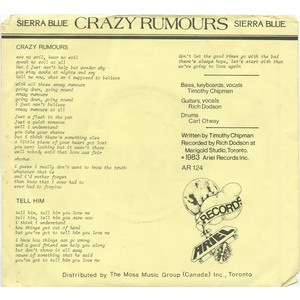
45-Sierra Blue - Crazy Rumours BACK
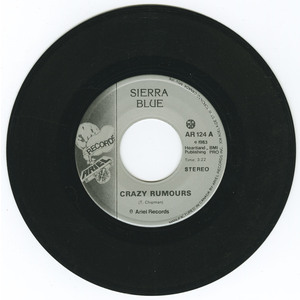
45-Sierra Blue - Crazy Rumours VINYL 01
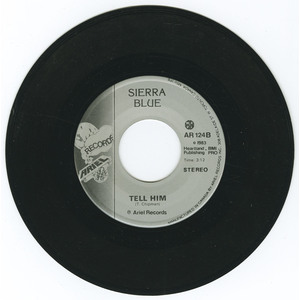
45-Sierra Blue - Crazy Rumours VINYL 02
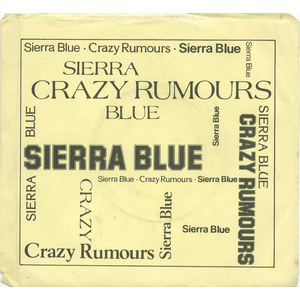
Crazy Rumours b/w Tell Him
Media
Videos
0 videos
No videos available for this title.
Credits
Musicians
Timothy Chipman: bass, keyboards, vocals
Rich Dodson: guitars, vocals
Carl Otway: drums
Songwriting
'Crazy Rumours' written by Timothy Chipman
'Tell Him' written by Timothy Chipman
Production
Recorded by Rich Dodson
Recorded at Marigold Studio, Toronto
Companies
Distributed by The Moss Music Group (Canada) Inc., Toronto
Notes
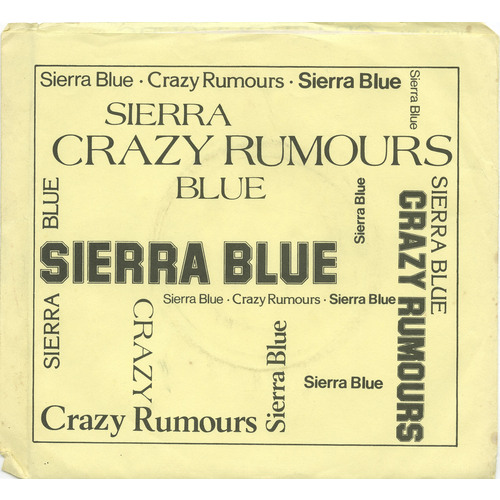
Issued with picture sleeve.
No Comments