Insight
Paul Helstrom was a Saskatchewan farmer-singer from Gray, a small prairie community southeast of Regina, whose privately issued recordings preserve a warm mixture of church-singing tradition, old sentimental favourites, prairie humour, and Scandinavian-Canadian novelty material. Born in 1908, Helstrom came from a family rooted in the treeless wheat country around Gray, where his parents had settled in 1905. That prairie origin is central to his album Songs I Like To Sing, whose liner notes describe the region’s flat, fertile gumbo soil, wheat fields, summerfallow, harvest colours, and the hard early years when settlers avoided the land because there was no wood, no wells, and the sod was too rough for horses.
Helstrom’s music was not made for the commercial pop market. It belonged to church gatherings, family occasions, local halls, and the kind of community entertainment that existed before rural performers were separated from their audiences by industry machinery. Local-history references remember him singing solos in church, and his first known LP, A Treasurechest Of Old Favorites As Sung By Paul Helstrom, appears to have been recorded around 1962 with organ accompaniment by Sharon Frei and Ron Moats at church locations in the Regina area. That earlier record placed him firmly in the sacred and sentimental vocal tradition.
His second self-released album, Songs I Like To Sing, appeared in 1972 and shows another side of his personality. Credited as Paul Helstrom Sings With Ron Moats, the album pairs Helstrom’s vocals with Moats’ electric organ, and on “The Old Wooden Rocker”, a seventy-year-old reed organ. The first side is billed as “Enjoyabul Scandihoovian Toons,” leaning into rural Scandinavian-Canadian humour with songs such as “The Poor, Poor Farmer,” “Aunt Freda’s Enjoying Poor Healt’,” “The Picnic Song,” “Goin Back To Whur I Cum Frum,” “Hilda, Oh Hilda,” and “I Yust Go Nuts At Christmas.” The second side shifts toward familiar favourites including “El Rancho Grande,” “Lucky Old Sun,” “Galway Bay,” “Danny Boy,” and “The Old Wooden Rocker.”
The album’s liner notes reveal Helstrom’s own sense of purpose. He describes the record as a collection of songs he and Ron Moats liked and hoped others would enjoy too, moving from comic prairie characters and homemade dialect humour to Mexico, Ireland, the American South, and old parlour sentiment. He gives special thanks to Ellis Howlett, who recorded the sessions, and to Moats for his organ accompaniment, calling the project “a family effort,” with Helstrom, their uncle, supplying the vocal. That family-and-community setting is essential to the record’s charm.
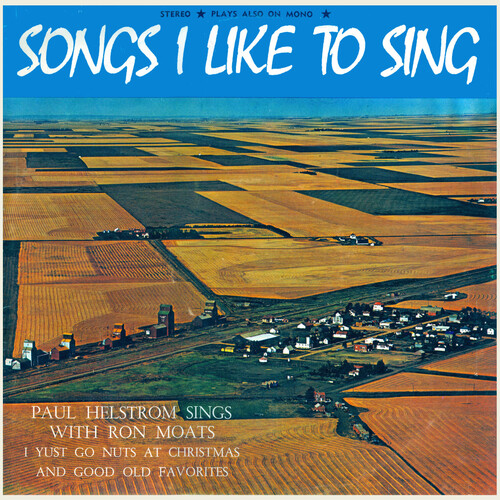
The cover image also places the album deeply in Saskatchewan. Helstrom explains that the colour photograph was an aerial view of his hometown of Gray, taken by noted photographer George Hunter. The image had previously appeared on the cover of Imperial Oilways and in Kramer News in January 1966, and Helstrom thanked Kramer Tractor Ltd., the Saskatchewan Caterpillar equipment dealer, for the loan of the colour materials. For Helstrom, the image was not decorative; it was a visual statement of origin, showing “God’s green earth turn to gold at harvest time.”
Helstrom died in 1992, but his two private LPs remain small, distinctive documents of Saskatchewan vernacular music. They preserve the voice of a prairie farmer who sang from the world he knew: church pews, family gatherings, wheatland humour, immigrant memory, sentimental standards, and the stubborn pride of a community built on open land. Songs I Like To Sing is exactly what its title promises — not a commercial bid for fame, but a personal record of songs, stories, family, and place.
-Robert Williston
Gallery
Images
2 images
Paul Helstrom / Songs I Like To Sing BACK

Songs I Like To Sing
Media
Videos
0 videos
No videos available for this title.
Credits
Musicians
Paul Helstrom: lead vocals
Ron Moats: electric organ on 'The Poor, Poor Farmer', 'Aunt Freda’s Enjoying Poor Healt', 'The Picnic Song', 'Goin Back To Whur I Cum Frum', 'Hilda, Oh Hilda', 'I Yust Go Nuts At Christmas', 'Yingle Bells', 'El Rancho Grande', 'Lucky Old Sun', 'Galway Bay' and 'Danny Boy'
Ron Moats: reed organ on 'The Old Wooden Rocker'
Ron Moats: quips on 'Goin Back To Whur I Cum Frum'
Production
Recorded by Ellis Howlett
Artwork
Photography by George Hunter
Liner notes
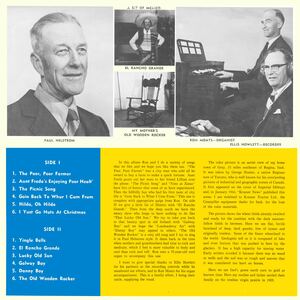
In this album Ron and I do a variety of songs that we like and we hope you like them too. “The Poor, Poor Farmer” was a city man who sold all he owned to buy a farm to make a quick fortune. Aunt Freda pours out her woes to her friend Lillian over the phone. “The Picnic Song” and “Nuts at Xmas” have bits of humor that some of us have experienced. Then the hillbilly boy who had his first taste of city life is “Goin Back to Whur I Cum From.” This one is complete with appropriate quips from Ron. On side II we give a little bit of Mexico with “El Rancho Grande.” Then from the deep south we have the weary slave who longs to have nothing to do like “That Lucky Old Sun.” We try to take you back to that beauty spot in old Ireland with “Galway Bay” and we hope the “Londonderry Air” with “Danny Boy” may appeal to others. “The Old Wooden Rocker” is a very old song and I try to sing it in Paul Helstrom style. It dates back to the time when mothers and grandmothers had time to rock and meditate, which I feel is more valuable to body and soul than rock and roll. Ron uses a 70-year-old reed organ to accompany this one.
I want to give special thanks to Ellis Howlett for his patience at the recording controls while he monitored our efforts, and to Ron Moats for his organ accompaniment. This is a family effort, I being their uncle, supplying the vocal.
The color picture is an aerial view of my home town of Gray, 25 miles southeast of Regina, Sask. It was taken by George Hunter, a native Reginan now of Toronto, who is well known for his outstanding pictures of industrial and geographic scenes of Canada. It first appeared on the cover of Imperial Oilways and, in January 1966, “Kramer News” published this scene. I am indebted to Kramer Tractor Ltd., the Caterpillar equipment dealer for Sask. for the loan of the color materials.
The picture shows the wheat fields already swathed and ready for the combine with the dark summer-fallow fields in between. Here we see flat, fertile farmland of deep, dark gumbo, free of stones and originally treeless. Some of the finest wheatland in the world. Geologists tell us it is composed of lake and river bottom that was pushed in here by the glaciers. It has a high capacity for storing water. Early settlers avoided it because there was no wood or wells and the sod was so rough and uneven that it was considered too hard on horses.
Here we see God’s green earth turn to gold at harvest time. Here my mother and father settled their family on the treeless virgin prairie in 1905.
Matrix
Side 1 label matrix: ST-57242
Side 1 runout: ST 57242 1 TGX
Side 2 label matrix: ST-57243
Side 2 runout: ST 57243 2 TGX
No Comments