Insight
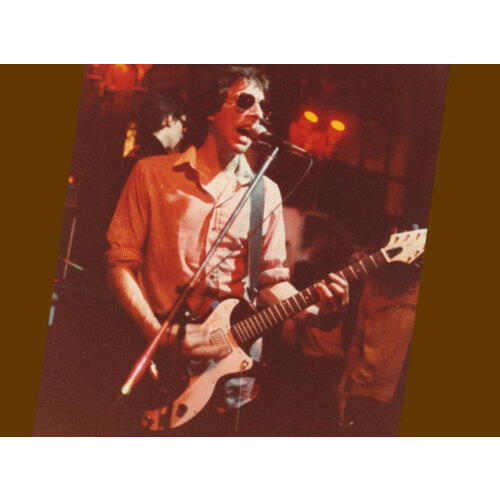
VEX was a short-lived but unusually forward-looking Montreal group formed in 1979 by singer, guitarist and multidisciplinary artist Alan Lord and experimental electronic musician Bernard Gagnon. With Dave Hill on bass and Angel Manuel Calvo on drums, the group combined abrasive punk-derived guitar music with Minimoog electronics at a time when Montreal’s post-punk and synthesizer scenes were still beginning to take shape.
Lord had already become an active participant in Montreal’s emerging punk culture. He wrote for the local fanzine Surfin’ Bird and performed with The Marauders, a group documented on the city’s club circuit during 1979. Rather than remaining solely an observer and writer, Lord moved increasingly toward creating music that reflected the artistic and social disruption he saw developing around him.
His next project was initially called The Blew Genes. The name was later changed to VEX, a shorter and more confrontational identity suited to the band’s increasingly stark musical direction. Bernard Gagnon brought the Minimoog into the group, while Hill and Calvo completed its rhythm section. Later archival accounts identify Lord and Gagnon as the group’s principal founders, with Calvo also closely associated with its formation.
In the summer of 1979, VEX began incorporating synthesizers into its dark, abrasive compositions. The combination of Lord’s guitar and vocals with Gagnon’s electronic textures placed the band among the earliest Montreal groups to move beyond straightforward punk into the less clearly defined territory of post-punk, minimal synth and new wave.
The surviving recording ‘DNA’ is the clearest document of that approach. Built around a terse, mechanical structure and prominent Minimoog, the song sounds markedly different from much of the conventional rock being produced in Quebec at the time. Its robotic character, repetition and electronic tension anticipated musical ideas that would soon become more widespread within post-punk and minimal electronic music.
VEX appeared at the Festival New Wave at Montreal’s Hôtel Nelson in June 1979. That October, the group opened for The B-52’s at the Pretzel Enchaîné, placing it in direct contact with one of the most inventive American groups associated with the first international new wave movement.
Despite the originality of its music, VEX did not release a record during its original existence. ‘DNA’ remained unheard commercially for almost three decades, surviving as evidence of a Montreal group that had reached an electronic post-punk sound before a substantial local market or recording infrastructure existed to support it.
The recording finally appeared in 2007 on the German limited-edition compilation Echoes From Our Past, released by Anna Logue Records. The collection focused on obscure minimal electronic, synth-pop and electro recordings from several countries, placing VEX within an international history of privately recorded and previously overlooked electronic music. Only 500 copies of the compilation were pressed.
The release brought ‘DNA’ to collectors approximately 27 years after its recording and helped establish VEX retrospectively as an early Quebec post-punk and minimal-synth group. A later profile of Lord specifically noted the delayed recognition the song received through the German compilation.
‘DNA’ was subsequently included on the 2020 compilation Nome Noma – Québec Post-Punk et New Wave 1979–1987. Its appearance there returned the recording to its Quebec context and placed VEX alongside other overlooked Francophone and Anglophone artists working beyond the province’s established rock industry.
Although VEX had only a brief existence and left behind very little recorded material, its members continued to influence Montreal’s alternative music community. Bernard Gagnon later became associated with Heaven Seventeen and Cham Pang, while Angel Manuel Calvo performed with Rational Youth and Cham Pang.
Alan Lord soon attracted the attention of poet and rocker Lucien Francoeur, who recruited him to write and produce material for the 1980 album Le Retour de Johnny Frisson. Lord remained an important figure in Montreal’s underground culture, later directing the Festival Ultimatum and joining the iconoclastic post-punk group Vent du Mont Schärr in the mid-1980s. His later projects included Alan Lord and The Falling Men and Pagan Gurus.
-Robert Williston
Gallery
Images
1 image
DNA
Media
Videos
0 videos
No videos available for this title.
Credits
In Transit
No Comments