Album / Title
Old Native and Métis Fiddling in Manitoba Volume 1 - Ebb and Flow, Bacon Ridge, Eddystone and Kinosota: Ka Été Nagamunan / Kakkwékkiciwank
By: Compilation
Insight
These recordings were made and gathered in 1985 and 1986 in Saulteaux and Métis communities in western Manitoba. They are a combination of recent recordings done under a variety of conditions as well as tunes taken from tapes made up to twenty years ago in the communities themselves. Many players of the old style had already passed away by the time this project was underway, so that old tapes made on home equipment are often the only record of how they played.
Old Native and Métis fiddling in Canada’s Northwest is a unique phenomenon which is largely unknown outside of its own communities. It combines the tunes and some of the style of the French-Canadian and Scottish fur traders (and later, tunes from American, Ukrainian and other musicians) with some of the phrasing and expression of traditional Native music. This results in highly complex musical structures. The French-Canadian roots of the music are obvious, especially in the vigourous bowing and the tapping of both feet to emphasize the rhythm. However, the uneven lengths of the phrases and the way the tunes are constructed owe much to the Native heritage of the musicians and make this style of fiddling unique in North America.
To many people, Native and non-Native alike, the old tunes are considered to have ‘crazy rhythm’. Many players have moved away from the old style, finding themselves more attracted to the smooth, symmetrical fiddling they hear on the radio and on commercial recordings. Some just never hear the old tunes anymore and so forget them; while others, in trying to survive between the two worlds of white and Native, have discarded elements of their cultural past which might not seem to be in keeping with the ‘modern’ world. But some hang on tenaciously, insisting on playing the old tunes in the “old-time” way. This collection is meant to be a tribute to the fiddlers, an inspiration to others and a means of passing on this complex and highly creative tradition to future generations.
Anne Lederman
Production and Field Recording: Anne Lederman
Consultant, Translator, and Field Assistant: Lawrence “Teddy Boy” Houle
Additional field interviews, recordings and photographs: Willie Henry
Design and Layout: Ian Bell and Anne Lederman.
Final mastering: Bruce Cameron, Dave Hillier and Sean Snell.
My thanks to Rummelt Hummelin of the Association for Native Development in the Performing Arts for providing recording equipment and to Graham Townsend for help in identifying some of the tunes. Thanks also to Steve Starchev for technical assistance.
Funds for this project were made available by the Manitoba Department of Culture, Heritage and Recreation and by the Explorations Branch of the Canada Council. Some earlier recording was undertaken under a field research grant for the Canadian Centre for Folk Culture Studies (CCFCS) of the National Museum. I would especially like to thank Carmelle Bégin of the CCFCS for her initial support and René Landry for making some of those recordings available. Thanks go to Mitch Podoluk and Jim Robinson for their encouragement and especially to Ava Kobrinsky and John Myers for their work on funding. Also throughout the project, John has been the liaison between the world of government and the project itself, an invaluable service for which I am very grateful.
The greatest credit goes to the musicians themselves, some of whom I know only through their recordings. Most, however, I have been privileged to spend at least some time with, sharing tunes, stories, laughter and glimpses of past and present experience. My time with them has permanently changed my life, and I can only hope that the social occasions we forged will continue in future years.
I would not know of the existence of this music but for Willie Henry who was inspired to send me a tape some years ago. Some of the recordings and interviews and many of the photographs contained herein were provided by him. I would also like to thank him and his wife Linda, Carl and Vivian Grexton, Eldon and Audrey Campbell, and James and Christianne Thurgood for their friendship and for sharing their homes with me throughout the project.
And finally to Lawrence Houle, my cultural “seeing eye” throughout, I can only hope that the final product will be a continuing reward to you, and that our friendship will survive this and future endeavors.
- Each package contains the following: two discs or one cassette; a booklet which includes history, a discussion of the music and traditional dances, biographies of the fiddlers, quotes from interviews, notes on the tunes and photographs.
- Some of the older tapes reproduced on these recordings are not of the best quality. It was felt that the value of the cultural legacy captured on these tapes vastly outweighed considerations of hi-fidelity, although every effort was made to reproduce the music as clearly as possible.
There has been fiddling in the Saulteaux communities of western Manitoba for as long as anyone can remember. In spite of the trend towards Country music in the last 30 years and the more recent trend towards Rock, “old time” fiddlers still play for themselves, with family and friends, in bands, at dances and at parties. The tunes heard today are a curious mixture of old and new, from almost unrecognizable versions of old Scottish or American tunes such as Caber Feigh or Year of Jubilo to Don Messer tunes and Nashville breakdowns. Sometimes, a player will noticeably change style when switching from new to old tunes. For the modern sound, he* will sit back, tap a toe lightly, stretch out the bow strokes and relax. Yet, when it comes time to play the old tunes, the pace quickens, bow strokes become shorter and more aggressive and both feet start to move off the floor. If the guitar player is young, he frequently gets lost trying to follow the uneven phrasing and stops, letting the fiddle recreate by itself a sound heard for generations on the prairies. The fiddler, for his part, “gives it her tapper.” When the tune is over, he is usually panting and has to wipe sweat off his brow. This old music is the legacy of the fur trade in Canada’s Northwest—a music which combines the sometimes irreconcilable cultures of White and Native. It is a music not quite like any other.
VOLUME I — EBB AND FLOW, BACON RIDGE, EDDYSTONE AND KINOSOTAThe Ebb and Flow Reserve is located halfway up the western shores of Lake Manitoba. Established in 1871, it has about 400 residents, while another 300 live in the “non-status” community of Bacon Ridge, right beside the reserve. Eddystone is about 15 miles north of the reserve, and there are some close family connections. Most older residents of Ebb and Flow, Bacon Ridge and Eddystone speak Saulteaux as their first language (pronounced “Soto” by those who live there). As in most Saulteaux communities in Manitoba, however, surnames are mostly French and Scottish, even though French is spoken by only one or two people. English is used in school, and most residents are fluent in English as well as Saulteaux.
Kinosota is a few miles south—a cluster of farms right on the shores of Lake Manitoba, spreading out around the remains of an old Hudson’s Bay trading post. Called Manitoba House, it was established in 1828 according to a local sign. In Kinosota, names are almost completely Scottish, and the English language prevails, although there have been Gaelic speakers in the area within living memory.
All three settlements have close family ties and share a common heritage. They are largely the mixed-blood offspring of French and Scottish fur traders and Saulteaux Indians, and have been established along these shores since at least the early 1800’s. Traditionally, they have hunted, fished and farmed for livelihood. Some hire themselves out as labourers in other communities.
Right beside the reserve and a few miles up from Manitoba House are the Narrows of Lake Manitoba, which was always a sacred spot for the Saulteaux. Here, the lake is only about half a mile across, and “unearthly” noises are frequently heard as the wind blows across the limestone rocks. The island in the Narrows is called “Manito-wapah,” which literally means the “Spirit’s Narrows,” and is thought of as the dwelling place of God or Manitou. It is from this name that the word “Manitoba” is thought to derive.
Because the narrowing of the waters made it such a good meeting place for those dwelling on both sides of the lake, several Hudson’s Bay posts were established here over the years, starting in 1798 and continuing off and on until 1911. Trade in furs was carried on with both the Ebb and Flow Indians on the western shore and those from Dog Creek on the east. It was such a well-established and strategic trading spot that, for years, the main line of the CPR was slated to go through here, bypassing Winnipeg altogether. However, various business deals caused plans to change—the railway went south of Lake Manitoba and the area became once more a somewhat isolated home for those who remained.
Unfortunately, much of the land is low and marshy which makes it unsuitable for farming. With few local resources to develop, business opportunities are limited and the area is somewhat economically depressed. However, there are good schools, good farm land to the south and a rich cultural heritage, which give some possibilities for the future.
THE PLAYERS AND THE TUNESWithin living memory, fiddling seems to be concentrated in families: the three Flett brothers—Charlie, Roderick and Walter; their sons Lawrence Flett and Lawrence Houle; brothers Antoine, Pete and Willie Mousseau; brothers Albert and Alfred Beaulieu, all of Ebb and Flow; William Spence and sons Arsène and Emile Spence of Eddystone; Alfred and Arthur Dumas from Crane River; Jack and Fred Ducharme from Kinosota and nephews Jimmy Anderson, Gus McLeod and Eldon Campbell. Some of these players have passed away over the last 30 years, although they are still remembered in the community. About half of them are represented on these recordings. The fiddlers range in age from 45 to 82 at the time they were recorded. There is also quite a variety of repertoire and playing styles among them, but all have learned from the old local tradition to some extent. Although I have concentrated on the oldest tunes known in the community as much as possible, the influences of the past 40 years are also evident in tunes such as Gene Autry’s Lonesome Cattle Call.
Some families had gramophones by the late 1930’s, but poverty prevented these luxuries from being commonplace. Guitars appeared by the late 1940’s and other instruments such as banjo, mandolin and accordion turn up occasionally after that. Up until then, the fiddlers played solely to the accompaniment of their own feet or other fiddles. However by the 1960’s, according to home tapes, music at family gatherings consisted of a mixture of the old Quadrille tunes played on fiddle and guitar (refer to section on “Repertoire”), old-time country songs and newer tunes such as Faded Love and Maiden’s Prayer (mostly learned from American radio stations). There were several dance callers in the community who also contributed to these informal gatherings. They all called in English, except for Pete Garneau who used French.
Outside of hymns sung in Church and the occasional popular Irish and Scottish song, there seems to have been little singing in these communities for some time before Country and Western music became popular. Some residents know some Ojibwa songs used for medicine ceremonies but have learned them elsewhere. There is one Saulteaux song known in Ebb and Flow sung to a fiddle tune (see #11, Side IV for the tune: no recording was obtained of the singing) but it and a bilingual version of These Shoes Keep Walkin’ Back To You are the only non-religious Saulteaux songs that I came across.
The era of the organized band coincides with the advent of country singing around the early 1950’s. At first, bands consisted mainly of guitars and fiddle but later began to include bass and drums (probably the late 1960’s). Now, several bands play for events in their own and in other communities within a few hours travel. These bands include most of the younger players on these recordings. Even today however, drummers are rare (again, the cost of drum sets is no doubt a factor) and groups are often just trios, usually consisting of one electric and one acoustic guitar player and a fiddler, with one or more of the musicians singing. But at home it is still solo fiddle or fiddle and guitar which are heard most often, and that is what we have gathered for this collection.
- Although I was told about the occasional female fiddler in the past in these communities, I neither met nor heard about any who are still active. Fiddling has always been largely a male activity in Native communities.
As Willie Mousseau, Walter Flett and Jack Ducharme had passed away before this project began, I copied tapes of them made by family members and others who had recorded them during their lifetime. Also, some tapes of Emile Spence are from older cassettes he made at home. Some tunes of Lawrence Flett, Emile Spence, Frank Desjarlais and Lawrence Houle are taken from 1/4 inch reels I made on an earlier trip in May and June, 1985. They were recorded on a portable Uher in the players’ homes. A couple of tunes from Eldon Campbell and Frank Desjarlais were made on a Sony Professional Walkman, also in their homes.
All other recordings were made directly onto Beta tape in August-September, 1986, using an F1 digital processor and two Sennheiser CK 30 microphones. Three recording sessions were held in the conference room of the Ebb and Flow Band offices on the evenings of August 18, 19 and 20, 1986. It is a long carpeted room mostly filled with a large table. We put a small board down for the fiddlers’ feet. Several fiddlers had been invited to come down at a time, where they took turns playing a few tunes each. Along with interested family and friends, they sat and listened to each other the rest of the time and provided comments, jokes and anecdotes over the course of the sessions.
Two other sessions were held in the old Hill School in Bacon Ridge, the first schoolhouse in the non-status settlement. The building is now managed by the local branch of the Manitoba Métis Federation and used as a community hall for various group activities. We wanted to try using the larger space so that more members of the community could come down and watch.
SIDE I(Names in brackets are nicknames by which the players are usually called. Many people in these communities do not know each other’s formal names, only their nicknames.)
Willie MousseauBorn: 1903, Ebb and Flow Reserve.
Died: 1985, Ebb and Flow Reserve.
Willie and two of his older brothers, Antoine and Pete, were all fiddlers. Willie, who spoke to Bill Henry shortly before his death in 1985, says he learned mainly from Antoine, who died “about 40 years ago. Ask anybody you see, they know Antoine Mousseau, he was a damn good fiddler.” (No recordings were made of Antoine. There are apparently some in existence of Pete, but they were not available for these records.) Talking about his youth, Willie said,
There were not very many [fiddlers] . . . one in Sandy Bay [possibly Joe Roulette, see C Reel, #3, Side III], there was one up north, Fairford, and there was another one in Camperville—Chartrand [probably Michel Chartrand who is mentioned by several Camperville fiddlers, see Volume II]. So there were not very many, not like today . . . there are a lot of them playing violin but they’re not good. The ones I’m talking about, they were the best.
Willie’s playing is very energetic, and he uses many two-note chords, his feet beating a precise accompaniment to both jigs and reels. He accents the “offbeat” heavily, and his phrases tend to be longer than many other players’. His opening phrases especially are lengthened. Likewise, he usually signals the start of a tune with a few chords. (See section on “The Old Music—Tune Structure”.)
Recording Situation: These tunes were all recorded by Willie Henry in the spring of 1984 at Mr. Mousseau’s home in Ebb and Flow, using a stereo Marantz cassette recorder and Shure microphones. The rhythmic accompaniment on these tunes (and throughout the recordings) is being made by the fiddler’s feet. (See section on “The Old Music” for more information.)
Guitar — Bill Henry
1. Quadrille Set (Haste to the Wedding, Year of Jubilo, D Reel) — (See sections on “Dancing” and “Repertoire”.) Both of the first two tunes are well-known in the community in local versions. Haste to the Wedding is often called simply “the wedding tune” and is usually played for the first dance at a wedding party. The third is from Joe Roulette of Sandy Bay, according to Lawrence Houle. (Sandy Bay is just south of Ebb and Flow.)
2. G Reel — This tune was also played by Roderick Flett.
3. C Reel (Caber Feigh) — This was sometimes the third tune in a set of C reels known as Three Sisters in Camperville (see Volume II). The other two were versions of Wagoner and Billy in the Lowground (the Scottish Braes of Auchtertyre — see section on “Repertoire”). Lawrence Houle plays them as a set also, as did Roderick Flett, but does not call them by this name. All three of the tunes are generally unnamed in the community, although Lawrence calls this one Roulette’s Reel as it was also learned from Joe Roulette of Sandy Bay.
4. D Reel — A common “old-time” tune in the area, I have not been able to trace it to any other source.
5. Red River Jig — (See section on “Dancing”.) This version is particularly interesting because Willie does not retune the fiddle the way most players do but leaves the bottom string tuned to G, very much changing the sound of the low part.
Walter Flett (“Megwassi”*)Born: 1908
Died: May 1986, Winnipeg, Manitoba
Walter was the youngest of the three Flett brothers. He had 8 of his own children and was stepfather to 4 others having married widow Edith Houle in 1959. He worked for a farmer near Amaranth in the early 1950’s—Jewel Kartinson—and lived with his family on Mr. Kartinson’s land. Then, he moved to the newly built Bacon Ridge, where his children plus a few others made up the required nine so that Edith could ask for a teacher and school.
Walter learned to play from his father and older brothers and later, from recordings of Andy de Jarlis and eastern fiddlers such as Don Messer. His bowing is very smooth, and his repertoire reflects both the “Old Time” Ebb and Flow style and the “Down East” sound. He had quite a formidable reputation during his lifetime and recorded several tunes for the Manitoba Museum exhibit “Birth of a Province,” which are now held in the National Museum in Ottawa (#6 is from this recording). He was known as an excellent dancer as well as fiddler. Stepson ‘Teddy Boy’ Houle says,
He was the best . . . ’cause he played the fiddle the way he wanted to. He played it very freely, and he played it in a character that would suit only him.
Recording Situation: The first tune comes from the tape made for a Manitoba Museum exhibit in 1972 called “The Birth of a Province.” The others were taped by Walter’s son, Jimmy, in 1978, on a reel-to-reel machine. On these latter tunes, Walter is playing through an amplifier and Jimmy is playing an electric guitar.
Guitar — Jimmy Flett
6. Drops of Brandy — a Native and Métis standard. This tune is also called the Hook Dance because of the swinging figures in the dance, or Koshkwepigiken in Saulteaux, which literally means “fish hook dance”. (See section on “Dancing” for more information.) Again, the percussion is from Mr. Flett’s feet.
7. D Jig — Unknown
8. G Two-step — Unknown
9. Girl I Left Behind — Played the “old-time” way.
- Walter’s nickname “Megwassi” means “Ukrainian,” given to him because his first marriage was to a Ukrainian woman.
Born: October, 1938, Ebb and Flow
Current Residence: Lockport, Manitoba
‘Teddy Boy’, as he is generally known, is Walter Flett’s stepson from mother Edith Houle’s first marriage. He grew up in Bacon Ridge but has worked at a number of occupations in Winnipeg and rural Manitoba over the past 30 years, including archeological surveying and community development.
He learned fiddle mainly by watching his stepfather, Walter, his uncles Charlie and Roderick and neighbour Willie Mousseau. He says no one, including his father, showed him anything, as seems to be typical in this tradition. “I would just play it and play it and play it, and . . . I used to cry beside this instrument, I wanted to learn it so bad.” At first, he had to steal it from his father’s hiding place when his parents went to town since his father had forbidden the kids to touch the fiddle, which was, after all, a rare and valuable possession. According to Teddy Boy, “Nobody had anything. If you had a fiddle, my goodness, you were a millionaire.” In spite of the fact that he is now considered a professional, he still says he will never play as well as his dad did. On the other hand, he believes everyone should have their own approach:
See the three brothers here (Walter, Charlie and Roderick) . . . if you asked them to play the same tune, they all had different versions, so, that’s when I decided I must have a version too . . . so I would never really try to copy anybody because I had my own style.
In spite of his exposure to recorded music, he prefers the “old-time” way of playing from his own community. ‘Teddy Boy’ is fairly well-known throughout the prairies, plays regularly for dances in many communities and has appeared at the Winnipeg Folk Festival. He works with traditional dance groups in the communities of Hollow Water and the Cody Reserve and has released his own album of tunes learned from his father on the Sunshine label (SSBCT 442). He was also hired to work on this recording project as consultant, translator, and cultural ‘guide’, where his assistance has proved invaluable throughout.
Recording Situation: #10 and #11 were recorded at the Band Office, #13 at the old Hill School, all in August, 1986, on Beta. #12 was recorded at the home of Kate Carey in Winnipeg, August, 1985, on a portable Uher.
10. Demerais Reel — Fiddle tuned A E A E. Lawrence’s father learned both this tune and the next from Charlie Demerais of Amaranth. (Amaranth is a small community about 20 miles south of Ebb and Flow.)
11. A Reel — Fiddle tuned A E A E. See #10.
12. Red River Jig — Two versions. Fiddle is tuned A D A E. The first version is one of the old local ways of playing the Red River Jig and is quite unusual in that the high part stays in a D tonality while the low part centres around an A chord, the opposite of most versions. The second, while also a local version, is closer to those commonly heard elsewhere.
13. A Reel — From Lawrence’s father, Walter Flett.
SIDE II Lawrence Flett (“Toulouse”)Born: October, 1940, Ebb and Flow Reserve
Current Residence: Bacon Ridge
One of thirteen children of Charlie Flett (the oldest of the three Flett fiddlers—see Side I), Toulouse began playing about the age of five, learning his first tune, a waltz, entirely by sliding his fingers up and down the E string. His mother, Marie, played button accordion. He learned mainly by listening to his father and uncles and Willie Mousseau, but also has his own versions of tunes. He has been in bands off and on since the age of 14 when he played with Curly Napper, a local country singer. They travelled locally and played on the Dauphin Radio Station, CKDM. He currently has a band called “The Flett Trio” including Danny Flett on guitar and Steve Flett on bass. In 1985 they released a 45 rpm of a local tune and song.
Lawrence is considered by other players to be one of the best in the community and is known locally for having a remarkable ear. ‘Teddy Boy’ Houle (see Side I) says, “He has such an ear for fiddle music, he’ll hear a tune and immediately play it.” He is beginning to be more interested in the old tunes, having preferred in his younger days to play the American tunes he heard on the radio, such as those of Roy Acuff. But he does know many of the old tunes and has cultivated a repertoire of tunes in “altered” tunings, a practice typical of the older players. (See section on “The Old Music—Tunings”.)
When asked about learning tunes, he said,
At first I just listened, eh? I listen ’til I get to know the song I guess . . . I try to get it in my head first, to think about it. If I’m alone, I whistle . . . in the bush . . . I can whistle a tune pretty good. Then I hum it. I don’t take the fiddle right away when I try to catch on a tune. First, I try to get to know it. . . I try to make the fiddle sound fancier than the other guy, what he does. I guess everybody’s like that. Sometimes a tune doesn’t sound good . . . so I try to change it a little bit . . . try to make it sound nicer.
Recording Situation: Band Office, Ebb and Flow, August, 1986, except for the first version of #2, which was recorded privately at the home of Frank Desjarlais at a house party, June, 1985, using a portable Uher.
1. Devil’s Reel — Fiddle is tuned A E A C#. This is a standard of the old repertoire. It is a version of Hangman’s Reel or La Reel du Pendu in Quebec (called Lost Indian in the U.S.) (See section on “Repertoire”.)
2. A Reel — Here Lawrence is saying that his grandfather told him never to play “those old tunes” (the ones in open tunings), that “If you ever play them, the devil will walk in, he’ll come . . . and take the fiddle off you and maybe you’ll never, ever, play a tune again.” As he says though, he didn’t worry about it too much and nothing seems to have happened to him so far. On the first version (recorded June, 1985) the fiddle is tuned A E A E, while on the second (September, 1986) it is tuned A D A E. I included both versions to show the freedom with which players sometimes approach a melody and the flexibility of technique that allows a player to play more or less the same tune in two different tunings. Lawrence says this tune comes from his uncle, Roderick Flett.
3. G Reel — Fiddle is tuned G D G D on this recording, but Lawrence got to it after several other altered tunings. It is likely that he plays it with the fiddle tuned higher usually, in A E A E.
4. Yankee Four (Kakashkabatek—Smothered in Smoke) — ‘Teddy Boy’ Houle says this tune was sometimes used for the dance Yankee Four. (See Side IV, #10 for another tune used for this dance.) Lawrence Flett calls it Kakashkabatek which literally means “smothered in dust” (usually translated by the players as “smothered in smoke”), referring to the dust kicked up by the dancers’ feet. Some players use this name for other tunes as well.
Albert Beaulieu (“Nijoday”*)Born: 1928, Sandy Bay Reserve, Manitoba
Current Residence: Ebb and Flow Reserve
Albert’s mother was from Ebb and Flow, and his father from the nearby reserve of Sandy Bay. His family moved to Ebb and Flow when he was 11. (It is traditional in Saulteaux culture for a husband to move to the wife’s community.) He started playing fiddle around the age of 16, listening mainly to Willie Mousseau, his uncle Florian and his grandfather John St. Paul who played left-handed. The first tune Albert learned was You are My Sunshine heard on a Wilf Carter recording. He generally learned by sitting in the background at dances and trying to follow along, although he also likes to have his own versions of tunes:
I used to follow them behind when they were singing . . . I didn’t want to stay in front because I was scared. It was dark all over, no lights . . . I just have to go over there [to houses where other fiddlers are gathered] and wait for a while and get another tune there, go back home and think about it . . . sometimes I’ve got to think about it until [I] go to sleep—wake up in the morning, I’ve got it.
Albert plays some old local tunes but more which were probably learned from the early days of recording and radio. They are somewhat altered, however, as can be heard on these recordings.
- “Nijoday” means “twin”. Mr. Beaulieu was one of twins, but his brother died several years ago.
Recording Situation: Band Office, Ebb and Flow, August, 1986.
Guitar — Danny Flett
5. La Double Gigue (Fisher’s Hornpipe) — A standard, but in very asymmetric versions in Native communities. (See section on “Dancing”.)
6. D Reel (Fiddlin’ Phil) — This tune is generally well-known to the Ebb and Flow and Camperville players. It appears to be related to the Down-East tune called Fiddlin’ Phil and may have been adapted from the playing of Don Messer. However, it may have been an older Scottish tune in the community as well. (For a similar tune, see Emile Spence’s D Reel, #3 Side III; also Volume II.)
7. G Jig — Again, played by several Ebb and Flow players, including Willie Mousseau, Walter Flett and Lawrence Houle. It may actually be derived from the old Irish jig St. Patrick’s Day, noted for its irregular B part completed by a return to part of the A section. The first few notes were cut off in this recording.
8. Walter Flett’s Reel (Rotary Club Breakdown — Earl Mitten) — A tune Albert learned from Walter Flett, one of the three Flett brothers. (See Side I.) It appears to be a version of Earl Mitten’s Shelbourne Rotary Club Breakdown, probably originally learned from a recording.
Albert Beaulieu, Lawrence Flett and ‘Teddy Boy’ HouleThe practice of “doubling” on fiddle is remembered by all of the younger players as something they did with their fathers. Since several fiddlers were together at the recording sessions in the Band Office, they wanted to try playing some tunes together to recapture the older sound. In these situations, they like to play the melody in different octaves and improvise harmonies and chords.
Guitar — Danny Flett
9. Lady Do-si-do — This tune is well-known in the community. It reportedly was brought by Willie Mousseau (see Side III) who learned it from “an old guy” in Camperville. (See Volume II for players from Camperville.)
10. Willie Mousseau’s Reel (Wagakut) — Another tune learned by the younger players from Willie Mousseau. It has been nicknamed Wagakut in Saulteaux which literally translates as “curved stick” or “curved penis.”
11. Homecoming Waltz (Home Sweet Home) — See section on “Repertoire”.
SIDE III Emile SpenceBorn: 1914, Eddystone.
Current Residence: Eddystone.
Emile lives in his old family home, now sharing it with his wife, Claudia, and three children and their families, including several grandchildren. He has worked in Dauphin and Eddystone on cattle and dairy farms and on hydro, telephone and road construction as these amenities were brought to the community. He and his family also harvested and sold seneca root for many years. Seneca is used in cough syrups and other medicines and is a traditional source of income for many Métis families in Manitoba.
Emile started playing fiddle around the age of 14. Both his father, Joseph, his older brother, Arsène, and his cousins Arthur and Adler Dumas, played as well. (No recordings are available of these players.) However, as usual, Emile says that none of them really taught him:
I used to sit right beside him [his father] and watch his fingers. I thought I’d never be able to make my fingers go like that, but I tried and tried... and then I could do it. . . I was pretty shy at that time, I hung back . . . my mother was very enthusiastic about my playing the fiddle. My father, he didn’t bother about it too much.
(‘Teddy Boy’ comments at this point that this was a contrast to Emile’s older brother Arsène who needed no encouragement and was “right in the centre of the action all the time.”)
Emile says he was not too interested in the old tunes. When his family got a gramophone, he learned American and “Down-East” tunes and later was very influenced by Andy de Jarlis and Ward Allen. He played for many dances when younger and has a wonderfully light touch. Since 1965 or so he has “put together” many of his own tunes, which, in spite of his stated preference for the “Down-East” sound, tend to be more in the old local style with a fair amount of asymmetric phrasing. In 1973 he made a record on the Century 21 label (ESR — 1) which contains two of his own tunes. Three more of them are on this recording.
Recording Situation: The first two are from cassette tapes that Emile made on a home machine a few years ago with his son Ivan playing guitar. #3 was taped when I visited Emile at his home in July, 1985, and #4 was taped at the Band Office of Ebb and Flow in August, 1986.
Guitar on #1 and 2 — Ivan Spence
#4 — Eldon Campbell
1. Andrew’s Waltz — Original. Emile “made” this tune when his son Andrew was born.
2. White-Tailed Deer — Original. ‘Teddy Boy’ Houle gave the name to this tune while we were recording it in 1986. Emile liked it and it seems to have stuck. This version is taken from an older tape, however (see “Recording Situation”, above).
3. D Reel — Original, but somewhat related to Fiddlin’ Phil. (See #6, Side II.)
4. Turkey in the Straw — The “old way” according to Emile. This tune is well-known by the older players in local versions similar to Emile’s. Sam Bayard has tried to trace this tune to older Scottish sources (see section on “Repertoire”) but as there is no clear Scottish ancestor, it likely came from American tradition in this area.
Frank DesjarlaisBorn: November, 1933, Vogar, Manitoba.
Current Residence: Bacon Ridge
Frank was raised in Vogar and moved to his current property in Bacon Ridge when he married his wife, Roseanna, in 1952. He leaves the community quite frequently to work, however, having gone north to Thompson and worked off and on in other Manitoba communities such as Amaranth and Melita, either as a construction worker or farm labourer.
Frank began playing fiddle at age 13, using only his first two fingers on the left hand at first and sliding them up and down the fingerboard to reach other notes. In Vogar he heard players Pat Maytwayshasing (Clifford’s father, mentioned by Lawrence Flett), Joe and Albert Monkman and his father Willie. When younger he played regularly at local dances, especially with Leonard Mousseau, with whom he also “made” tunes.
As are most Ebb and Flow players, Frank seems very comfortable with the fiddle in a variety of positions, often straight up and down resting in his wrist, with his head on either side of the fiddle. He uses no chin rest and often turns the fiddle as he plays when crossing from string to string.
Recording Situation: #5 was recorded at a party at Eldon Campbell’s house (Frank’s son-in-law) in September, 1986. #6, #7 and #8 were recorded at a similar gathering at Frank’s house in June, 1985.
Guitar on #5 — Sandy Campbell
#6, #7 and #8 — Danny Partenais
5. D Two-Step (Gateman’s Reel — Jim Magill) — A version of Jim Magill’s popular tune, Frank’s first phrase is extended.
6. D Jig — Another tune learned from Walter Flett.
7. A Foxtrot — Frank and Leonard Mousseau made this tune. It is played by many Ebb and Flow players and Lawrence Flett used to call it The Ebb and Flow Special.
8. G Jig — Unknown. The beginning was cut off in the original recording.
Fred LevasseurBorn: December, 1931
Current Residence: Ebb and Flow Reserve
Fred began playing at age 14, listening mostly to Michel Roulette of Sandy Bay who now lives in Austin, Manitoba. He moved away from Ebb and Flow in the late 1950’s, returning to the reserve in 1978. He used to play frequently with guitar player John Houle and has several home tapes of his playing. He refers to the old Native style of the area as “playing on all the strings at once” and says he prefers the “one string at a time” approach of the Down-East style. However, his playing still reflects local influences. Fred is a very light player, but clear and accurate. On these recordings the fiddling is somewhat overshadowed by his vigorous feet, but comes through nonetheless.
Recording Situation: Ebb and Flow Band Office, August, 1986.
Guitar — Danny Flett
9. D Jig — original
10. Snowshoe Reel — This is an unusual version of the tune known variously as the Snowshoe Reel or La Tuque Bleu in Québec. It seems to be fairly old in these communities.
11. Flowers of Edinburgh — An “old Scotch Reel” as players are apt to say. Again, this is a distinctive version.
SIDE IV John Alexander Asham Ducharme (“Jack”)Born: November, 1904
Died: August, 1974
Jack lived within 10 miles of the Kinosota area throughout his life, although grandfather Antoine had come from Joliette, Québec, in the mid 1800’s. According to Jack’s sister, Mary, he began to play around the age of 14, mainly with older brother Fred, also known as a fine fiddler, while Mary accompanied them on piano. (She had taken six lessons on piano from a schoolteacher at Reedy Creek, just north of Kinosota, who taught her to play by ear. The local halls in Kinosota and Leaford had pianos.) The brothers also began playing in local bars and for dances as teenagers and were well-known throughout the area as two of the best musicians. Mary also says that Jack could play breakdowns much better than Fred, but Fred was much better on waltzes. They learned from older players Willie Ross, Ray Asham and Jim Armot of Alonsa. Jack and Willie Ross also played together in bands.
According to his wife, Jack also liked to add a little bit to a tune. Jack’s son, Frank, quotes one of his father’s favourite sayings as “Come on, you might as well play the fiddle, I’m not going to be here forever.” Frank points out how important music was to Kinosota people in general by noting, “Most of them around here all had good fiddles even though nobody had any money. They were as poor as Church mice.” Nephew Angus McLeod (see following biography) says of Jack,
Uncle Jack was a good fiddler, b’y . . . How he could turn around and put background into a fiddle . . . run his fingers down, just seemed like he went down the back door ladder, y’know and he come out on top with his fingers still. I don’t know how this guy plays like that, b’y.
Recording Situation: These two tunes are from an old reel-to-reel recording made by Eldon Campbell at a house party in the 1960’s. The first had been partially erased by later recording so only the one A and B part of the tune were intact.
1. G Reel (fragment) — Fiddle is tuned G D G D. This tune may be a version of the American Sugar in the Gourd, related to Turkey in the Straw but usually played in A rather than G. Jack also played a separate version of the “old” Turkey in the Straw in standard tuning. (See #13, Side IV, for a longer version of this tune played by Eldon Campbell. Also see #4, Side III for a local version of old Turkey in the Straw.)
2. D Reel — Unknown, played also by Willie Mousseau, Walter Flett and Lawrence Houle. Jack’s B part is reminiscent of Arkansas Traveller. Jack pauses momentarily after the first phrase of the tune, probably just recalling the tune to mind. Then he continues from where he left off.
Angus McLeod (“Gus”)Born: February, 1949
Current Residence: Silver Ridge (just south of Kinosota)
Gus started to play when he was 6. He says his father hung a fiddle on the wall and said to Gus and his two older brothers,
‘The first one who plays that fiddle can have it.’ I went upstairs and I take that fiddle every day and I try to play it, eh . . . dad showed me how to play Yankee Doodle, he showed me and I stuck with that thing until I learned how to play [it] . . . I went downstairs and I said, ‘Dad, I can play the tune’. He said, ‘Ok, the fiddle’s yours’.
Gus’ brother, Bob took up the guitar and played with him after that.
Gus respected his uncle Jack Ducharme’s playing above all. He tells this story about how Jack finally heard him play:
You remember mom and dad’s house burnt and dad put that addition on to the house . . . I was sitting beside the window where it was cool, eh, because I had to play so long, me and my brother, Bob . . . he snuck around the house. We had no windows in the house, eh, it was just a new building, and I turned around and I looked like that, and he said, ‘Boy’, he says, ‘you’re a good fiddler’. That dirty old bugger, walked around the house and he came and he stood behind me, listened at the window, eh, to me playing ’cause I was always ashamed to play in front of him ’cause he was gooder’n me.
Recording Situation: These and the following tapes of Jimmy Anderson were recorded at a session in Mac Campbell’s old house on the Campbell farm in August, 1986. The house had been empty for some time, and the Campbells were kind enough to invite me to use it while I was there.
Guitar on #3 and #5 — Jimmy Anderson
#4 — ‘Teddy Boy’ Houle
3. G Reel — Gus says he learned this from an old record his mother used to have, probably from Québec.
4. G Reel (Heather Hill — Dan R. Macdonald) — This tune is also common to most players in this area. Although written by Dan R. Macdonald, it was most likely popularized in this area by Don Messer’s recording.
5. Lonesome Cattle Call — written by Tex Owens, popularized by Eddy Arnold and the Gene Autry television show.
Jimmy AndersonBorn: March, 1925
Current Residence: Silver Ridge
Jimmy took up the fiddle as a boy:
Well, I started when I was maybe about 10 . . . we had an old fiddle there, and I just picked it up and tried playing and got one tune out of it. My brother Colin . . . we used to have an old pump organ in the front room there, he sat down and fiddled around with it until he got chording. That’s the way we got together, started to play this one tune that I learned and he learned to chord for it . . . My father played, all my uncles played and . . . it just more or less came natural to me once I got into the swing of it and got to learn to pick out different tunes. But a tune has to be in here [pointing to his head] before I can play it.
Jimmy also used to “chord on the piano” at one time and played in many bands over the years with other local players. “We used to have two [fiddlers]. Uncle Jack [Ducharme] and Willie Ross played together two fiddles . . . they played harmony all the time.” Jimmy is also well-known locally as a caller for square dances and is the best source of all the old dances from the area. He learned tunes from many local fiddlers, including Gilbert Sanderson of Reedy Creek, Boz Scofield from south of Bacon Ridge, Willie Ross, Jack Ducharme and Lizzie Campbell, Eldon’s grandmother (see following biography).
Recording Situation: Old Campbell home, August, 1986.
Guitar on #6 and #7 — ‘Teddy Boy’ Houle
#9 — Anne Lederman
6. A Reel (Wind That Turns the Mill) — Attributed to Andy de Jarlis but probably older.
7. D Reel — Jimmy learned this from Willie Ross (“Punjab”), an older Kinosota player who was well-known. It seems to be a version of the Québécois Les Guenilles (literally translated as “the rags”) and may have come from a recording.
8. D Two-step — This tune may be related to Jim Magill’s Parry Sound Reel.
9. Gilbert Sanderson’s Waltz — Gilbert Sanderson lived at Reedy Creek, the name given to the area between Ebb and Flow and Kinosota. Many other players in the area learned this waltz from him.
Eldon CampbellBorn: 1945, Kinosota.
Current Residence: Kinosota.
Eldon began playing guitar for his uncle, Willie Ross, as a boy and took up the fiddle around age 12, hearing mainly Willie and other uncles Emerson, Jimmy and Colin, and his grandmother, Lizzie. He says that before he started he would pick up the fiddle and pretend to play while singing a tune, something his 5-year-old son, Cameron, does now. The first tune he tried to play was Elvis Presley’s Don’t Be Cruel. Several of Eldon’s brothers and sisters also played instruments (mainly guitar) and would play together at local dances and amateur shows. Eldon also learned many tunes from the radio and from Don Messer records. Later he picked up some novelty fiddling from television, such as playing under a knee and behind the back, and slacking the hair off the bow and wrapping it across all four strings for a bagpipe effect. (The same technique was adopted by jazz fiddlers such as Joe Venuti.) But he also has many old local tunes in his repertoire, largely learned from Willie Ross.
Eldon’s band “The Country Cousins”—consisting of bass, drums and guitar (the latter played by brother Sandy Campbell)—is in great demand for local dances. Most of the time they play two-steps, polkas and a range of popular country songs. However, Eldon still remembers the tunes for some of the older dances (see #12) and is currently involved in helping to revive “old-time” dances in Kinosota.
Recording Situation: #10 and #13 were recorded at the Hill School in Ebb and Flow, August, 1986. #11 and #12 were recorded at Eldon Campbell’s home in Kinosota on a Sony cassette recorder in September, 1986.
Guitar — Sandy Campbell
10. Yank Four — Eldon says this tune was used for the dance Yank Four in Kinosota, although other tunes were used at Ebb and Flow. (See #4, Side II, and section on “Dancing”.)
11. G Second Change — Eldon says he learned this from Allen McLeod, Angus’s father. It is played by most Ebb and Flow and Camperville players and has been adopted also for a Saulteaux song sung at Ebb and Flow often called Ganawia kokush, meaning “We have no more bacon”. It apparently was a popular tune in Québec also, having been recorded with French words by Madame Bolduc under the title Le bonhomme avec le nez pointu (Carnaval C518, Swing La Baquaise et les autres chansons). Unfortunately, I don’t remember what the clacking sounds were. There were a number of people at this gathering, including several children. Someone may have been experimenting with a set of spoons. (See also Volume II, #8, Side II.)
12. Broom Dance/Rabbit Dance — Tunes for two older dances (see section on “Dancing”). The first tune is the Scottish Keel Row, the second so far untraced to sources outside the northwest.
13. Harry Asham’s Tune — Fiddle is tuned A E A E. Eldon learned this from Harry Asham, an older player in Kinosota. As he mentions, however, other people thought of it as belonging to different players.
TRANSCRIPTIONSAnyone wishing to learn some of the tunes on the recordings should work from the recordings themselves as in any traditional style. That is, of course, if it is impossible to spend time with the players themselves. The timing of the notes can only be approximated in notation, especially on jigs. The following transcriptions are merely offered as sketchy examples of a few tunes, and only of the first time through. Many of the tunes are substantially different on subsequent repeats, and players should learn these variations from the recordings for greater insight into the possibilities of the style.
The bowings are often indistinct on the recordings but I have put in as many as I could hear in order to give some indication of the possibilities. The style consists largely of one bow stroke per note with occasional 2, 3, and 4-note slurs. Notice also the accents on the third note of the triplet in 6/8 time.
The sign ~ indicates a gracing which varies from player to player in timing, but is usually a fast upper note played after the beat.
The asymmetrical phrasing of the tunes makes it impossible to use standard time signatures and barlines and the “one-beat” feel of the music makes them misleading (i.e., each beat is equally accented). I have added half-bars only as an aid to reading, and indicated jigs with a bracketed 6/8 to distinguish them from reels and two-steps.
Symbols Used in Transcriptions
[indistinct-note symbol] - indistinct note
[grace-note symbol] - grace notes
( ) - notes sometimes omitted on subsequent repeats.
- smaller note heads indicate open strings played with the melody. They also vary from time to time.
KAGANA NISHIMUN (La Double Gigue, Fisher’s Hornpipe)
Albert Beaulieu - Side II, Band 5
- Again, a popular tune in the old style. Every player has his own version.
HASTE TO THE WEDDING
Willie Mousseau - Side I, Band 1
A REEL
Lawrence Flett - Side II, Band 3
- A tune I only heard from Lawrence Flett.
LADY DO-SI-DO
Albert Beaulieu, Lawrence Flett and Lawrence Houle - Side II, Band 9
- This transcription is taken from the version played by Teddy Boy Houle on his solo album (Lawrence “Teddy Boy” Houle, Sunshine Records, SSBCT 442) since it is hard to pick out the nuances of the melody from the group version on the album. This tune is very popular at Ebb and Flow and players frequently play it together, doubling the melody an octave lower and adding some harmony.
TURKEY IN THE STRAW
Emile Spence - Side III, Band 4.
Originally, the word “Saulteaux” meant “jumpers” or “leapers” and was applied by French fur traders to the Ojibwa living near the rapids of Sault St. Marie, probably because of their ceremonial dancing. In the late 1700’s, these northern Ojibwa moved gradually westward through Manitoba, largely following the fur trade.
As there were few white women in the west until the mid-1800’s, intermarriage between French and Scottish traders and Native women became a way of life in the early days of the fur trade. To a great extent, traders depended on Native women for survival in the Northwest, for everything from making their clothing, moccasins and snowshoes to cooking, travelling and setting up camps in the bush. In turn, women’s lives were made vastly easier by the amenities brought by whites: cooking pots, cloth, needles and thread et cetera. Some traders remained with their Native families at retirement, settling in the west and basically adopting a Native way of life, while many returned to the east leaving their wives and children behind. In the latter case, the women would usually return to their own people with their mixed-blood children. This meant that not only were entire Métis communities created by the families and descendants of traders and Native women, but that the original Saulteaux communities gradually became mixed as well, permeated with French and Scottish surnames and aspects of white culture.
Many of these “mixed-blood” children were not granted treaty rights when the reserves were established in the 1880’s. Many other people have lost their treaty rights over the years either by marrying a non-status person in the case of the women, or for various political or economic reasons.* However, family and cultural ties are much stronger than the two-tiered legal classifications of “status” (those with treaty rights) or “non-status” (those without) so that large “non-status” settlements have grown up around most reserves on the prairies, in many cases outnumbering the reserve population itself. The communities created in this way, each consisting of a reserve and surrounding settlements, are unified by bonds of family, history, language and culture.
Over the years, the culture of these reserve communities in western Manitoba has become increasingly complex. Immigration has brought people of many different ethnic groups to settle nearby, while intermarriage as well as constant exposure to white teachers, government officials and culture-transmitting machines such as radios and televisions have added to the blend. Most residents now speak at least one other language on top of their native Saulteaux. English is the most common of these but French, Cree, Ukrainian and others turn up, depending on the particular community and family associations. A number of religions are practiced, from traditional medicine rites to various denominations of Christianity—Catholic, Anglican and Pentecostal. And finally, the music that has been practiced within living memory, at least from about the turn of the century up until 30 years ago or so, centred almost exclusively around the violin—music handed down originally from French fur traders and added to from every new source that became available.
- The law stating that Native women who married non-status men lost their treaty rights (although Native men marrying non-status women did not) was recently changed so that many are now re-applying for treaty status. Also, many people sold their treaty rights for cash sums, not realizing the long-term implications of losing their land. The social and political ramifications of the last 250 years of Native-White relations on the prairies are very complex and will not be discussed in detail here. There are many books available on the subject such as Joe Sawchuk’s The Métis of Manitoba (Toronto, 1978), Sylvia Van Kirk’s Many Tender Ties (Winnipeg, 1980) and the works of Bruce D. Sealey and Antoine S. Lussier. See John W. Friesen and Terry Lusty’s The Métis of Canada: An Annotated Bibliography (Toronto, 1980) for a list of sources.
Some Saulteaux vocabulary for music and dance traditions:
(from Lawrence Houle)
Pronunciation: “i”—like “sit”; “i”—ee like “machine”, š—soft, like “treasure”, “e”—somewhere between “bed” and “hay”; “k”—between “k” and “g” like “guard”.
kiduchigun — any instrument, but especially a fiddle
kiduchigen — Play the fiddle (a command)
nagamun — song (plural, nagamunan), also a verb, “sing”
kiduchigé nagamun — tune (literally, “fiddle song”)
kiduchigé nowi kabukisit — guitar (literally, “fiddle with a hole in it”)
ke ete nagamunan — old tunes, or old songs
nímin — dance (literally, “holding him or her up”; plural, niminan, verb, “nimi” — to dance)
nišo shimun — double gigue, stepdance for two couples
ka niš osinding — couple dances (literally, “two people holding each other”)
nishwasso shimun — square dance (literally “dance of eight”)
niswasso shimun — Seven-step (a particular dance)
shishibi shimun — Duck dance
wabosso shimun — Rabbit dance
kakišiba shimun, or wagishimun — round dance (literally, “around”, refers to square dances or couple dances.
mokomani shimun, or kidgi shimun — Sword dance, Cross dance (literally, “knife dance”)
koshkwepigiken — Drops of Brandy (literally “fish-hook dance”, because of the swinging figures where arms are linked)
RepertoireIt is in the musical traditions of these Saulteaux communities that we can perhaps most easily see the mixed legacy of the past 200 years. As mentioned, even though it is their mother tongue, no one seems to sing Ojibwa songs anymore. Fred Mckay (see Volume II), born in 1908, says he never heard any “powwow music” at Pine Creek in his lifetime, only violin. In spite of that, however, and even though the older style of fiddling is close to Québécois playing in many ways, the fiddle music in these communities bears the unmistakable stamp of traditional Native music. That is what makes it so unusual.
This Native character is evident largely in the form of the tunes. The length of the phrases changes drastically from one line to the next: the overall structures have any number of these different-length phrases and are very asymmetric. Each player has his own versions of tunes and the players vary the tunes in certain ways from one time through the tune to the next. These renditions frequently vary in length as well as in melody. This is playing in “the old-time way”.
The old style was described to me as “playing on all the strings at once” by Gus McLeod of Kinosota. Similarly, “Them old timers, they used them strings all the time,” Fred Levasseur of Ebb and Flow told me, plucking the bottom two strings of the fiddle. This means that other strings are often sounding with the melody, if not on every note then at least on accented beats. (This can be clearly heard in the playing of Willie Mousseau—listen especially to #1, Side I, Haste to the Wedding.) Even when new tunes were learned over the past fifty years from radio and recordings, players often transformed them into this older style, making them sound like those that had already been around for a hundred years. This means that it is sometimes hard to tell new tunes from old. On the other hand, the opposite happens in the hands of some of the younger players. They sometimes “straighten out” the older tunes, making them sound more “modern”. Some don’t like the old “double-stringing” style and have adopted the single note “Down-East” sound even for playing old local tunes. And, as mentioned, some players play in both styles, switching from one to the other depending on the tune.
The old tunes, the music that was played before there were radios and gramophones, have been ‘maintained’ through several generations by ear. Fiddlers are largely self-taught. They watch and listen, but very rarely are they actually shown anything by other players. It seems to be completely up to the individual whether or not he or she decides to take up the fiddle. Mothers are said to have given much encouragement in certain cases, but rarely fathers, especially those who were fiddlers themselves. Children usually start by “finding” tunes on the fiddle that they already know in their heads and often practise in secret until they can play a few tunes. (See biographies of individual players for personal stories of learning to play.)
From the descriptions I was given, it seems that players gathered almost every night in someone’s home to play in the 1930’s.
Them days, when they used to have music sessions, they’d arrange this . . ‘We’ll do it here tonight’. . . and the next night your place, and then the other guy.’ They were going in circles . . . and that was no drinking’ either, it was just like this, coffee, tea, or whatever they have, wild meat . . .
— Albert Sutherland (see Volume II)
There are fewer players now, however, and they get together much more rarely. In fact, some of the players on these recordings had never heard each other play until we started the recording sessions.
Very few tunes in the old Native repertoire of this area have names. Those that do are usually the most common ones. Other tunes are recognizable versions of tunes known in other areas, while still others have been recorded and given names by Andy de Jarlis.* Following is a list of the most common tunes in the old repertoire by their local names, with some indications of their probable origin. However, most of the old Irish and Scottish tunes were probably originally introduced to the community by French-Canadians as Québécois fiddling has been largely dominated by Scots-Irish repertoire since at least the late-1800’s. There is also an obvious southern influence in the older repertoire (and possibly in the playing style) which might be explained by the fact that people tended to travel north and south on the plains quite frequently in the 1800’s. But it should be remembered when reading this list that the versions of tunes found in these communities are often very different than the way they are played in other places, as is evident on the recordings.
The first four of these are used for specific dances which will be discussed in the section on dancing.
- Older players generally don’t use his names, however. Andy de Jarlis is a southern Manitoba fiddler of French-Métis background who made over 30 LP recordings between 1956 and 1975. His records contain many tunes from the Native fiddling tradition in Manitoba, but, in many cases, the tunes have been somewhat ‘straightened out’ for the commercial market.
Red River Jig — A version of La Grande Gigue Simple of Québec. The bottom string of the fiddle is usually tuned up to A.
Drops of Brandy — A version of Le Brandy of Québec, it may be derived originally from the 9/8 Scottish pipe tune of the same name which is used for the same dance. However, as played in Québec and the west, the tune is a reel and appears to bear little resemblance to the pipe tune.
Duck Dance — The tune and the dance seem to be indigenous to the Northwest but may have come originally from Scottish tradition.
Macdonald’s Reel - Scottish
Little Brown Jug — American, published as a song in 1869 by J. E. Winner. (This tune is called Red Round Jug by Fred Mckay from Camperville.)
Soldier’s Joy — Scots-Irish
Arkansas Traveller — American
The Home Waltz or The Homecoming Waltz — Published as Home Sweet Home by Henry Bishop in London, 1823, it was originally from a play by John Howard Payne called Clari, or The Maid of Milan. Since then, it has been used for numerous hymns and popular songs.
La Double Gigue (Fisher’s Hornpipe) — originally British, probably composed by J. Fishar in 1780, according to Sam Bayard. (See Dance to the Fiddle, March to the Fife, University of Pennsylvania Press, 1982.)
The Seven Step — This tune is common in white communities in Manitoba as well but does not seem to be known east of Manitoba. According to Graham Townsend, the first part is exactly like a Shetland tune and so may have come over with Scottish traders. The dance, however, is also known as the German Schottische and probably originated in continental Europe. The tune may be continental as well, or it may have become attached to the dance in Canada.
Heel Toe Polka — Probably European in origin.
Haste to the Wedding — Scottish, known in Ebb and Flow as the “wedding tune” and usually played as the first dance for the bride and groom.
Devil’s Waltz, Devil’s Reel — Fiddle is tuned A E A C#. The waltz seems to be a version of the Irish-American Rye Whisky, or Drunken Hiccoughs but is played in Québec as well under the title Hangman’s Waltz or La Valse du Pendu. Similarly, the reel is a version of the Québécois Reel du Pendu (Lost Indian in the U. S.). However, the distinctive first part common to both the Québécois and American tunes is usually missing in the Manitoba versions.
Whisky Before Breakfast — common in the southern U. S. and throughout western Canada but does not seem to be well-known elsewhere.
The following is a list of other common tunes in the old repertoire for which the players usually have no names. The names given are those commonly used in other parts of North America. (Again, remember that the versions on these recordings are often significantly different than the more widespread versions.)
Wagoner — American, also recorded by Andy de Jarlis as the Trading Post Reel. According to Bayard (1984), Wagoner may originally relate to the Scottish Braes of Auchtertyre (the ancestor of Billy in the Lowground) and The Gaberlunzie Man (also Scottish). However, it is quite different now than the Braes of Auchtertyre and, in fact, is often played with it as a set in these communities. It is quite possibly a version of another Scottish tune which remains to be discovered.
Braes of Auchtertyre (Billy in the Lowground in the U. S.) — Scottish originally but may have come into Saulteaux communities from American sources.
Caber Feigh — Scottish, called Roulette’s Reel by some Ebb and Flow players after Joe Roulette, a local player from Sandy Bay from whom many Ebb and Flow players learned it.
Girl I Left Behind — Irish
Kingdom Coming (Year of Jubilo) — American, published as a song by Henry Clay Work, 1862.
Turkey in the Straw — American, originally published as a song called Old Zip Coon in 1834 in New York but probably known long before. According to Sam Bayard, it may be a composite of older Scottish melodies as it does resemble, in parts, The Rose Tree, The Bonny Black Eagle and others.
Buffalo Girls — American
Durang’s Hornpipe — Composed for John Durang (an American actor) by Hoffmaster, a violin teacher, in 1785.
Tunes named and recorded by Andy de Jarlis but which seem to have been well-known in these communities before his versions appeared include:
Romeo’s First Change
Crossing the Ferry
Grandpa’s Whiskers
Trading Post
Wind that Turned the Mill
House Party Jig
. . . and others.
Many popular “Down-East” tunes also seem to have been in the repertoire for some time, but it is very difficult to establish whether or not they were in the aural tradition on these communities before the eastern records became available. Some of them are unnamed and have the asymmetric phrasing of the older style, which might indicate that they have been there for some time—but not necessarily. On the other hand, the fact that they don’t use the altered tunings common to much of the older repertoire (especially A major tunes) may indicate that they are newer. It is possible that they were introduced around the turn of the century as homesteaders began moving into the area, many from Ontario. It is also possible that they were learned in the early days of radio and recording and spread very quickly throughout the community. Players tell stories of how excited they were to learn tunes from American 78’s in the 1940’s, tunes like Cackling Hen, Hell Among the Yearlings and Lonesome Cattle Call. Although no one actually remembers when the Down-east tunes first appeared, a similar process may have occurred at an earlier time as well. Confusing the situation even further is the fact that some of these tunes are versions of older Scots-Irish tunes whose names have been changed in North America. The older tunes may have already been known in the Native communities before the Down-east recorded versions appeared, so that now, older and newer versions may exist side by side. The most common of these tunes are:
Growling Old Man, Grumbling Old Woman
Crooked Stovepipe
Big John McNeill
Over the Waves
The Sword Dance
Fiddlin’ Phil
Grandy Fagnan (see Volume II), born in 1902, made a revealing remark about the old repertoire when talking about the tunes his father played:
The way I play now, he never played like that. He was playing those Quadrilles. I never heard him play a waltz or anything or a foxtrot. Me, I play almost anything now . . . Ukrainian tunes, foxtrot, waltzes, schottische.
This remark may indicate that, before the turn of the century, the repertoire was almost exclusively jigs (first changes), marches or polkas (second changes) and reels (second changes or breakdowns) and that other types of tunes—schottisches, waltzes, foxtrots, rags and possibly even two-steps entered the repertoire only as people began to move into the area to homestead (1890’s).
Although a fascinating pastime, the task of tracing the history of tunes that have been in oral tradition upwards of 50 years is largely speculative and bound to meet with only limited success, especially given the changes many of them have undergone in Native communities. Perhaps the most interesting offshoot of ‘recognizing’ some of these old tunes is being able to see what has happened to them in the hands of Native players, which tells us a great deal about Native tradition and aesthetics.
In any case, the tunes that I have been able to identify are a very small percentage of the total recorded. Grandy Fagnan (see Side I, Volume II) recorded almost 200 different tunes over the past 5 years and had undoubtedly forgotten many more. A repertoire of well over 200 tunes is probably typical of most of the “old time” players. (Currently, the largest part of the repertoire is still reels (breakdowns) followed by two-steps.* Jigs are less common, but every fiddler knows several, as well as a few waltzes, schottisches (often Scottish marches or hornpipes) and foxtrots (usually newer song tunes). Some players also know a few Ukrainian polkas. (There is a large number of Ukrainian immigrants in the area, most of whom arrived around the turn of the century.)
- “Two-step” seems to have become a sort of catch-all term in this area for duple-time tunes that are generally slightly slower than reels and often have fewer notes per beat. It now includes tunes that were once polkas or Scottish marches as well as newer tunes. In practice, however, they are often impossible to distinguish from reels.
Versions of tunes vary from one fiddler to the next throughout North America, and Ebb and Flow and Camperville players are no exception. In many other areas, however, fiddlers try very hard to play exactly like someone else they have heard or to get a tune ‘right’; whereas, amongst the older Native players, one is more likely to hear the opposite attitude expressed—that one should have one’s own version of a tune, that one should always try to make a tune “better” somehow than the way you heard it, and that one’s versions are a kind of personal property. In fact, some players refuse to play for other fiddlers because they want to keep their tunes a secret. Albert Sutherland described the feelings of personal ownership in Camperville: “If someone heard you playing his tunes, [he’d] walk up to you and say, ‘Hey, you play your own tunes’.”
Fiddlers have personal versions of the most common older tunes especially, such as Red River Jig, Drops of Brandy et cetera (see previous list). However, players also criticize each other’s versions, saying that so-and-so “doesn’t play that tune right.” This kind of contradiction between creativity and conformity to tradition, between having one’s own versions and playing a tune ‘right’ occurs in many folk cultures. But here the paradox is made worse by the strong traditions of ownership and individuality inherent in Native culture.
Very important is the fact that many players vary the tunes from one repeat to the next. In fact, they take great pride in their ability to do so. These changes seem to be a combination of spontaneous improvisations on a melodic idea and variations that they have played or heard before. These variations frequently add or drop beats to the phrases. Thus, besides changing the bowing and ornamentation or slightly altering the melody, they may embellish certain notes for several beats one time and not the next; they commonly repeat a one or two-beat motif different numbers of times on different repeats of the tune; a rising or falling line may be shortened or lengthened; and short phrases may be just left out or new ones added in. Mr. Fagnan (Volume II) said at one point that he could play a tune “five different ways” which he proceeded to demonstrate by playing Over the Waves. During his rendition, he freely changed keys, altered phrasing and improvised around bits of melody so that the original tune was completely unrecognizable:
The same tune, I just play this one outside the next one. . . I follow that old tune, but this one here I put alongside it, just like it’s lost, the tune is lost and the next time I play on the side of it . . . then I go higher.
Although he may be an unusual example, the principle seems to hold for many older players: that maintaining an exact structure is not important, and that there is a certain freedom to “play around” with the melody. Of course, the fact that this was largely a solo tradition until recently made it a little easier to take such liberties, although I have heard both guitar players and other fiddlers play along with each other quite well even when the tunes are changing from minute to minute.
Younger players are much more likely to play tunes almost exactly the same way every time, even when playing tunes that they have learned from the older players. I speculate that this is at least partly due to the influence of recordings on younger players: that hearing permanently ‘frozen’ versions of tunes over and over on recordings psychologically undermines the art of variation in the tradition as a whole. This trend indicates that this whole creative aspect of personal variation may be lost even if some of the older tunes are maintained.
TechniquePlaying techniques are similar to those of folk fiddlers in other parts of North America. Some play left-handed (without changing the strings) and some hold the fiddle against their chest. Most have the instrument more or less under their chin but often almost straight up and down and usually resting on their wrist (see photographs). The bow is usually held a few inches up from the frog with thumb bent back. Playing is in “first position” mostly, but shifting up the neck does occur on certain tunes, accomplished by bending at the wrist. Fingering is generally standard, but some players have developed unusual systems. Roderick Flett of Ebb and Flow, for example, did not use his middle finger but slid his others to reach the notes required.
In the old style, fiddling is almost always accompanied by the vigorous rhythm of both feet, which usually beat out the time in the following pattern for a reel:
right right left right right left right right left
heel toe toe, heel toe toe, heel toe toe etc.
This pattern continues throughout the tune, as is heard on most of the tunes on the records. For a jig the rhythm changes to:
[6/8 rhythmic notation]
On a waltz, every beat is tapped with either heel or toe.
In “the old days”, the fiddler’s feet were usually the only accompaniment. Sometimes two or three fiddles would play together, in which case one or two would play “the back” and only one “the front.” “The back” seems to have consisted of sustained notes and chords as well as bits of melody and harmony, often an octave down. Listen to the end of Side II, Volume I, for examples of three players together. A couple of the fiddlers told me they could chord on the piano, having learned at school or at the TB Sanitarium, but there did not seem to be any pianos in the community halls or in homes, so I had no opportunity to hear them played. In Kinosota (see Volume I) some people had pump organs and there were a couple of button accordion players here and there, especially at Duck Bay, north of Camperville. However, the fiddle by and large remained unaccompanied until guitars became popular in the late 1940’s. Now, most players do not like to play without guitar accompaniment.
The old style in this area is also characterized by a kind of “preparing the tune” that can be heard on a number of selections on these recordings. Bowing lightly on the strings, almost inaudibly sometimes, players will run through certain parts of the tune or even play unrelated phrases in the same key before launching into a full-scale version of the tune. This practice even has a Saulteaux name—“kaweh da bignigen” which loosely means “rehearsing” a tune. Lawrence Houle quotes his stepfather, Walter Flett, as saying that you could always tell whether a player was any good or not by watching him go through his warm-up.
The most popular keys now seem to be D and G major as in many other fiddle traditions. The older A tunes are generally played in A E A E tuning (except Devil’s Waltz and Devil’s Reel which use A E A C#) but most players know some newer A tunes in standard tuning as well. C, Bb and F are used much more commonly by older players than younger, and there are stories of some who played almost exclusively in Bb. There are very few minor key tunes, but the occasional one does turn up, usually G or E minor. In open A tuning (A E A E) some of the tunes seem to be in between major and minor, or they shift from one to the other. This indeterminate major-minor tonality is also typical of other older traditions, especially Scottish where it relates to the bagpipe scale. It is probable that Native players were influenced by this Scottish tradition, either by way of Québec or from direct Scottish influence.
TuningsAlthough “standard” violin tuning is the most common (G D A E), a number of other tunings are used in the old style. The pitches are all relative in these examples as violins are often not tuned to A440. Most often, they are a little lower. Some tunings are for certain common tunes such as the Red River Jig (A D A E) or Devil’s Reel (A E A C#), although Red River Jig tuning is used for many other D tunes as well. As mentioned, “A” tuning (A E A E) is also common, while other tunings occur rarely for a special tune here and there. Players sometimes make up tunes for these less common tunings. Interestingly, only the first three listed here, the most common ones, seem to be widely used in Québec and in Scottish tradition, while the others are found more often in the U. S.
There is a certain amount of superstition surrounding these open key tunings. Some players refuse to play them for dancing, telling stories of how fiddlers in the past became possessed while playing them, how the chair lifted right off the floor and the dancers felt that they couldn’t stop dancing, how the devil will come and get you if you play those tunes. (Listen to the beginning of #2, Side II, Volume I for one of these stories.) However, the tunes seem to be safe for listening and none of the players hesitated in playing them for me.
The following is a list of all the tunings that I came across:
1. A D A E — Red River Jig tuning. The bottom string is raised from G up to A. This tuning is sometimes used for other D major tunes as well but is largely associated with the Red River Jig.
2. A E A E — Both the bottom strings are raised (or sometimes the top two lowered). It is used for A tunes, either major or minor, or that region in between which occurs on some of the older tunes. It is also used by Scottish players (often called “raised bass tuning” in Cape Breton). Some older players have complete Quadrille sets in this tuning. (Listen to #11, Side III, Volume II.)
3. A E A C# — used mainly for Devil’s Reel and Devil’s Waltz, although some younger players play Black Mountain Rag in this tuning as well.
4. D D A D — mainly used for one tune as well, a version of Bonaparte’s Retreat known by a couple of the older players (listen to #7, Side II, Volume II). It may have been learned from an early 78 record.
5. A D A D — used for one or two tunes. Some players know Red Crawford’s Fiddling Around in this tuning.
6. E E A E — Grandy Fagnan used this tuning for one tune with a Cree name which roughly translates, according to Mr. Fagnan, as Old Man He’s Stoned. Unfortunately, he couldn’t quite remember it the night he tried to play it for me.
All of the tunes I heard in open tunings (except a version of British Grenadiers played by Mr. Fagnan in A E A E) have quite asymmetric phrasing, even if made up by the fiddlers themselves. The ones that are not original are generally claimed to be “very old.”
Tune Structure(Warning: This section delves into the technical world of musical analysis for the string-hearted.)
As mentioned, it is in the structure of the older tunes that we see Native influence coming to the fore. For example, of the 200 or so tunes recorded by Grandy Fagnan, about 150 have highly asymmetric phrase structures; that is, they consist of a sequence of phrases which vary greatly in length throughout the tune. The tunes are made up of any number of these phrases, not generally the four or eight usually found in Scots-Irish tradition.
This feature is significant as he is one of the oldest players of whom tapes are available, and one who, by all accounts, was influenced very little by commercial recording. Other players of his generation—Willie Mousseau and Roderick Flett of Ebb and Flow (Volume I), Fred Mckay, George Demerais, J. B. Ledoux, Frank Catchaway (all on Volume II)—seem to have a similar proportion of asymmetric tunes in their repertoires. This proportion vastly decreases among most of the younger players who generally play a far larger number of tunes in regular “32-bar form,” the standard of most Scottish, Irish, eastern-Canadian and eastern-American fiddling.
In North America, this form seems to dominate areas with strong links to Scottish and Irish tradition, such as New England and Eastern Canada; whereas, those areas with French heritage tend to have more irregular phrasing. Asymmetric tunes also seem to be fairly common in more rural areas of the U. S., especially the western states, as documented in Marion Thede’s work (see The Fiddle Book, New York: Oak Publications, 1967). Interestingly, like western Canada, this area was probably less influenced by strict Scots-Irish style than the east, being so late for a longer time. It is probable that, in both Québec and the west, at least some of the influence towards uneven phrasing may come from Native tradition. Early Québec society in the more northerly areas was quite intermingled with Native, and the fur trade routes of course went both west and east, bringing tunes and other cultural products from the west back into Québec as much as the other way around.
In the old-style fiddling of western Native communities such as Camperville and Ebb and Flow, however, the principle of asymmetric structure is developed much further than even in other French-influenced areas. The tunes also have other features with little or no connection to Scots-Irish or French tradition. The following is a general overview of some features of the old style:
a) Phrases range in length between two and seven beats. Thus, four or eight-beat phrases are often interspersed with two, three*, five, six and seven-beat phrases. Actually, 5-beat phrases seem to be especially common overall, which is especially interesting because the Ojibwa number system is based on multiples of five. Although one section of a tune may contain several phrases in a row of the same length (but not necessarily 4 or 8 beats), there are generally phrases of many different lengths in the tune as a whole.
b) There are often three or five phrases in a section. (Listen to #3, Side III, Volume I).
c) Tunes sometimes have only one section or one section plus a sort of “tag” phrase at the end. On some repeats, these tags are played while on others they are not. (Listen to #2, Side I, Volume I.)
d) Sections sometimes consist of basically only one short melody repeated several times, often with slightly different endings. (Listen to #3, Side I, Volume II.)
- Both Irish slip jigs and the “triple time hornpipe” found in British Isles tradition consist of 3-beat phrases. However, both of these forms are largely obsolete in other North American fiddle traditions, except in Québec where so-called “6/4” tunes still occur (more properly should be 3/2, as there are three main beats in the measure). For example, both La Grande Gigue Simple and Le Brandy are usually triple-time tunes in Québec. But western versions (and some in Québec) are irregular, with three-beat phrases mixed in with those of other lengths.
e) Overlapping phrase structures occur, where the last section or note of one phrase seems to be also the beginning of the next. (Listen to #1, Side I, Volume II). Sometimes, a short phrase that seems to stand on its own at one point becomes part of a longer phrase at another point in the tune.
f) There is much repetition of bits of melody as in other styles of fiddling but often in irregular sequences. (Listen to #2, Side I, Volume I.)
g) Tunes often have ‘introductions’, sometimes just a chord but usually a longer rhythmic motif or whole phrase of melody played before the tune gets underway. (Listen to #6, Side I, Volume II.) Sometimes, the first phrase of the melody is just longer and more elaborate the first time through the tune than on later repeats. (See #1, Side I, Volume I.) These introductions are played at normal volume and are separate from the “kaweh da bidnigen” or “practising” noted in the section on “Technique”.
h) Cadence notes are often repeated or embellished for several beats at the end of a tune. (Listen to end of #5, Side I, Volume II.)
i) Tunes are more often descending in structure. In Scots-Irish tunes, there is generally a “low” part and a “high” part, occurring about equally in either order in the tradition as a whole, according to standard tune books such as O’Neill’s The Dance Music of Ireland and The Skye Collection. Players in Camperville and Ebb and Flow have a tendency to play the high parts first, even on some Scots-Irish tunes that are originally the other way around. However, they also start with different parts on different occasions, suggesting that the order of the parts may not be particularly important to them overall.
j) Ornamentation is in some ways similar to older Scottish styles (as heard in Cape Breton) but has a distinctive character and frequently involves longer trills than are common in other fiddle styles. (Listen to #6, Side III, Volume II.)
By comparison to Native structural features, even irregular French-Canadian tunes are much closer to 32-bar form. They usually maintain two sections with four phrases per section overall, and there is usually only one or two phrases that are longer or shorter than eight beats. Listen especially to the playing of Louis Boudreault for this older style.
All of these general features of Camperville and Ebb and Flow fiddling are common to old Ojibwa song, however, as recorded by Frances Densmore in Minnesota and Wisconsin circa 1910.* These songs usually have several phrases of different lengths and start high in pitch, gradually dropping down. They have extended endings on one pitch (comparable to the extended endings Native fiddlers often play) and frequently have introductory lines. Also, an early researcher of Ojibwa song in Northern Ontario, Frederick Burton, noted that phrases of five beats were especially common in Ojibwa music and that vibrato and elaborate ornamentation was a major feature of Ojibwa singing style. The ornamentation used by Saulteaux fiddlers may owe something to this old Ojibwa vocal tradition.
Actually, the changing phrase lengths are common to much of Native music throughout North America, which may explain why older Native fiddling from Manitoba to Alaska seems to share this feature. Introductions, monotone endings, descending pitch and five-beat phrases are especially typical of the Ojibwa and Plains tribes. Thus, although they are part of Saulteaux fiddling style, more research is needed to determine how widespread these latter features are in Native fiddling throughout the Northwest.
Of course, it is not necessary for the fiddlers alive today to have heard old Ojibwa music for its influence to be felt, and most of them have not. The current “powwow” revival is re-introducing them to certain types of Native music, but little of their own heritage of Ojibwa songs. However, these features could easily have become an ingrained part of Native fiddling in the west generations ago when both musics existed side by side. Since then they may have been passed on just in the fiddling itself, although I believe they are reinforced by other aspects of the culture, especially the language. This idea remains to be developed. Given the fact that many qualities of Native fiddling in this area are remarkably different than those found in the ‘source’ fiddle repertoires (Scots-Irish via Quebec, and American) and remarkably similar to certain features of traditional Ojibwa music, it is almost certain that Native music has influenced the old fiddle style of the Canadian Northwest.
- Some of these recordings, originally done on wax cylinders, have been released on a Library of Congress recording, Songs of the Chippewa, AFSL 122. “Chippewa” is another version of the word “Ojibwa”. Remember that the Saulteaux originated in these more easterly areas, moving west only in the past 200 years with the fur trade.
Dances were held in people’s homes in “the old days” (up to the 1960’s or so).
They never had a hall. They dance this in their homes . . . they’d move all the furniture out into the shed.
— Albert Sutherland
On more organized occasions, there was usually a “floor manager” who would decide on the order of dances and often call the quadrille sets. It’s hard to say how old the practice of using callers in these communities is, but they are reported in Alberta in Métis communities as early as the 1880’s (see Jock Carpenter’s Fifty Dollar Bride). Fiddlers would take turns or sometimes play together (see section on “Technique”). Now there are halls in the communities, either schools, churches or separate community centres which have been built mainly for recreation. A particular fiddler or band is generally hired to play for the evening, although again, others often join in or take over for a while.
In contrast to the surrounding white communities, most Native and Métis dancers “jig” throughout square and line dances. They generally use a basic step of
step shuffle hop step tap,
(left right left right left) (reverse feet)
for the reel; whereas, on the jig it is
step shuffle step tap
(left right right left)
However on the “steps”, dancers frequently land on both feet. Also the reel pattern does not necessarily start on the main downbeat of the tune.
Because of the irregularity of the tunes, the dance figures in the older line and square dances tend not to begin and end with the phrases of the tune, as they do in Anglo-Canadian and American square dancing. If there is a caller, he usually prompts only by singing out the next figure just before the dancers get to it, which may be anywhere in the tune. This doesn’t seem to create any particular problems for either dancers or callers who manage to stay more or less together by watching and listening.
Following is a list of most of the “old time dances” done in the Camperville, Ebb and Flow and Kinosota areas, according to various residents. The first six are part of the nineteenth-century fur trade legacy and have links to Québécois, Scottish or Native tradition—sometimes all three. Today, these dances are generally known only in Native, Métis and some French communities. They are described following the list.
Of the Anglo-Canadian dances, Yankee Four is a two-couple reel whose exact figures and origin I was not able to determine. It uses a particular tune (#10, Side IV, Volume I), although different ones are used by different players. The Cork Leg done to the tune Little Brown Jug may have been a local expression. It is an individual dance in which one leg is dragged in imitation of a man with a wooden leg. The Broom Dance is a solo dance of figures done over a broom held in one hand. It may be a derivative of the Sword Dance in which a cross is made on the floor using knives or scarves, thus its alternate names—Cross Dance, Knife Dance, Scarf Dance or Handkerchief Dance. The Sword Dance is also a solo dance in which figures are performed around the cross, hopefully without touching it. This dance, and the others listed after it, were popular in much of rural Manitoba; most are also well-known in other parts of Canada. Many of these are described in old books of Manitoba dances issued by Department of Health in the 1950’s (available in the Winnipeg Centennial Library’s Pamphlet file under “Dancing”). Again, many of them were probably introduced into Native communities around the turn of the century when white immigrants moved into the area. The couple dances are usually done in sets of three; for example, one waltz is played, a second one and then the first one again. The same partner is generally kept throughout the whole set.
Old Time Dances in Camperville and Ebb and Flowa) Native, Métis and French
Red River Jig
Drops of Brandy
The Duck Dance
The Rabbit Dance
La Double Gigue
Quadrille Sets
b) Anglo Canadian
Yankee Four
The Cork Leg
Broom Dance
The Sword Dance/Cross Dance/Scarf Dance
Square dances such as Dip and Dive, Casey Jones, Crack the Whip
Four, Six and Eight-hand reels
Heel-Toe Polka
The Seven Step
The Jersey
Rye Waltz
One-Step
Two-Step
Schottisches
Waltzes
Polkas
Foxtrots
1. The Red River Jig — seems to have been known from Alaska to James Bay by the mid-1800’s, according to historical reports. The tune, although somewhat different from player to player as usual in this tradition, is generally recognizable throughout this whole area with its distinctive A major (high) and D major (low) sections (but note Lawrence Houle’s version in which the high part is basically in D and the low part in A—#12, Side I, Volume I). It is the main stepdance done in Native and Métis communities, and people take very seriously the knowledge of many different steps. At house parties in Ebb and Flow and Camperville, it occupied a special place, being danced once a night approximately between midnight and 1:00 a.m. with one couple or solo dancer taking the floor at a time. In this context, the couple circles on the “little” (high-pitched) section of the tune, standing side by side and using a basic step. Starting with the woman, they take turns doing a fancy step on the “big” (lower-pitched) part while the other partner continues the basic shuffle. When one couple is tired or runs out of steps, they simply stop and another couple takes the floor.
There are also jigging competitions in many Manitoba communities, although they seem to have been introduced only recently in this area (the last 20 years or so). They happen occasionally at Ebb and Flow, Waterhen and Crane River, two other Native communities nearby. At a competition, the women and men compete individually in separate classes, still doing their fancy steps on the “big” part and their circling on the “little” part. Each competitor dances three times through the tune to show three different fancy steps.
The steps themselves have not been studied in detail. It is quite possible that they are related to French-Canadian, Irish or Scottish stepdancing but it may also be that they are closer to Native steps. Some people are actually taught by older members of the community, while others claim that “you just do it.” I have met dancers who “jig” to any fast reel but will not perform the Red River Jig, saying that it has particular steps which must be properly learned.
Freddie Flett of Ebb and Flow, born in the early 1920’s and considered the champion jigger of Manitoba because of the number of contests he has won, recalls learning as a boy:
I was very young when I started that, around 7. It was one of those days . . . my grandfather was on old age. I think old age was $20.00 at that time, and he used to go to the store with money for us . . . and he used to come back. He used to bring candy and peanuts . . . he used to have a candy in his hands, ‘Come on, let’s dance’. I didn’t know what I was doing, but I had to dance to that tune . . . same with peanuts. Sometimes he had three peanuts in his hand and I had to dance for those peanuts . . . (not now, you give them a dollar and they want five) . . . that’s when I started . . .
So I used to go to a dance in that small community [Ebb and Flow]. There was about 10 . . . to 15 good jiggers . . . I watched them and I learned from there . . . house parties, eh? There was no halls or anything like that in that community . . . so . . . they got some food and then they will take time off, pass lunch around, and then the Red River Jig after, Red River Jig for half an hour . . . I used to put some odd steps in there.
At that time, when I was . . . close to 20 . . . I used to do 40 to 50 steps, all different. . . all at once, eh? And I was dancing with moccasin rubbers. That was hard times, you were lucky to get [them]. I used to wear moccasins and rubbers on top, Gero Rosette used to wear the same thing, always . . . he’ll dance for a few minutes, then he’ll take off his rubbers, then he’ll dance with his moccasins.
(interviewed by Willie Henry, September, 1986)
2. Drops of Brandy — This is also called the Hook Dance (Koshkwepigiken in Saulteaux, literally, the “fish-hook dance”) because of the swings that are done with linked arms. It is a version of the dance variously known as Strip the Willow or Drops of Brandy in the British Isles and Le Brandy in Québec and is related to the Virginia Reel in the U. S. and Canada. As mentioned in the Repertoire section, the tune is also related to the Québécois Le Brandy but both Québec and Manitoba versions sound quite different from the Scottish Drops of Brandy, a 9/8 jig, even though the dance is more or less the same.
As danced at Batoche, 1985 (a Métis gathering from all over the prairies), several couples form two lines facing each other, alternating male and female. As usual, all dancers do a basic jig step throughout the dance, which in this case lasted about half an hour. It was claimed by many that it often lasted far longer, depending on the number of couples participating. The head couple went through the following figures before moving to the foot of the set, allowing the next couple to begin:
- backwards down centre of set and forward up
- backwards around outside of set and up middle
— repeat first two figures - lady swings with each male, alternating with her partner down and back up the set.
— repeat figure 2, then 1, then 2
— repeat 3 with man swinging with women
— repeat 2, 1, and 2
— repeat 3, with both partners swinging
— down outside, couple stays at foot of set
The second couple danced facing forwards down the set, and their second figure was down the centre and up the outside rather than vice-versa. According to Lawrence Houle, dancing backwards down the set is a matter of personal choice and is the mark of a good dancer. It occurs in other Métis dances as well, especially the Duck Dance, and may be unique to Native communities.
3. Duck Dance — This dance may derive from the Scottish Duck Dance (Dannsa na Tunnag in Gaelic) but doesn’t have the squatting figures reported in the Scottish dance. It is done with either three or six couples, male and female side-by-side, with one couple behind the next. I saw two performances at Batoche in 1985. They both used the same figures but in slightly different order. As usual, all dancers “jigged” throughout the dance.
- everyone dances forward and back twice
- head couple casts off backwards and up centre
— repeat first two figures - each couple traces a figure eight pattern, winding around each other.
- under and over figure — One couple raises arms in an arch while the next dips under; then, they raise theirs so that each couple alternates going under the arch, then making the arch.
These four figures are repeated several times. In the performances I saw, both groups did fairly lengthy ending figures which involved dancing through and around each other several times in order to bow in all four directions, still jigging the whole time. This was probably added for stage performance, however.
The dance is usually done to a particular D major reel also called the Duck Dance, but sometimes other tunes are used. One performance at Batoche was done to a version of Devil’s Reel. Both the Duck Dance and Devil’s Reel have fairly irregular phrasing and again, the dance figures did not begin or end with the musical phrases.
4. Rabbit Dance — This dance was not well-known at Ebb and Flow but was done in Kinosota and in Camperville. Descriptions came from Lawrence Flett of Ebb and Flow and from Albert Sutherland of Camperville and were very similar. The tune is an irregular D major jig. (See #12, Side IV, Volume I.) The dance begins like Drops of Brandy with two lines, one of men and one of women. The head couple dances down the set, possibly more than once—I was not able to determine how many times this occurred before the “rabbit” section. When they reach the bottom of the set, the woman “runs” away and the man chases her until she is caught, both hopping only. When the woman is tagged, they go to the foot of the set and the next couple begins.
This description, as far as it goes, accords with that given in the notes to Folkways, FE 4070, Music of the Kutchin Indians of Alaska (Mishler, 1974). Here, there is an initial sash ay and elbow swing down the set, which is repeated. The chase follows, during which the other dancers look elbows and the lead pair hop around and through them. However, Mishler says the roles are then reversed, the woman chasing the man, which was not mentioned by the people I spoke to. Mishler thinks this may have been a Native dance adapted to fiddle music. It may have been adapted to the double line formation as well, since single file is more common in Native tradition.
5. La Double Gigue — This was a stepdance involving two couples done to versions of Fisher’s Hornpipe. The tune is still played and is usually called La Double Gigue in these communities. Unfortunately, few people remember the dance, and I was not able to obtain a good description of it other than that the two couples face each other and at some point change positions. It is known in Quebec and is also done by the Kutchin Indians of Alaska to the same tune, so it may be a very widespread tradition. Reference to Fisher’s Hornpipe as a common tune for stepdancing, circa 1890, is also made by Nellie McClung in Clearing in the West.
6. Quadrille Sets — As mentioned, the traditional Quadrille set in this area consists of three dances: a First Change, a Second Change and a Breakdown, as is common to much of Canada and the U. S. These are all square dances done to a variety of calls. The First Change is usually done to a jig, the Second Change to a march, a two-step or a medium-paced reel and the Breakdown to a fast reel. Eldon Campbell of Kinosota recalls that “everybody’d run outside and cool off” between the three parts.
In spite of their former popularity, old time fiddle dances seem to have gradually died out during the past thirty years. Recent dances more often hire local bands that play a mixture of fiddle tunes and Country and Western songs, with dancing restricted mainly to two-steps and waltzes since there are no callers. However, a “sideways” polka (or “side-by-side” polka) is also popular, in which couples do a basic jigging step while linked arm in arm, usually moving in a counterclockwise circle around the room. It seems to happen only in Native and Métis communities and may be an older tradition.
Freddie Flett, Ebb and Flow’s master jigger, commented on the loss of old-time dancing:
This is . . . going away for quite a while, since they’re putting the roads in to Ebb and Flow. See, everything was gone . . . parties were gone . . . after the roads came in.
However, there has also been a revival of old-time dancing in the past few years, often related to anti-alcohol programs. Kinosota held a few “Old Time” dances in the fall of 1986 for the first time in many years and “dry” dances are held at Sandy Bay and other Native Manitoba communities at which everyone is encouraged to participate in the old dances. In some communities, organized square dance groups of children and adults have been started who perform the old dances in costume. These groups have performed at Ebb and Flow and in Dauphin in an attempt to encourage the formation of similar groups in this area. Whether or not these will lead to a general revival of old-time dancing for its own sake rather than for stage performance remains to be seen.
Anne Lederman
- Anyone wishing more detailed information on either the history of Native and Métis music and dance practices on the prairies, or on the structure of the tunes themselves and their relationship to Ojibwa tradition should consult Lederman’s M.A.thesis: “Old Native and Métis Fiddling in Two Manitoba Communities: Camperville and Ebb and Flow,” York University, 1986. It is available from the Scott Library of York University or the National Library of Canada.
© 1987, Anne Lederman
Gallery
Images
22 images
View All
VA Old Native and Metis Fiddling in Manitoba Vol 1 BACK
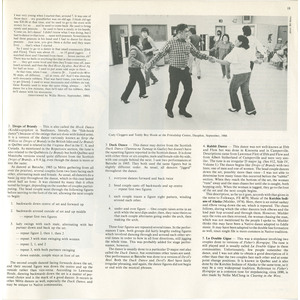
VA Old Native and Metis Fiddling in Manitoba Vol 1 BOOKLET PAGE 19
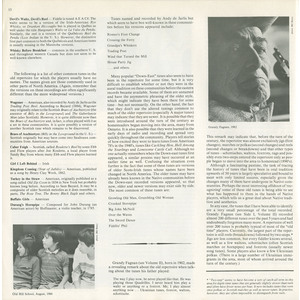
VA Old Native and Metis Fiddling in Manitoba Vol 1 BOOKLET PAGE 14
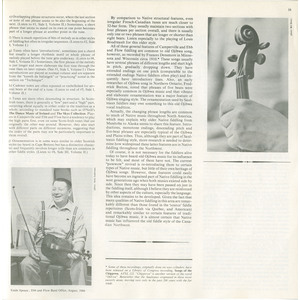
VA Old Native and Metis Fiddling in Manitoba Vol 1 BOOKLET PAGE 17
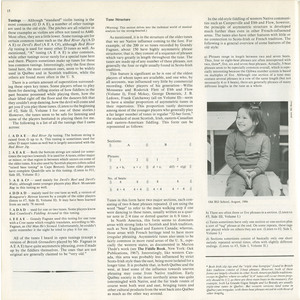
VA Old Native and Metis Fiddling in Manitoba Vol 1 BOOKLET PAGE 16
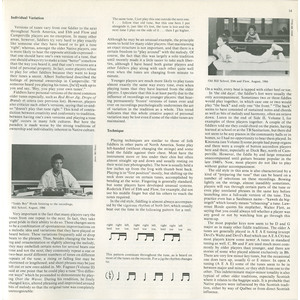
VA Old Native and Metis Fiddling in Manitoba Vol 1 BOOKLET PAGE 15
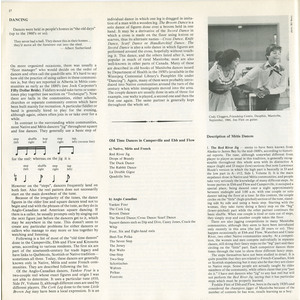
VA Old Native and Metis Fiddling in Manitoba Vol 1 BOOKLET PAGE 18
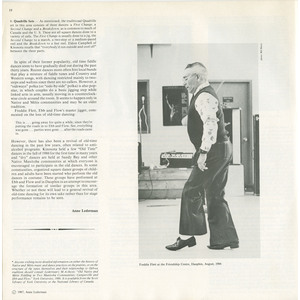
VA Old Native and Metis Fiddling in Manitoba Vol 1 BOOKLET PAGE 20
Media
Videos
0 videos
No videos available for this title.
Credits
Fiddlers
Willie Mousseau: fiddle
Walter Flett: fiddle
Lawrence “Teddy Boy” Houle: fiddle
Lawrence Flett: fiddle
Albert Beaulieu: fiddle
Emile Spence: fiddle
Frank Desjarlais: fiddle
Fred Levasseur: fiddle
John Alexander Asham “Jack” Ducharme: fiddle
Angus “Gus” McLeod: fiddle
Jimmy Anderson: fiddle
Eldon Campbell: fiddle
Guitar Accompaniment
Willie Henry: guitar with Willie Mousseau (credited as Bill Henry in the booklet)
Jimmy Flett: guitar with Walter Flett
Danny Flett: guitar with Albert Beaulieu; Albert Beaulieu, Lawrence Flett and Lawrence Houle; and Fred Levasseur
Ivan Spence: guitar with Emile Spence, Side III, selections 1 and 2
Eldon Campbell: guitar with Emile Spence, Side III, selection 4
Sandy Campbell: guitar with Frank Desjarlais, Side III, selection 5
Danny Partenais: guitar with Frank Desjarlais, Side III, selections 6, 7 and 8
Jimmy Anderson: guitar with Angus McLeod, Side IV, selections 3 and 5
Lawrence Houle: guitar with Angus McLeod, Side IV, selection 4; and Jimmy Anderson, Side IV, selections 6 and 7
Anne Lederman: guitar with Jimmy Anderson, Side IV, selection 9
Sandy Campbell: guitar with Eldon Campbell
Production and Field Recording
Anne Lederman: production, field recording
Lawrence “Teddy Boy” Houle: consultant, translator, field assistant
Willie Henry: additional field interviews, recordings and photographs
Bruce Cameron: final mastering
Dave Hillier: final mastering
Sean Snell: final mastering
Research and Booklet
Anne Lederman: research and booklet text
Lawrence “Teddy Boy” Houle: consultant, translator and cultural guide
The booklet includes historical background, biographies of the fiddlers, interview material, tune notes, musical transcriptions and discussion of traditional Native and Métis dances.
Recording
Recordings were made and gathered during 1985 and 1986 in Saulteaux and Métis communities in western Manitoba. The collection combines contemporary field recordings with earlier home recordings and tapes made as much as twenty years before the project.
Primary 1986 recording sessions were held at the Ebb and Flow Band Office and the old Hill School in Bacon Ridge. Additional recordings were made in musicians’ homes and at private gatherings in Ebb and Flow, Bacon Ridge, Kinosota, Winnipeg and surrounding communities. The principal August and September 1986 sessions were recorded directly to Beta tape using an F1 digital processor and two Sennheiser CK 30 microphones.
Earlier source recordings include cassette tapes, reel-to-reel recordings, portable Uher recordings, Sony Professional Walkman recordings and material originally recorded for the Manitoba Museum’s 1972 The Birth of a Province exhibit.
Design
Ian Bell: design and layout
Anne Lederman: design and layout
Photography
Willie Henry: additional field photographs
Bill Henry: photography
Anne Lederman: photography
Christiane Turgeon: photography
Jimmy Flett: Walter and Edith Flett photograph supplied from family collection
Funding and Support
Manitoba Department of Culture, Heritage and Recreation
Explorations Branch of the Canada Council
Canadian Centre for Folk Culture Studies, National Museum: earlier field research grant
Acknowledgements
Rummelt Hummelin, Association for Native Development in the Performing Arts: recording equipment
Graham Townsend: assistance identifying tunes
Steve Starchev: technical assistance
Carmelle Bégin, Canadian Centre for Folk Culture Studies
René Landry
Mitch Podoluk
Jim Robinson
Ava Kobrinsky
John Myers
Willie and Linda Henry
Carl and Vivian Grexton
Eldon and Audrey Campbell
James and Christianne Thurgood
Lawrence “Teddy Boy” Houle
Additional Information
The original package contained either two discs or one cassette together with an extensive booklet documenting the history of the music and traditional dances, biographies of the fiddlers, interview excerpts, tune notes, musical transcriptions and photographs. Some selections were preserved from older home recordings whose historical and cultural importance was considered more important than their recording quality.
Booklet text: © Anne Lederman
Recording: ℗ © Falcon Productions.
No Comments