Insight
Heather May makes folk music that feels private and still lets a listener in. The Calgary songwriter performs as Heather May, while her songwriting credits appear under her given name, Heather Adam. She builds her songs with a lot of room in them. Her guitar is usually tuned away from the familiar shapes, her voice sits down inside the song instead of riding above it, and her writing draws on books, gardens, prairie country, faith, doubt, memory and ordinary domestic life. The songs sit inside the folk tradition on her own terms.
Her first release was a six-song EP, While I’ve Been Away, in 2018. By the time she made her first full-length album she had a much wider musical language to work with. For Mark came out in 2020, recorded with producer and bassist Phenix Warren, drummer John Ferguson, pedal steel player Michael Kissinger and guitarist Ben Cameau, with Heather singing and playing acoustic and electric guitar. The title is personal. On the album page she dedicates the record to Mark, “the beautiful boy that the world lost too soon.”
For Mark widened her audience in Calgary. Songs from it were played on CBC, CKUA and CJSW, and Heather organized the release concert at Knox United Church herself, drawing more than eighty people. The album won Folk Recording of the Year at the 2020 YYC Music Awards.
Heather reads, and it shows in the writing. On Folk Revival, released in 2022, biblical figures, Harper Lee, Hank Williams, prairie geography, gardens, birds, railways, changing seasons and questions of faith and mortality all turn up as pieces of lived experience. “Job” moves an ancient story of suffering into a Canadian hotel. “To Kill a Mockingbird” takes its literary reference into a meditation on love, pride and moral courage. Other songs are plainly western Canadian: open prairie, bitter winter, spruce sap, birch bark, mountain rock, and the way a landscape changes its meaning depending on who is looking at it.
The sound of Folk Revival opened up as well. Heather sang and played acoustic guitar and piano, and Warren added bass, percussion and Mellotron. Jarret Mayo played pedal steel, Colin Carbonera piano, John Ferguson drums, and Ben Longman electric and acoustic guitar and vocals. Warren produced, engineered, mixed and mastered the album at Alta Sound. The bigger arrangements gave the songs more rooms to move through, and the writing still ran the record.
It found listeners well outside Calgary. In September 2022, Folk Revival reached number seven on the Earshot National Folk, Roots and Blues chart, and her music kept getting airplay on CBC, CKUA, CJSW and CHLY. Her Calgary shows have included the King Eddy and Heritage Park, where she was introduced as a songwriter whose unusual tunings and carefully built lyrics keep coming back to truth, love, mortality and belonging.
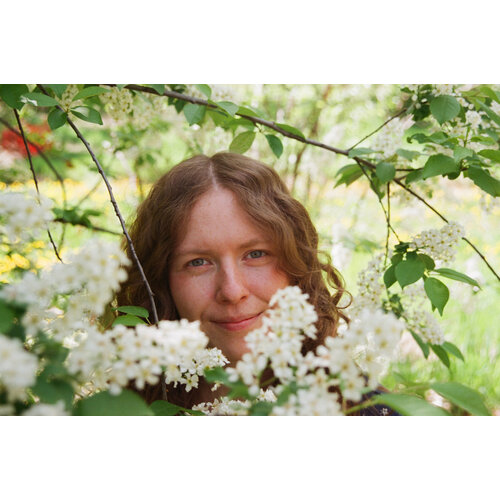
Four years later she went almost the other way. Her third album, Room for Improvement, released August 1, 2026, comes down to voice and acoustic guitar, with a harmonica turning up only at the end of the record. Heather cut the guitar and vocal together in one pass instead of building the performances up in layers, and let the tempo move with her own internal sense of rhythm. Phenix Warren came back to produce and mix, Micah Erenberg mastered it, and Evan Smibert shot the cover photograph.
That approach gives the record its character. The songs are out in the open with nowhere to hide, and no need to hide. A small movement in the guitar carries weight, and so does a breath. The small shifts in pace that usually get corrected or locked to a grid stay in the performance. The title carries an acceptance in it: a human performance does not have to be perfected out of existence.
The writing has changed too. The searching that ran through the earlier records is still here, though these songs are in less of a hurry to arrive anywhere. They come back to spring, flowers, friendship, love, longing and the natural world, and trust runs underneath all of it: trust that longing may find completion, that grief and love can share a life, that something new can bloom after a hard stretch. The record closes on the image of learning to move with the waves.
Taken together, the three albums make an unusual shape. For Mark carried grief into a full-band folk record. Folk Revival built a wider world around the songs, with pedal steel, piano, Mellotron, percussion and electric guitar. Room for Improvement clears most of that away and leaves Heather alone with the instrument the songs started on.
The writing is the constant. Heather May pays attention to things that are easy to walk past: a bird, a garden, a stretch of prairie, an old song on the radio, the colour of a season, the way a person holds onto someone who is gone. She keeps them at their own size and gives them enough quiet to be heard.
-Robert Williston
In her own words: Heather’s third album, Room for Improvement, echoes the intimacy of 1960s and 1970s folk classics. This collection features only three instruments: Heather’s voice, her acoustic guitar, and a harmonica (which is exclusive to the last track). She opted to record the guitar and vocals simultaneously, guided only by her inner rhythm; the result is a stripped-back, undeniably human quality that highlights the album’s core philosophy: leaving Room for Improvement.In many ways, these songs are an ode to trust: trusting that one day our longing will be complete, that though love may bring tears to our eyes it will wipe them dry; that the lilies will bloom, and they will be the colour of a fairer start.
The album concludes with the declaration “In waves, we tumble, we cry, we learn to glide.” In these songs, perhaps, Heather has found peace in the waves that once consumed her. She hopes her listeners will find the same.
Gallery
Images
1 image
Room for Improvement
Media
Videos
0 videos
No videos available for this title.
Credits
Musicians
Heather Adam: vocals, acoustic guitar, harmonica on final track
Songwriting
All songs written by Heather Adam.
Production
Produced and mixed by Phenix Warren
Mastered by Micah Erenberg
Vocals and acoustic guitar recorded simultaneously
Artwork
Cover photography by Evan Smibert
Copyright
All rights reserved
Additional Information
Room for Improvement is Heather Adam’s third album. The recordings feature only her voice, acoustic guitar and, on the final track, harmonica. The guitar and vocals were recorded simultaneously without a separate rhythm track.
No Comments