Insight
Robert Leslie Emmerson was born in Ottawa on September 17, 1944. His father, Bob, worked in the hardware business, and his mother, Olive (née Rooke), kept the house. A cheap Sears guitar he got one Christmas sat untouched until 1956, when Elvis Presley turned up on the Dorsey Brothers’ Stage Show on CBS and Les decided he had to learn it. He first stepped on a stage in grade 8, at City View Public School, pulled up by a friend who had put a little band together. Nobody got paid that night, and he never minded.
At Laurentian High School he played in the Profiles, who opened for Ronnie Hawkins at the Pineland Dance Hall in 1963. Hawkins’ backing band, the Hawks, would later become the Band, and the teenaged Emmerson walked out of that show changed. He later said he never knew live music could sound so good. In February 1964 he was working with country pioneer Hughie Scott when the band timed its set break to catch the Beatles on The Ed Sullivan Show. The new chords and changes settled it. When the Staccatos needed a guitar-playing singer, he took a pay cut to join them.
The Staccatos had formed in Ottawa in 1963 around singer and disc jockey Dean Hagopian, guitarist Vern Craig, bassist Brian Rading and drummer Rick Bell (born Rick Belanger). Emmerson took over from Hagopian and split the lead vocals with Bell. Their home base was the upstairs Rose Room at the Chaudière Club in Aylmer, Quebec, where they played British Invasion material and even pronounced the words the way the British did. Emmerson and Craig began slipping their own songs in between the covers.
‘It Isn’t Easy’ reached number 3 on CFRA in Ottawa in the spring of 1965 and brought a deal with Capitol Records of Canada. Being on the Beatles’ label felt like the big time. ‘Small Town Girl’ made the national top 20, ‘Move to California’ and ‘It’s a Long Way Home’ followed it up the charts, and the debut LP Initially arrived in 1966. In March 1966 Capitol also slipped out a novelty single under the name the Smart Set, ‘Sorry About That Chief’ backed with ‘Would You Believe’, both titles lifted from Don Adams’ catchphrases on Get Smart. Producer Paul White came up with the idea, and Emmerson and Craig took the writing credit as Lemon-McCaffrey, a wink at Lennon-McCartney. That summer Rick’s brother Mike Bell joined as a second drummer and third voice, and in August Capitol issued Emmerson’s ‘Let’s Run Away’. At the RPM Awards for 1966, the Staccatos were named top vocal instrumental group and ‘Let’s Run Away’ won best produced single. Emmerson was writing most of the originals by then, and his ‘Half Past Midnight’ went to number 1 in Ottawa and number 8 nationally in 1967. Around town they called him the Paul McCartney of Ottawa. On Canada Day of the Centennial year the Staccatos played for Queen Elizabeth and about 20,000 people at Lansdowne Park, and they were pulling in $1,500 a night, though national radio play stayed hard to get.
In 1968 producer Jack Richardson picked the Staccatos to share a Coca-Cola promotional LP, A Wild Pair, with the Guess Who. Fans mailed in bottle caps and a dollar for a copy. The Staccatos were the top band in the East and the Guess Who the top band in the West, and although Emmerson didn’t want to do it, the record paid well. Capitol then brought the band to Los Angeles, where they traded the matching suits for something scruffier. Ted Gerow came in on keyboards at the end of 1968 and Vern Craig left soon after. When producer Nick Venet said the Staccatos name sounded dated, Rading pointed to an Emmerson song called ‘Five Man Electrical Band’ and said that was exactly what they were. The self-titled album came out in early 1969, and when ‘It Never Rains on Maple Lane’ stalled, its flip side, ‘Private Train’, went top 40 in Canada. Capitol and the band parted at the end of the year and the five went home to Ottawa.
They tried Los Angeles again with Dallas Smith of Renaissance Productions, partnered with Jimmy Webb’s Canopy company, and landed at MGM. ‘Moonshine (Friend of Mine)’ went into the Alan Alda film The Moonshine War, and the 1970 album Good-byes and Butterflies had to be pulled and reissued because its cover showed a marijuana plant. The single ‘Hello Melinda, Goodbye’ stopped at number 55 in Canada. On its B-side was ‘Signs’.
Emmerson wrote ‘Signs’ after a drive on Route 66 through the Southwest, where a steady parade of billboards blocked out the desert. He said the whole song was right in front of him and he only had to write it down. The opening line about long-haired freaky people came from friends who had been turned away from jobs for their hair, and the church verse, with the narrator who has no penny for the plate, was written with his deeply religious grandmother in mind. MGM dropped the band after ‘Hello Melinda’ flopped, and the members went back to Ottawa expecting to call it quits.
Dallas Smith had meanwhile found a home with Lion Records, a new label tied to the Lionel model train company. In February 1971 MGM signed the band over, and in May Lion reissued the record with ‘Signs’ as the A-side, cut to three minutes by dropping two guitar solos. CKLW in Windsor put it into rotation and Detroit picked it up. Manager Abe Hoch talked the band out of breaking up. That summer an old friend working as a DJ in Norfolk, Virginia called to say the song was exploding and asked them down to play an outdoor festival, where the crowd sang along to a horizon’s worth of people. On the long drive to a Seattle date, WLS in Chicago announced ‘Signs’ as its new number 1 in the middle of the night. The band pulled over on a cloverleaf and jumped up and down beside the car. ‘Signs’ reached number 3 on the Billboard Hot 100, number 4 in Canada and the top 5 in Australia, went gold in August 1971 and sold more than 1.5 million copies. Boston stations objected to the church verse and wouldn’t play it, so the band never played Boston.
The hit put them on tour with the Allman Brothers, Jefferson Airplane, Sly and the Family Stone and BTO, and onto a Mardi Gras stage in New Orleans. For one week at the Whisky a Go Go they were Chuck Berry’s backing band, with the Rolling Stones watching from a booth. Emmerson’s legs were shaking, and his lasting regret was that nobody took a picture. Emmerson kept the songs coming. ‘Absolutely Right’ went to number 3 in Canada and number 26 in the U.S. in 1971, ‘Money Back Guarantee’ and ‘Werewolf’ charted on both sides of the border, and ‘I’m a Stranger Here’, sung by a space alien appalled at the pollution and everyday cruelty of Earth, became the band’s highest Canadian chart hit at number 2. The albums Coming of Age (1972) and Sweet Paradise (1973) followed. Mike Bell and Brian Rading left during the Sweet Paradise sessions, Rick Bell left in 1974, and when ‘Johnny Get a Gun’ peaked at number 69 in Canada in 1975, Emmerson and Gerow shut it down. Along the way, in 1971, Emmerson sued 4-Star over the worldwide handling of his song catalogue and settled the following year.
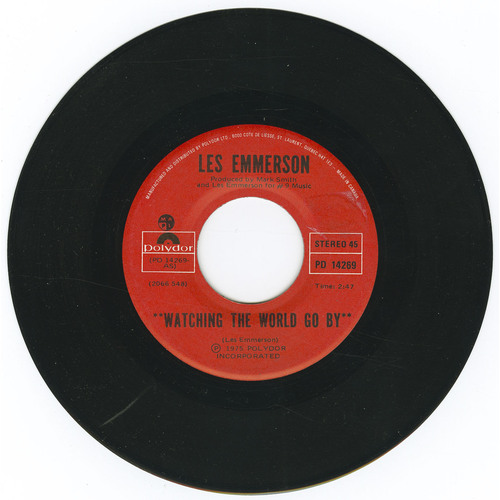
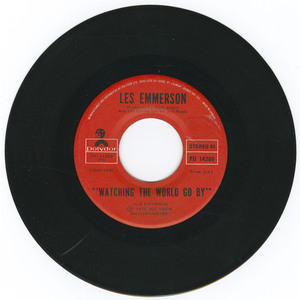
Emmerson had always preferred the studio to the road, and in 1972 he started a solo career alongside the band. ‘Control of Me’, backed with ‘Goin’ Through the Motions’, came out late that year on Polydor in Canada and Lion in the U.S., reached number 5 on the RPM chart in early 1973 and scraped to number 51 on Billboard. ‘Cry Your Eyes Out’ followed to number 18 in September 1973, ‘Cliches’ charted in 1974 and ‘Watching the World Go By’ reached number 26 in 1975. When the band ended he stayed in Los Angeles, working in the studios and writing songs like ‘California Take Me In’, about everyone who comes west chasing the big time, himself included. RCA issued ‘Dance, She Said’ in 1977. His 1976 and 1977 sessions sat on the shelf for thirty years until Sonic Past Music released them in 2007 as The Sound City Sessions, his only solo album.
By the end of the decade Emmerson was back in Ottawa, gigging in local clubs with the Emmerson Electrical Band, which included Brian Rading, and working with the Cooper Brothers. In 1986 all five original members, with Vern Craig sitting in on the Staccatos songs, reunited at the Ottawa Civic Centre for a Children’s Wish Foundation benefit. It was meant to be a one-off and turned into a yearly run of concerts and festivals that lasted the rest of his life, including Maxville’s 100th anniversary in 1992 and Canada Day on Parliament Hill in 1997. Through the 1980s and 1990s he played the CJOH telethons with the CHEO Bear Band, which helped raise tens of millions of dollars for the Children’s Hospital of Eastern Ontario, and in 2006 the band helped the Tabitha Foundation raise $250,000 for houses, schools and wells in Cambodia. Emmerson bought the rights to the band’s recordings and licensed them himself, starting with the 1995 collection Absolutely Right: The Best of Five Man Electrical Band.
‘Signs’ kept finding new audiences. Tesla’s acoustic cover on Five Man Acoustical Jam reached number 8 on Billboard in 1990 and sold another 1.5 million copies. Emmerson admitted he had thought the song might be dated, and was surprised how many kids still bristled at being told what they could and couldn’t do. In the mid-2000s Fatboy Slim built ‘Don’t Let the Man Get You Down’ on a loop of its opening line, and his bandmates joked that Les didn’t care for rap until the royalty cheque showed up. From then on the song alone gave him a comfortable living. ‘Signs’ earned a BMI award for a million U.S. airplays, and SOCAN gave Emmerson Classics Awards, each marking more than 100,000 Canadian radio plays, for ‘Signs’, ‘Absolutely Right’ and ‘I’m a Stranger Here’. In 2008 the Canadian Songwriters Hall of Fame inducted it, with Suzie McNeil and Kyle Riabko performing it at the gala. In 2014 he led ‘Signs 4 Change’, a remake produced by Eddie Kramer with guests including Lawrence Gowan, to raise money and awareness for Friends of the Earth Canada’s climate work.
In his later years Emmerson lived in Barrhaven, where his daughter Kristina called him the Birdman of Barrhaven for his love of birds. He had perfect pitch, did the crossword, golfed, knew his hockey trivia and liked a cold Alexander Keith’s with friends and a good story, usually his own. Ted Gerow remembered his motto as “Fun is the best thing to have.” In 2020, at 75, he said he still felt about 28, and he was recording a new album with his bandmates under a new name, one last kick at the can. He contracted COVID-19 in early November 2021 and, already weakened by other health problems, died at the Queensway Carleton Hospital on December 10, 2021, at 77. He was survived by his wife Monik, daughter Kristina and sister Darlene.
On May 25, 2022, Five Man Electrical Band played a tribute to him at the Bronson Centre, with his favourite Fender Stratocaster shown on the screen. Councillor Jeff Leiper brought along the sign for Les Emmerson Drive, a new street in Barrhaven, and Tesla’s Jeff Keith closed the night with ‘Signs’.
-Robert Williston
Gallery
Images
2 images
45-Les Emmerson - Watching the World Go By VINYL 02
Watching the World Go By b/w Why Woman Why
Media
Videos
0 videos
No videos available for this title.
Credits
In Transit
No Comments