Album / Title
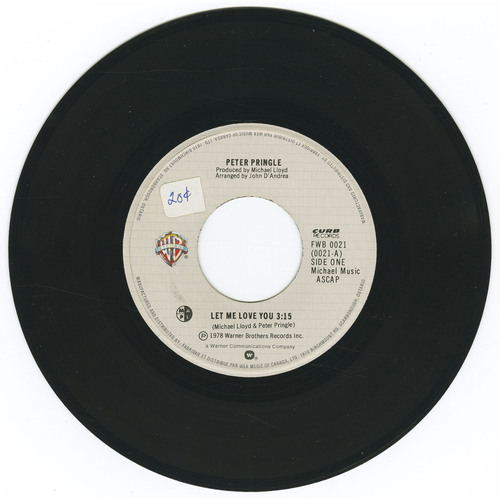
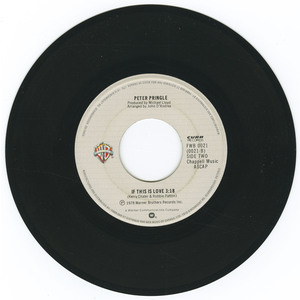
Let Me Love You b/w If This is Love
By: Peter Pringle
Origin: Halifax, Nova Scotia → Toronto, Ontario, 🇨🇦 → Los Angeles, California, 🇺🇸 → Montréal → Magog, Québec, 🇨🇦
Insight
Peter Pringle was born in Halifax, Nova Scotia, on September 7, 1945, and grew up in Toronto. At six he was singing soprano in the children's chorus of the Canadian Opera Company, an opera career that ended at thirteen when his voice dropped to baritone. He studied classical piano, attended the University of Toronto, and then travelled through Europe and Asia, studying sitar with Ravi Shankar and adding the surbahar and lute to his instruments. He paid for those years of study by writing pop songs.
Those songs reached producer Brian Ahern, who was then making Anne Murray's records. Ahern passed them to Murray, who recorded 'Drown Me' and 'Please Don't Sell Nova Scotia' and hired Pringle as a backup singer. Mary Travers of Peter, Paul and Mary recorded his material as well.
In 1975 Ahern, now producing Emmylou Harris for Reprise in Los Angeles, brought Pringle south to record for Warner Bros. His self-titled album came out on Reprise in 1976, produced and engineered by Ahern for Happy Sack Productions and played by much of the circle that made Harris's records: Bill Payne on keyboards, Mickey Raphael on harmonica, Rick Cunha, Fred Tackett and Mason Williams on guitar. Harris sang on Willie P. Bennett's 'White Line' and Linda Ronstadt sang on Rodney Crowell's 'Seeing's Believing'. Pringle wrote the other eight songs, played piano and harp, and recorded his own versions of the two songs Anne Murray had taken first. Christopher Dedrick, Glen D. Hardin and Milan Kymlicka shared the arrangements.
Warner Bros. issued 'You Really Got Me Needing You' as a single in 1977. A year later Warner and Curb Records released 'Let Me Love You', a song Pringle wrote with producer Michael Lloyd, backed with Kerry Chater and Robbie Patton's 'If This Is Love' and arranged by John D'Andrea. That year he was nominated for the Juno Award for Most Promising Male Vocalist. American television took notice, with appearances on the shows of Merv Griffin and Dinah Shore, and at home he guested with Al Hamel and Alan Thicke. In 1979 he headlined his own CTV network special.
Pringle moved to Montreal in 1980 and signed with A&M. Rain Upon the Sea (1981), produced by Harry Hinde at Manta Sound in Toronto, carried four of his own songs, 'Stranger', 'Lead Me Home', 'Sweet Lightning' and 'Merlin's Dance', alongside Peter Allen's 'I Could Have Been a Sailor' and 'It Just Occurred to Me', written by Skip Prokop of Lighthouse with Bob Johnson. He cut that single in English and French, and the French version sold more than 25,000 copies and sat at the top of Quebec's charts for weeks. In 1982 he earned his second Juno nomination. He became one of the few Canadian singers to build a career in both languages, releasing Magicien (1981), Fifth Avenue Blue (1982), Pour une femme (1982), Souris-moi, Fantasies and Chansons d'amour (all 1984) and Pauvre Casanova (1985). He hosted his own TVA series, Pringle, along with the Miss Canada and Miss Teen Canada pageants.
In 1985 he joined René Simard, Gilles Vigneault, Nanette Workman, Patsy Gallant and others on 'Les Yeux de la faim', Quebec's charity single for Ethiopian famine relief, and in 1986 he performed at Canada's first major benefit concert for AIDS. That same year he and Kevin Hunter wrote 'Cold as Ice' for the film Toby McTeague. It earned a Genie nomination for Best Original Song, though the Academy left it off the first round of ballots and had to mail out replacements.
Pringle spent a year studying Noël Coward, interviewing people who had known him, before the Coward estate gave him permission to play the man on stage. He wrote Noel Coward: A Portrait, mixing monologue with Coward's songs, and starred in it at the National Arts Centre in Ottawa, the Charlottetown Festival and Toronto's Bathurst Street Theatre in 1987, then toured it across Canada for years. More revues followed: From Irving Berlin to Gilles Vigneault, Le Secret du Cantique des Cantiques (1992), drawn from the biblical Song of Songs with his own music, and New York-Paris, A Musical Voyage. In 1994 he played Duncan in a Montreal production of Wendy Wasserstein's The Sisters Rosensweig.
In 1996 he released the retrospective Comme j'étais, comme je suis! and took up the theremin, which along with historical instruments became the centre of his work. Within a few years he was performing it in solo concerts and with the Montreal Chamber Orchestra. His main instrument is the 1929 RCA theremin that once belonged to Dr. Samuel Hoffman, whose playing is heard on dozens of mid-century film soundtracks. He recorded Many Voices (2003) and A Theremin Jewel Box, arranging Handel, Puccini and Richard Strauss alongside the Beatles and Brian Wilson.
From his home in Magog, Quebec, Pringle has since built one of the most watched music channels of its kind on YouTube. Since 2007 he has posted performances of ancient poetry sung in the original languages on instruments he plays or builds himself, among them the lyre and the hurdy-gurdy. His reconstruction of the opening of the Epic of Gilgamesh, sung in Sumerian to a three-string long-necked lute called the gishgudi, has drawn millions of views. He has also recorded the Hurrian Hymn No. 6, the oldest substantially complete song known, built a working replica of the Gold Lyre of Ur, and played a tribute to Leonard Nimoy on a 26-string Vulcan harp. He released Dancing Alone in 2021.
-Robert Williston
Gallery
Images
2 images
45-Peter Pringle - Let Me Love You bw If This Is Love VINYL 02
Let Me Love You b/w If This is Love
Media
Videos
0 videos
No videos available for this title.
Credits
Songwriting
‘Let Me Love You’ written by Michael Lloyd and Peter Pringle
‘If This Is Love’ written by Kerry Chater and Robbie Patton
Publishing
'Let Me Love You': Michael Music (ASCAP)
'If This Is Love': Chappell Music (ASCAP)
Phonographic Copyright ℗ 1978 Warner Bros. Records Inc.
Production
Produced by Michael Lloyd
Arranged by John D'Andrea
Release
Warner Bros. Records / Curb Records, FWB 0021, 7" 45 RPM Single, Canada
Manufactured and distributed by WEA Music of Canada Ltd., 1810 Birchmount Road, Scarborough, Ontario
A Warner Communications Company
Matrix/Runout
Side A: FWB - 0021 - A
Side B: FWB - 0021 - B
No Comments