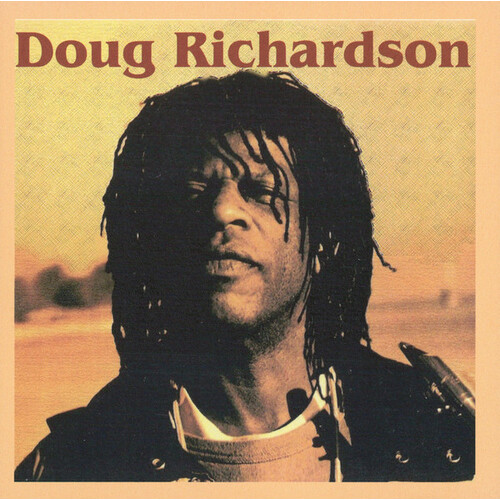
Album / Title
Doug Richardson
By: Doug Richardson
Origin: Toronto, Ontario → Montréal, Québec → Toronto, Ontario, 🇨🇦 → Los Angeles, California, 🇺🇸 → Toronto, Ontario, 🇨🇦
Insight
Douglas Joseph “Dougie” Richardson played tenor saxophone and flute on bandstands in Toronto, Montréal and Los Angeles for half a century. He was in Alfie Wade’s Stablemates in late-1950s Montréal, on the Prestige sessions by Duke Edwards & The Young Ones in 1968, in the second Motherlode in 1970, and on a run of Los Angeles jazz-funk records in the late 1970s. In his sixties, back in Toronto, he co-led Kollage, the hard bop band he built with his boyhood friend, drummer Archie Alleyne.
Richardson was born in Toronto on March 24, 1937, and grew up around Kensington Market. Alleyne, four years older, was a neighbourhood friend, and so was Larry Green, who later hosted jazz on JAZZ.FM91. Richardson and Alleyne were already working together in the 1950s: in January 1958 The New Canadian’s jazz column caught “drummer Archie Alleyne and young tenorman Doug Richardson” at the Club One-Two on Adelaide Street East.
In 1958 Richardson moved to Montréal, where he played in the Stablemates, a band pianist Alfie Wade put together with Nova Scotia guitarist Nelson Symonds, alto saxophonist Chet Christopher, drummer Charlie Duncan and bassist Bob Rudd, with Charlie Biddle occasionally sitting in on bass. For close to a year in 1958 and 1959 they held down the Vieux Moulin on Sherbrooke Street, a room of about 200 that booked them to play for dancing. Visiting musicians often came by to jam with them. The Montreal Star photographed the band at the Vieux Moulin in April 1959, and that July the Stablemates played Parc La Fontaine. He stayed in Montréal for the next decade, playing with Symonds among others.
In April 1968 Richardson joined the Montréal sessions for Is It Too Late?, the only album by Duke Edwards & The Young Ones. Prestige producer Cal Lampley recorded the band on April 29 and 30, and Richardson played tenor alongside Bernard Moore on ‘Black Elephant’, a piece built on free improvisation, gospel and blues. He moved back to Toronto that year.
In 1970 Revolver Records, which owned the Motherlode name, rebuilt the band around singer and keyboard player William “Smitty” Smith after the original group behind ‘When I Die’ had split. Smith brought in Richardson on saxophone, guitarist Anthony Shinault, who had played with Ike & Tina Turner, and drummer Philip Wilson, with label head Mort Ross producing. Richardson was the only Canadian among the three new players. Their single ‘I’m So Glad You’re You (And Not Me)’, backed with the instrumental ‘Whipoorwill’ (Revolver REVS 008), came out that summer and reached number 33 on RPM’s Canadian content (MAPL) chart in October. The second Motherlode broke up soon after.
By 1976 Richardson was working in the Los Angeles studios, playing soprano and tenor saxophone and flute on El Coco’s Let’s Get It Together for the producing team of Laurin Rinder and W. Michael Lewis. In January 1977 Capitol released For The Cos Of Jazz by the First Cosins Jazz Ensemble, produced by Bill Cosby’s longtime musical collaborator Stu Gardner, with Cosby credited as arranger and music consultant. Richardson played saxophone and flute alongside guitarist Wah Wah Watson, drummer James Gadson and keyboard player Larry Farrow.
That same year Rinder and Lewis made Richardson’s first album under his own name. Night Talk (AVI AVL 6013) brought him together with pianist David Benoit, trumpeter Harry Kim, trombonist Doug Wintz, guitarists Freddie Harris and Art Johnson, drummer Gary Ferguson, bassist David Williams, conga player Hector Andrade and Shamsi Sarumi on talking drum, with a string section arranged by Lewis. Richardson played tenor and soprano saxophone and flute, arranged the horns, and wrote most of the material, including the title track, ‘On The Prowl’, ‘Entre-Nous’ and ‘Winning Ticket’. AVI also pressed it in Canada (AVL 6013-V), and Pye issued it in Spain in 1978.
Rinder and Lewis kept him busy. He played tenor and alto saxophone and flute on In Search Of... by the In Search Of Orchestra (AVI, 1977), their album of music inspired by the television series. By November 1977 Cash Box reported he was between sessions for a second AVI album while recording for arranger Bill Loos’s score for the TV film Ruby And Oswald. No second solo AVI album has been identified. Around 1980 AVI repackaged three Night Talk tracks with music by Dave Benoit and Renzo Fraiese as Jazz Fusion (AVI 6090). Richardson also played tenor saxophone on the Rinlew Allstars’ self-titled 1979 album for AVI, alongside Harry Kim and other players from Rinder and Lewis’s Los Angeles circle.
Richardson was back in Toronto by the early 1990s, playing the clubs and, at times, with his old Montréal partner Nelson Symonds. Over the years he had worked with Rahsaan Roland Kirk, Freddie Hubbard and the O’Jays. Toronto musicians knew him as much for his warmth as for his playing. One night in 1991 a group of visiting Cuban musicians was turned away from the late jam session at the Rex. When Richardson heard about it he brought them up on stage with him. Flautist Jane Bunnett later called him a “positive force.”
In 1999 Richardson and Alleyne founded Kollage to keep the hard bop of the 1950s and 1960s alive and to give young Black Canadian musicians a place on the bandstand. Alleyne described the working method: he would bring in a record, Richardson would take the melody off it by ear, and within half an hour he and second saxophonist Joel Joseph had the horn parts worked out. Pianist and arranger Michael Shand, Joseph and Edmonton-born bassist Ron Johnston played on the band’s first album, Kollage Featuring Archie Alleyne And Doug Richardson (SeaJam, 2001), which included a tune Shand and Richardson wrote together. Fine Print, made with the support of JAZZ.FM91, followed in 2003, and Kollage released At This Time on Timely Manor and MapleMusic in 2006, with trumpeter Alexis Baro, trombonist Mei Kelly and pianist Robi Botos. It became one of the highest-profile and busiest jazz bands in Canada.
Richardson also made a second album under his own name, the independently released Doug Richardson (2003), produced with Chris Hall at The Bunker. Michael Shand played keyboards, with guitarist Kevin Breit, trombonist Russ Little, Alexis Baro, percussionist Norman Jones and bassist Ian DeSousa. Richardson played tenor, alto and soprano saxophones and flute, and recut ‘Salsa Mama’ more than 25 years after Night Talk. He dedicated the album to his partner, Adele.
Kollage played its last show with Richardson at Lula Lounge on December 5, 2006. He died at Hamilton General Hospital on January 25, 2007, while waiting for a lung transplant. He was 69. “He played from the heart,” said Larry Green. On February 11 the Toronto fundraiser Such A Melodious Racket, produced and directed by Ruby Webb and Archie Alleyne for St. Christopher House Music School and the Archie Alleyne Scholarship Fund, was dedicated to his memory. Humber College set up the Doug Richardson Memorial Award for its jazz students.
Gallery
Images
5 images
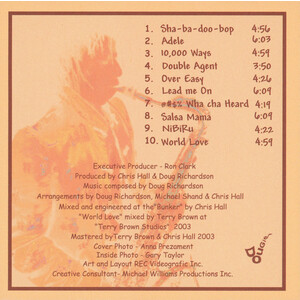
Doug Richardson – Doug Richardson (1)
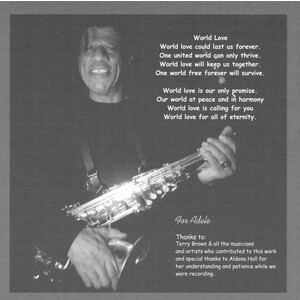
Doug Richardson – Doug Richardson (2)
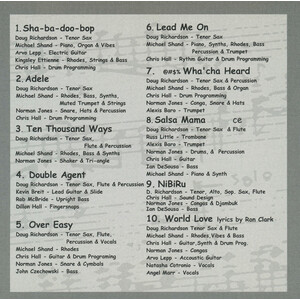
Doug Richardson – Doug Richardson (3)
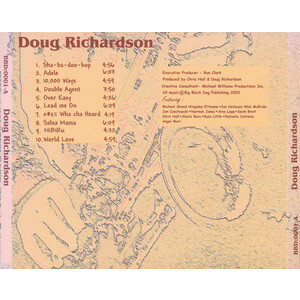
Doug Richardson – Doug Richardson (4)
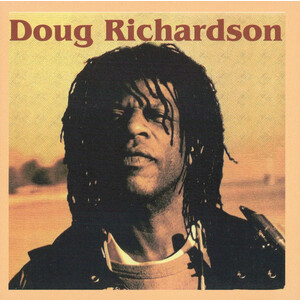
Doug Richardson
Media
Videos
0 videos
No videos available for this title.
Credits
In Transit
No Comments