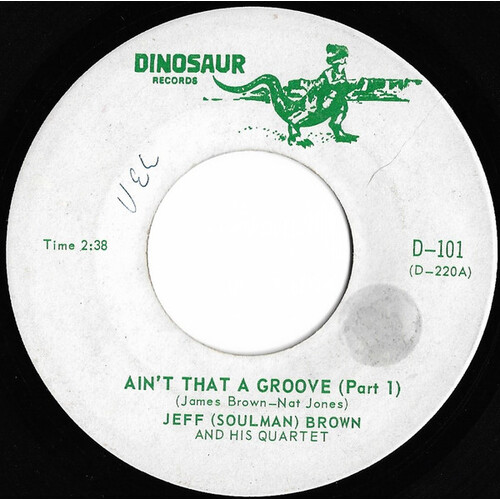
Album / Title
Ain't That a Groove
By: Jeff (Soulman) Brown And His Quartet
Origin: Philadelphia, Pennsylvania, 🇺🇸 → Montréal, Québec, 🇨🇦
Insight
Jeff St. Julian Brown came to Montréal in 1962 for a single engagement and stayed. An organist and singer who had worked the American R&B circuit with Little Anthony & The Imperials and Solomon Burke, he led bands at the Grand National, Harlem Paradise and the Esquire Show Bar, cut the Montréal soul 45 ‘Ain’t That A Groove’, and in 1967 put together the band that became Duke Edwards & The Young Ones. When that band broke up in September 1968, RPM columnist Solomon Tarr called him “one of the best organists in North America, to my mind.”
Brown was born in Philadelphia on June 14, 1940, the only son of a Methodist pastor, Jeff Brown Sr., and an educator, Alexzina Brown. He grew up around gospel music and counted Mahalia Jackson, Marian Anderson, Paul Robeson and Josephine Baker among his early influences. His start in music came in the Newark, New Jersey circle around organist Larry Young Jr., whom the family remembers as the relative who introduced him to the organ. Brown sang in the Challengers, the vocal group Young led through the late 1950s, and as a teenager joined a young jazz band called the Birdlanders.
He moved into rhythm and blues as a singer and musical director, working with Shep & The Limelights and Little Anthony & The Imperials, and was a founding member of a backing group called the Young Philadelphians. On the road he played behind Solomon Burke and Rufus Thomas and comedians Flip Wilson, Scoey Mitchell and Stu Gilliam.
Brown then joined the Earl Lett Quartet as its organist, and in 1962 the group came to Montréal to play the Grand National. He decided on the spot that Montréal would be home. With local and American players he formed the Jeff Brown Quartet, which packed the Grand National and Harlem Paradise and then became the house band at the Esquire Show Bar at 1224 Stanley Street, which billed itself as the House of Good Music and is remembered now as the city’s R&B mecca. Brown’s musicians backed the Motown acts and touring soul stars who played the Esquire’s horseshoe stage. Guitarist Wayne Prue joined the house band in 1965. Brown also drew billing in his own right: in September 1966 the Jeff “Soulman” Brown Combo was held over as Screamin’ Jay Hawkins opened, and in May 1967 the Jeff Brown Trio was the added attraction on Gene Chandler’s bill.
Along the way he recorded ‘Ain’t That A Groove’ with his quartet for the small Dinosaur label (Dinosaur 101), credited to Jeff (Soulman) Brown and His Quartet. It has since turned up on soul radio shows a long way from Stanley Street.
In 1967 Duke Edwards, the drummer and singer who had worked with Sun Ra and with Toronto’s Jon & Lee & The Checkmates, caught Brown’s set at the Esquire and asked him for a new kind of band. In July 1967 Brown built it out of his own house musicians: Prue on guitar, Clayton Johnston on drums, Dickie McGee on trombone and Bernard Moore on saxophones and flute, with Edwards out front as singer and narrator. That November the McGill Daily’s listings billed Ramadalic music by Jeff Brown & The Young Ones all week at Le Club, upstairs from Le Drug on Mountain Street, with a one-dollar cover. The Young Ones played long improvised cycles in Egyptian robes, ran their revue A Touch Of Black for fourteen weeks at Le Club, packed the Penny Farthing in Toronto, and on April 29 and 30, 1968, recorded Is It Too Late? for Prestige in Montréal, with Richard Woodson replacing McGee on trombone and Doug Richardson added on tenor saxophone for ‘Black Elephant’. Brown is credited on the album as J. St. Julian Brown. That summer the band opened for Cream at Massey Hall and the Centre Paul-Sauvé.
RPM reported the Young Ones finished at the end of September 1968, though the band still played a handful of dates into the next spring, and Tarr told readers Brown was now available. He went back on the road as musical director for a run of R&B singers, among them Vivian Reed, Dee Dee Warwick, Esther Phillips, and once again Little Anthony & The Imperials, and he played a world tour with the Platters.
After close to ten years of touring he settled in Dallas to write and arrange. He also went into business there, running an R&B bar called Mister Jeff’s, a taxi company, a limousine service, a beauty supply store and a French restaurant, Le Louvre. In 1987 he moved to Toronto and took up acting, with parts in Suspect, starring Cher, in Echoes In The Darkness and in Milk ’n Honey.
He came back to Montréal to set up BTA Management & Consultants and a music publishing company, Rocking Chair Music, and began writing and producing an album he called Sweetwater. Later he played New York and New Jersey rooms including the Peppermint Lounge, then moved to Atlanta, where he gave concerts at the Rialto Theater and kept performing until 2002. He died of kidney disease in December 2003.
In 2020 his widow, Claire Lamontagne Brown, and David Bloom founded Rockinchair Productions to bring his music back, describing him as a lyricist, vocalist and prolific Hammond B-3 organist. They brought in Ronald “Rock” Laster, James Brown’s longtime musical director, with bassist Fred Thomas and drummer Tony Cook, both veterans of James Brown’s band, and recorded new arrangements of Brown’s songs under the name Soul De Lune, including ‘Let’s Start All Over’. On January 15, 2021, Rockinchair released ‘Cousin Larry’ under Brown’s own name, followed on February 2 by Generations, published as Jeff “Soul Man” Brown, with ‘Cousin Larry’ alongside ‘Sister Sadie’, ‘Sunny’, ‘It’s Your Thing’ and ‘Fever’. The release does not say when or by whom its tracks were recorded.
-Robert Williston
Gallery
Images
2 images
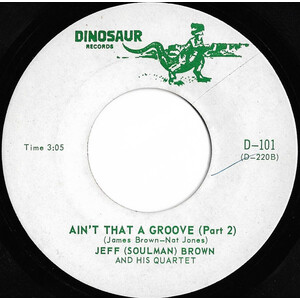
Jeff (Soulman) Brown And His Quartet – Ain't That A Groove (1)
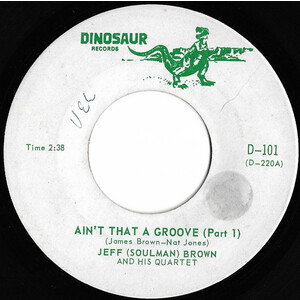
Ain't That a Groove
Media
Videos
0 videos
No videos available for this title.
Credits
Musicians
Jeff ‘Soulman’ Brown and His Quartet
Individual recording personnel not credited
Songwriting
‘Ain’t That a Groove (Part 1)’ written by James Brown and Nat Jones
‘Ain’t That a Groove (Part 2)’ written by James Brown and Nat Jones
Production
Lacquer cut at RCA Victor Studios, Montréal, Québec
Matrix Numbers
Side A: D-220A (label); D 220A G M (runout)
Side B: D-220B (label); D 220B G M (runout)
No Comments