Information/Write-up
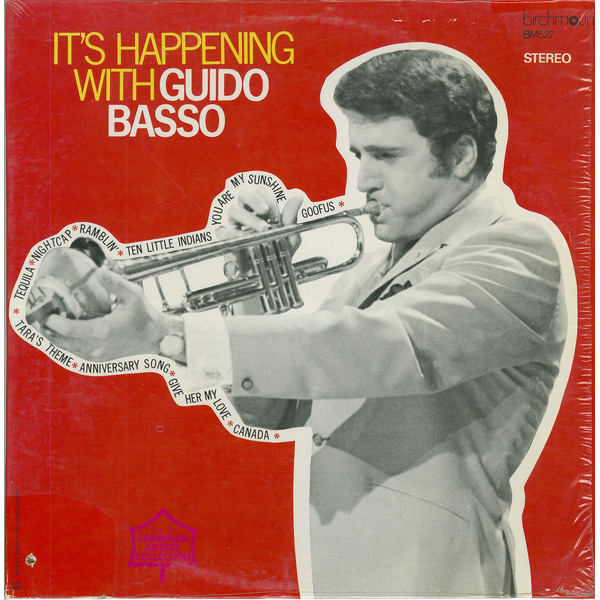
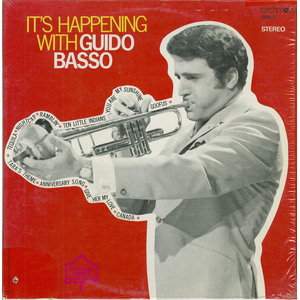
Guido Basso was one of the most important and distinctive brass voices in Canadian music, whose career spanned jazz, television, studio recording, big band leadership, and popular orchestral work. Born in Montréal, Québec, he began playing trumpet at the age of nine and studied at the Conservatoire de musique du Québec à Montréal. By his early teens he was already working professionally, performing under the nickname “Stubby” Basso in dance bands and show orchestras led by figures such as Al Nichols and Maury Kaye.
While appearing with Kaye at El Morocco in Montréal, Basso was heard by American singer Vic Damone, who hired the young trumpeter and took him on tour in 1957–58. This marked the beginning of several years of steady work in the United States. From 1958 to 1960, Basso toured extensively across North America with Pearl Bailey and the orchestra led by her husband, drummer Louis Bellson, gaining first-hand experience in major concert halls, theatres, and television productions while still in his teens.
In 1960, Basso relocated to Toronto, where he quickly became one of the city’s most in-demand studio trumpeters. He was a first-call musician for recording sessions, radio broadcasts, film and television work, and commercial jingles, and his playing soon became embedded across a wide cross-section of Canadian popular recording beyond strictly jazz contexts. He was also noted for his versatility, occasionally taking on harmonica assignments alongside his brass work. Toronto would remain his professional base for the remainder of his career.
Basso became a familiar national presence through his long association with the CBC. From 1963 to 1967 he served as musical director for the CBC-TV program Nightcap, followed by similar duties for Barris and Company from 1968 to 1969. He co-starred with vibraphonist Peter Appleyard on the CBC-TV series Mallets and Brass in 1969, was musical director for CBC Radio’s After Noon from 1969 to 1971, and later led orchestras for two major CBC-TV series devoted to big band music, In the Mood (1971–72) and Bandwagon (1972–73). In 1975, he organized and led large ensembles for high-profile concerts at the Canadian National Exhibition featuring Dizzy Gillespie and Benny Goodman.
Alongside his broadcasting work, Basso remained active as a performer in Toronto nightclubs and hotel lounges, leading small groups that often blended jazz and Latin rhythms. He was also a central soloist with many of Canada’s leading jazz ensembles, including the Boss Brass, the Rob McConnell Tentet, Nimmons ’N’ Nine Plus Six, and the big bands of Ron Collier and others. His flugelhorn playing, in particular, became widely admired for its warmth, lyricism, and expressive control, qualities that were heard to great effect on numerous Boss Brass recordings.
At the same time, Basso’s studio career extended deeply into Canadian pop, rock, soul, reggae, and television recording. His trumpet appears on a remarkably broad range of sessions, including recordings by artists as stylistically distant as Jackie Mittoo and Teenage Head, illustrating his role as a trusted first-call professional whose sound moved effortlessly between jazz ensembles, pop productions, reggae sessions, and punk-era rock recordings. That same adaptability placed his playing firmly within the wider soundscape of Canadian broadcast culture, including appearances on hockey-related recordings such as Lafleur! and the Hockey Night in Canada theme.
Despite his stature within Canadian jazz, Basso was often reluctant to present himself strictly as a jazz artist, preferring to work across stylistic boundaries. He was nonetheless capable of incisive bebop trumpet work when required and became well known for his oft-quoted observation that “you attack a trumpet, and you make love to a flugelhorn,” a phrase that neatly summarized his approach to tone and phrasing.
As studio work declined in the late 1970s, Basso shifted much of his professional focus toward leading what became one of Toronto’s most successful society orchestras, maintaining a high level of performance activity well into later decades. His contributions to Canadian music were formally recognized in 1994, when he was appointed a Member of the Order of Canada. Guido Basso passed away on February 13, 2023, at the age of 85.
-Robert Williston
Songwriting
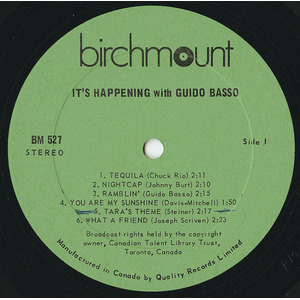
‘Tequila’ written by Chuck Rio (BMI)
‘Nightcap’ written by Johnny Burt (CAPAC)
‘Ramblin’’ written by Guido Basso (MR)
‘You Are My Sunshine’ written by Davis–Mitchell (CAPAC)
‘Tara’s Theme’ written by Steiner (CAPAC)
‘What a Friend’ written by Joseph Scriven (Public Domain)
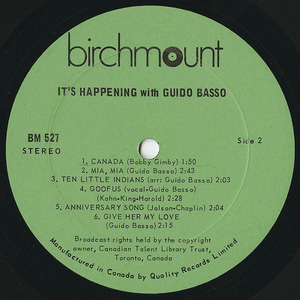
‘Canada’ written by Bobby Gimby (CAPAC)
‘Mia Mia’ written by Guido Basso (BMI)
‘Ten Little Indians’ arranged by Guido Basso (BMI)
‘Goopus’ written by Kahn–Kingsland (CAPAC) — vocal by Guido Basso
‘Anniversary Song’ written by Jolson–Chaplin (CAPAC)
‘Give Her My Love’ written by Guido Basso (MR)
Production
Produced by J. Lyman Potts
Engineered by Roy Smith
Recording supervised by Johnny Burt
Arrangements
All arrangements conceived by Guido Basso
Orchestrated by Jimmy Dale, Ben McPeek, Roy Smith, and Rick Wilkins
Courtesy of the Canadian Talent Library Trust
Notes
“Broadcast and public performance rights held by the Canadian Talent Library Trust, 23 St. Clair Avenue West, Toronto. Unauthorized use subject to legal action.”
Manufactured and distributed in Canada by Quality Records Limited
380 Birchmount Road, Scarborough 704, Ontario
Buy Canadian
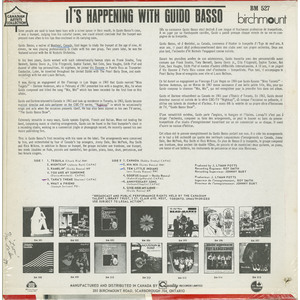
Liner notes
Some people are said to have been born with a silver spoon in their mouth. In Guido Basso’s case, it was a trumpet. Judging from his colorful career, one could almost conclude that the trumpet was pressed more often to his lips than enclosed in its carrying case.
Guido Basso, a native of Montreal, Canada, first began to study the trumpet at the age of nine. At eleven, he was playing professionally in clubs with his own group. Two years later, he was the featured soloist with the Al Nichols Orchestra.
In his teens, Guido worked with such internationally famous stars as Frank Sinatra, Tony Bennett, Sammy Davis Jr., Ella Fitzgerald, Sophie Tucker, Nat Cole, Sara Vaughn, Edith Piaf and dozens of other top personalities. At eighteen, he joined Vic Damone in Puerto Rico as Trumpeter-Conductor. Later, he travelled throughout the United States with The Pearl Bailey Show, and made recordings with her and Louis Bellson.
It was during an engagement at the Flamingo in Las Vegas in 1960 that Guido married “Miss Toronto” — Darlene Anderson, who in February of 1967 presented him with a daughter, Mia, for whom Guido composed and titled the song “Mia, Mia” which has been recorded for the first time on this album.
Guido and Darlene returned to Canada in 1961 and took up residence in Toronto. In 1963, Guido became musical director and solo performer on the CBC-TV series, “Nightcap” in which he occasionally sings and acts when the occasion presents itself. He has also been starred in his own TV series, “The Guido Basso Show”.
Extremely versatile in many ways, Guido speaks English, French and Italian. When not leading the band, composing music or charting arrangements, Guido can be found in the first trumpeter’s chair in a recording studio, working on a commercial jingle or phonograph record. He recently opened his own music publishing firm.
This is Guido Basso’s first recording with his name on the label. The arrangements were conceived by him, and orchestrated by four of Canada’s top arrangers, Jimmy Dale, Ben McPeek, Roy Smith and Rick Wilkins. In addition to Basso on trumpet, the group includes one trombone, one trumpet, two reeds (doubles on flute, piccolo and mandoline), two guitars, piano, bass, drum, percussion, and two female singers.
Dès sa naissance Guido Basso était destiné à une longue et fructueuse profession de trompettiste. En à juger par sa flamboyante carrière, Guido a passé presque chaque minute de sa vie en compagnie de sa trompette.
Guido Basso, né à Montréal, au Canada, commença à étudier la trompette à l’âge de neuf ans. A onze ans, il jouait déjà professionnellement dans des clubs avec son propre orchestre. Deux ans plus tard, l’orchestre d’Al Nichols l’engageait comme soliste.
Durant les premières années de son adolescence, Guido travaillait avec des personnalités aussi connues que Frank Sinatra, Tony Bennett, Sammy Davis Jr., Ella Fitzgerald, Sophie Tucker, Nat Cole, Sara Vaughn, Edith Piaf et nombre d’autres célébrités internationales. A 18 ans, il se joignit à Vic Damone à Porto Rico comme chef d’orchestre — trompettiste. Plus tard, il accompagna le Pearl Bailey Show et enregistra avec elle et Louis Bellson.
Ce fut durant un engagement au Flamingo à Las Vegas en 1960 que Guido épousa “Miss Toronto” — Darlene Anderson, qui en février de 1967 donna naissance à une belle petite fille, Mia, pour qui Guido composa la chanson “Mia, Mia”, qui est enregistrée pour la première fois dans cet album.
Guido et Darlene retournèrent au Canada en 1961 pour s’établir à Toronto. En 1963, Guido devint directeur musical et soliste de la série CBC-TV “Nightcap”, où lorsque l’occasion se présente, il utilise ses talents de chanteur et d’acteur. Il a aussi été la vedette de sa propre série d’émissions de TV, “Guido Basso Show”.
D’une versatilité extrême, Guido parle l’anglais, le français et l’italien. Lorsqu’il n’est pas à diriger l’orchestre, composer ou faire des arrangements, on peut le trouver au banc du premier trompettiste d’un studio d’enregistrement travaillant sur un air commercial ou un disque. Il vient d’ouvrir sa maison d’édition.
Cet album est le premier enregistrement de Guido Basso portant son nom. Il a créé les arrangements et le tout a été orchestré par quatre des meilleurs compositeurs d’arrangements au Canada, Jimmy Dale, Ben McPeek, Roy Smith et Rick Wilkins. En plus de Basso à la trompette, le groupe comprend une trombone, deux trompettes (de double flûtes, de piccolo et de mandoline), deux guitares, un piano, une basse et une batterie, les instruments de percussion et deux voix féminines.
No Comments