Insight
The Hometown Band was one of the great short-lived West Coast Canadian groups of the 1970s: a polished, highly musical ensemble that grew out of Valdy’s touring world, carried the instrumental sophistication of Vancouver’s studio scene, and gave Shari Ulrich one of her first national showcases as a lead vocalist.
The group was formed in Vancouver in 1975 by Claire Lawrence, the saxophonist, flautist, producer, and keyboard player whose earlier work with The Collectors and Chilliwack had already made him a central figure in British Columbia music. After leaving Chilliwack, Lawrence moved further into production, label work, and artist development, including his work with Valdy. As Valdy’s records became more arranged and his national touring profile expanded, the need for a full backing group became clear. Lawrence assembled a band from some of Vancouver’s strongest players, creating an ensemble that could support Valdy while also developing its own identity.
The core lineup featured Shari Ulrich on lead vocals, violin, flute, and other instruments; Claire Lawrence on saxophone and flute; Doug Edwards on guitar, bass, and keyboards; Robbie King on organ, piano, and keyboard bass; and Geoff Eyre on drums and vocals. The combination was unusually strong. Lawrence brought production discipline and arranging experience, Edwards and King brought deep studio and rock credentials, Eyre gave the group rhythmic drive, and Ulrich supplied the voice and instrumental colour that became the band’s emotional centre.
Before joining The Hometown Band, Ulrich had been part of the Pied Pumkin String Ensemble with Joe Mock and Rick Scott, a wildly inventive acoustic group that had become a cult favourite in British Columbia. That connection proved central to The Hometown Band’s story. The group’s best-known songs, ‘Flying’ and ‘I’m Ready,’ came from Joe Mock’s writing and had already been associated with the Pied Pumkin world before The Hometown Band recorded them. Ulrich’s performance of ‘Flying’ became the defining moment of the band’s first album and helped carry her voice across Canada.
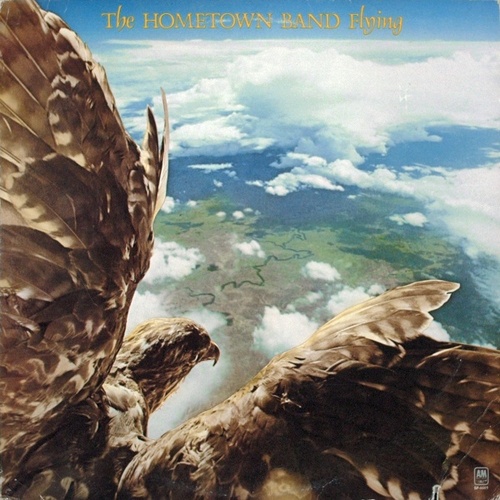
The band’s debut album, Flying, was released by A&M Records in 1976. Produced by Claire Lawrence and recorded at Little Mountain Sound in Vancouver, the album captured the group’s blend of folk-rock warmth, progressive West Coast musicianship, and radio-ready pop accessibility. What made the album work was the way it avoided being only a folk record or only a pop-rock record. The songs were melodic and open-hearted, but the playing had a much broader vocabulary: violin, flute, saxophone, organ, piano, keyboard bass, guitar, drums, and layered vocals. Ulrich’s lead voice gave the album its lift, while the band’s instrumental range gave the material a sophistication beyond the usual singer-songwriter backing group format.
The Hometown Band was also closely tied to Valdy’s own mid-1970s evolution. Valdy had first built his reputation as a solo folk performer, but by the time he was recording and touring with The Hometown Band, his music had expanded into a broader folk-pop setting. Their work together was documented on Valdy and The Hometown Band, also released by A&M in 1976. The album placed the group directly behind one of Canada’s most popular folk artists while also showing that Lawrence’s ensemble was more than a hired touring unit. They had their own sound, their own internal chemistry, and a lead singer in Ulrich whose presence was becoming impossible to miss.
In 1977, the group released its self-titled second album, The Hometown Band, again on A&M. By this point, Eddie Patterson had joined the lineup, expanding the band’s guitar presence. The album continued the group’s polished West Coast sound and included Shari Ulrich’s early songwriting breakthrough ‘Feel Good,’ the first song she had written. That song became an important stepping stone into her solo career after the band ended.
The Hometown Band’s national recognition peaked in 1978 when they won the Juno Award for Most Promising Group of the Year. It was a remarkable achievement for a group whose recorded output was limited, but it reflected the respect they had earned as players, arrangers, vocalists, and touring musicians during a period when Canadian folk, pop, and rock were increasingly overlapping.
Despite that promise, The Hometown Band did not last long. Their second album did not generate the same radio momentum as Flying, and the group dissolved soon afterward. In hindsight, their short lifespan makes them feel less like a conventional band and more like a convergence point: Valdy’s folk audience, Claire Lawrence’s production world, Vancouver’s studio musicians, Pied Pumkin’s acoustic eccentricity, and Shari Ulrich’s emerging songwriting voice all meeting in one brief, bright moment.
The afterlife of the band was significant. Shari Ulrich moved into a successful solo career, beginning with Long Nights in 1980 and One Step Ahead in 1981, the latter helping earn her the Juno Award for Most Promising Female Vocalist of the Year. Claire Lawrence continued to produce and work closely with her through her early solo albums. Doug Edwards, Robbie King, Geoff Eyre, and Eddie Patterson each carried deep musical histories of their own, making The Hometown Band one of those rare groups whose importance cannot be measured only by its discography.
For Shari Ulrich’s story, The Hometown Band was decisive. It moved her from the beloved but more regional world of Pied Pumkin into national visibility, gave her a signature vocal moment with ‘Flying,’ and introduced her as a songwriter through ‘Feel Good.’ For Canadian music, the band stands as one of the clearest links between 1970s West Coast folk culture and the more produced, radio-conscious singer-songwriter sound that followed. Short-lived as they were, The Hometown Band left a graceful and lasting imprint: accomplished, open-hearted, musically fluent, and unmistakably rooted in the creative energy of British Columbia.
-Robert Williston
Gallery
Images
1 image
Flying
Media
Videos
1 video
Credits
In Transit
No Comments