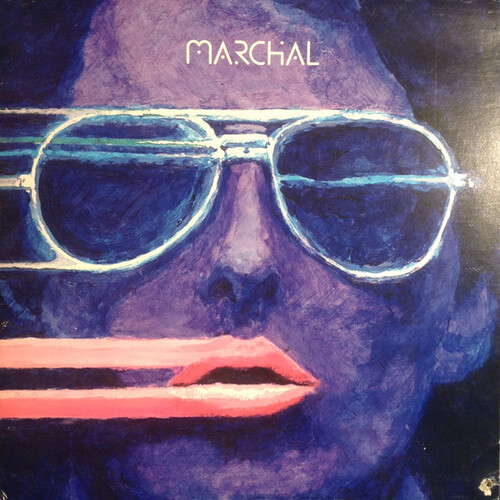
Insight
Diane Marchal was born in Montréal on March 26, 1948, and was singing in nightclubs before she was a teenager. She was twelve when she made her first club appearance, at La Porte St-Denis, and thirteen when she won an amateur talent contest. She spent the next decade on club stages, from 1964 as part of a team, and in 1974 she struck out on her own.
Polydor released her first single, 'Viens faire un tour', in the spring of 1974. Dimanche-Matin's reviewer noted that she brought a formidable amount of experience to a first 45, and the song turned up on request charts from Rimouski to Plessisville. 'Jesse Joe (Tu dois partir)' and 'Oublie demain' followed. Polydor put her on its Vive la chanson compilation beside Georges Moustaki, Serge Reggiani, Marie Laforêt and Maxime Le Forestier, and 'Jesse Joe' landed on K-Tel's Fantastiques 25 Supers Succès. That summer she was appearing at Chez Fernand, at À la Catalogne in Montréal's west end. Dimanche-Matin headlined its July feature with a play on her name: like Diana, the Roman goddess of the hunt, Diane Marchal had more than one string to her bow. She told the paper she was nervous by nature, that fishing and the outdoors were her "pill for the nerves", and that she had her eye on Europe.
Her self-titled album, Polydor 2424 100, followed in 1975. It was recorded at Son Québec and produced by Yves Vincent, who also wrote the arrangements, with four tracks produced by Ralph Siegel. Alan Thorne and Pete Tessier engineered and mixed it, and June Wallack wrote French adaptations of songs credited to Neil Young, Kris Kristofferson and Joe Tex. Alongside the singles were 'Je suis une femme', 'Il jouait', 'Oh Love, My Love' and 'Pourquoi toujours détruire'.
In 1974 and 1975 she toured Canada with a Polish cultural festival, and its organizers invited her to the 15th Sopot International Song Festival in August 1975, where she represented Polydor. On the festival's Polish Day, when foreign artists performed Polish songs, she sang 'Nie bójmy się jesieni' by Czesław Majewski and Ryszard Czubaczyński, with French words by Pierre Huet. The juries gave their main prizes to Glenn Weston and Corina Chiriac, but the accredited journalists gave theirs to the Canadian singer from Polydor. Her performance was issued on Polskie Nagrania's Sopot 75 album. By the time the story reached Provincetown in 1981, it had become first prize over contestants from 35 countries.
Québec television kept her busy that year. In April she was a guest on Lise Payette's late-night show, and on October 5 she sang on Radio-Canada's Les Beaux Dimanches, in an edition hosted by Jacques Boulanger, sharing the bill with Diane Dufresne, Georges Langford and Serge Laprade.
In January 1976 she was on hand when the new Interdisk label signed a manufacturing and distribution deal with Quality Records. Her Interdisk records were produced by André Di Cesare for Musique Bonaventure, with arrangements by Jerry De Villiers. 'Il est trop tard maintenant', a French version of 'Who's Sorry Now?', came first, then 'Amour incertain' by André Rousseau and Richard Huet, which reached the top 15 of the Saguenay chart that fall. The album Marchal, Interdisk ID 7001, moved onto the dance floor with 'Disco ville', 'Feu rouge', 'Y faut que tu « groove »' and 'Danse avec moi', and added the English-language 'Goodbye Little Lover'. Bruce Rickerd, Jean-Pierre Lamontagne, Kevin Gillespie, John Dufour and Ginette Parenteau were among the writers. 'Soleil de ma vie' charted in January and February 1977, and 'Disco ville' was on station playlists from Matane to Baie-Comeau that spring.
Provincetown, Massachusetts, came next. At a 1980 party at Shakra's Alley, the cabaret singer Linda Gerard, a former understudy to Barbra Streisand in Funny Girl and co-owner of the Pied Piper, introduced her as a French-speaking singer from Montréal. Diane apologized for her English and sang several songs in French. When the crowd called her back, she sang several more in perfect English. She spent the next two summers at the Pied Piper, singing Wednesday to Sunday nights with pianist Roger Kent, and in 1981 Applause of Provincetown gave her its Entertainment Award. Back in Montréal she was studying musical theatre at Concordia University. She planned to make her next album mostly in English and dreamed of one day running a theatre of her own.
She and Linda Gerard became a duo. In March 1982 they were singing six nights a week at Baja's on Lovett Boulevard in Houston, Texas. When the Pied Piper opened its 1983 season, the pair took the stage for 90 minutes with Toby Hall at the piano: duets of 'Year After Year' and 'Dream a Little Dream of Me', a country and western medley, Diane's solo turn on 'Teach Me Tonight', and an Irving Berlin medley for the songwriter's 95th year. They closed with 'God Bless America' and a standing ovation.
-Robert Williston
Gallery
Images
3 images
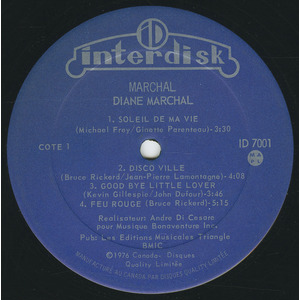
Diane Marchal - Marchal LABEL 01
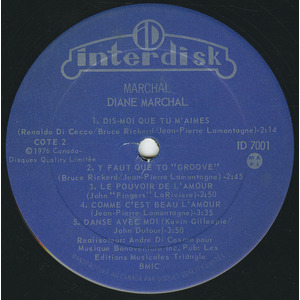
Diane Marchal - Marchal LABEL 02
Marchal
Media
Videos
0 videos
No videos available for this title.
Credits
Musicians
Diane Marchal: lead vocals
Songwriting
‘Soleil de ma vie’ written by Michael Frey and Ginette Parenteau
‘Disco ville’ written by Bruce Rickerd and Jean-Pierre Lamontagne
‘Goodbye Little Lover’ written by Kevin Gillespie and John Dufour
‘Feu rouge’ written by Bruce Rickerd
‘Dis-moi que tu m’aimes’ written by Renaldo Di Cecco, Bruce Rickerd and Jean-Pierre Lamontagne
‘Y faut que tu « groove »’ written by Bruce Rickerd and Jean-Pierre Lamontagne
‘Le pouvoir de l’amour’ written by John “Fingers” LaRiviere
‘Comme c’est beau l’amour’ written by Jean-Pierre Lamontagne
‘Danse avec moi’ written by Kevin Gillespie and John Dufour
Publishing
Les Éditions Musicales Triangle (BMIC)
Production
Produced by André Di Cesare for Musique Bonaventure Inc.
Release
1976, Interdisk, ID 7001, Vinyl LP, Canada
Manufactured and distributed by Disques Quality Limitée, Canada
Copyright © 1976 Canada – Disques Quality Limitée
No Comments