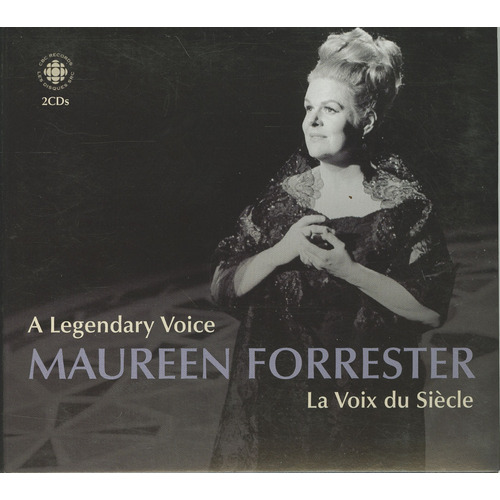
Insight
In 1956 the eighty-year-old and legendary conductor Bruno Walter invited the twenty-six-year-old and relatively little-known contralto Maureen Forrester to be soloist in his performances with the New York Philharmonic Society of Mahler's Resurrection Symphony. The event made Forrester famous, and through Walter she had a direct contact with Gustav Mahler (whose associate Walter had been), the composer whose vocal music has not had a more persuasive interpreter.
Forrester was born in Montreal where, in 1950, she became one of the first of many outstanding students of the Dutch baritone, Bernard Diamant, who had recently settled in the city. When she gave her first professional recital in 1953 her accompanist was John Newmark, with whom an artistic bond was formed that remained through many years and hundreds of recitals. That 1953 recital marked the beginning of a long and prosperous voyage that would encompass the concert halls and opera houses of the world.
Soon after the Montreal recital of 1953 there was a Beethoven Ninth Symphony conducted by Otto Klemperer in Montreal, a recital tour of Ontario and Quebec, an appearance in Toronto with the young Glenn Gould, and a European recital tour under the auspices of Les jeunesses musicales. Then came Bruno Walter who set the seal on what was already a rapidly developing career.
Maureen Forrester was sometimes singled out as the successor to the great English contralto Kathleen Ferrier after her early death at the height of her career in 1953. True contraltos are rare and great ones even rarer, and in the 1950s the only other singers with whom Forrester might have been compared were Ferrier and Marion Anderson. In fact, Forrester needed comparison with no one. In timbre and artistry she was distinctive in herself. Forrester's opulent voice had the glowing lustre of her esteemed contemporaries, as well as a highly variegated spectrum of colours through a wide range; and most important of all her voice carried the personal trait of only the greatest singers - it was immediately and unmistakably recognizable.
Forrester's sensibilities were especially well-suited to recitals and concerts. She combined an aristocratic bearing and a heroic voice with an engaging presence so that her audiences responded warmly to performances that were at once authoritative and intimate. Besides being an undisputed interpreter of the songs of Mahler she was equally successful with other masters of German art song, especially Brahms. By both temperament and quality of voice, she could realize equally the sombre gravity of the Four Serious Songs and the spirited and multi-faceted character of the Gypsy Songs. In Wagner's Wesendonck Lieder she never lost the intensity of utterance while sustaining the reflective interior mood of the songs.
At the same time that she was establishing her fame as a lieder recitalist, Forrester showed herself to be equally at home in the baroque music of Handel and Bach. There were many performances of Messiah and The St. Matthew Passion, and for nine seasons she was a member of the Bach Aria Group. But perhaps most remarkable for the time was her participation in a series of recordings of complete operas by Handel in the 1960s. These works were just beginning to return to the modern stage and Forrester revealed not only a sympathy with the dramatic requirements but also the ability to negotiate the vocal demands of Handel's operatic music. Just as the songs of Brahms and Wagner display the luminous quality of her true contralto, the opera arias of Handel often show off her higher range and the lightness and openness of which she was capable. The demanding "Se bramate d'amar" is a virtual paradigm of the other Forrester - agile, deftly brilliant, but always sensitive to the text.
Forrester had a few early encounters with opera in Montreal but her first important stage role was Orfeo in Gluck's Orfeo ed Euridice in Toronto in 1962. She sang Brangäne in Tristan und Isolde at Buenos Aires in 1963 and Cordelia in the New York City Opera's celebrated production of Handel's Giulio Cesare in 1966. Although the concert stage continued to be her principal home, the opera house took on increasing significance with appearances in San Francisco, Santa Fe, New York, Buenos Aires, Edmonton, Toronto, Ottawa, Montreal and Quebec City. The boisterous side of Forrester, which often could be glimpsed on the concert stage, was given full play in the role of the Witch in the Canadian Broadcasting Corporation's television production of Humperdinck's Hansel and Gretel in 1970. After that it was not surprising that she included in her repertoire such disparate roles as Fricka in Die Walküre (with the Canadian Opera Company in Toronto) and Erda in Das Rheingold (at the Metropolitan Opera in New York) as well as Bloody Mary in South Pacific (at the Edmonton Opera) and the Queen of the Fairies in Iolanthe (Stratford Festival). One of her greatest stage triumphs was in Strauss's Elektra with the Canadian Opera Company in Toronto when the nuance and subtlety of the song recital were brought to a prodigious vocal and dramatic portrayal of the mad and terrified Klytemnestra. She gave chilling impersonations of the aged and mysterious Countess in Tchaikovsky's Queen of Spades in Ottawa and Toronto, and in 1990 for her debut at La Scala in Milan. In the course of her long career, she sang more than twenty stage roles.
Maureen Forrester was always very much a Canadian contralto. She regularly performed songs by Canadian composers, who often composed works especially for her, and her international engagements were shared with those in towns and cities throughout her country. In 1984 she accepted a five-year term as Chairman of the Canada Council and gave that post a prominence and an unprecedented authority both with the public and with the arts communities that she so vigorously represented.
As her career on the concert and opera stages came to an end, she embarked finally with composer-pianist David Warrack on a one-woman show titled Interpretation of a Life. And what a life it was - circling the globe from Canada to Australia to the Soviet Union, Companion of the Order of Canada, Chancellor of Wilfred Laurier University, member of the Juno Hall of Fame, recipient of countless honours, mother of five children. In the spring of 2009 Maureen Forrester was living quietly in Toronto, behind her career that spanned well over forty years before the public, during which she lost nothing of her artistic poise and her directness of communication. Hers was a musical spirit that thrilled the connoisseur as well as the listener who enjoys a good song well sung.
-Carl Morey, 2009
En 1956, le légendaire chef d'orchestre Bruno Walter, alors âgé de 80 ans, invita une contralto de 26 ans encore relativement peu connue, Maureen Forrester, à chanter comme soliste dans la symphonie no 2 de Mahler, La résurrection, qu'il dirigeait avec la Société philharmonique de New York. Ce fut cet événement qui rendit Forrester célèbre. Cette collaboration avec Walter, jadis assistant de Gustav Mahler, lui donna un accès direct au compositeur dont elle deviendrait l'interprète consommée.
Forrester est née à Montréal où elle devint, en 1950, une des premières disciples de Bernard Diamant, un baryton hollandais récemment établi dans cette ville, et dont de nombreux élèves se distinguèrent par la suite. Son premier récital professionnel, à Montréal, en 1953, marqua le début d'une longue collaboration avec le pianiste John Newmark avec qui elle forgea une relation artistique qui se maintint durant de longues années, à travers des centaines de récitals. Ce premier récital lança une longue et brillante carrière dans les salles de concert et les opéras du monde entier. Il fut suivi par la Symphonie no 9 de Beethoven, sous la direction d'Otto Klemperer à Montréal, d'une tournée de récitals en Ontario et au Québec, d'une prestation à Toronto avec le jeune Glenn Gould et d'une tournée européenne parrainée par Les jeunesses musicales. Puis vint ce concert avec Bruno Walter, qui donna une impulsion définitive à une carrière déjà en plein essor.
On avance parfois que Maureen Forrester prit la succession de la grande contralto britannique Kathleen Ferrier morte prématurément au sommet de sa carrière en 1953. Les vraies contraltos sont rares, et les grandes contraltos le sont encore davantage. Dans les années 1950, Ferrier et Marion Anderson étaient les seules chanteuses avec qui on pouvait comparer Forrester. En fait, cette dernière n'avait pas besoin de comparaisons. Elle était unique tant pour son timbre de voix que pour sa façon bien à elle d'exprimer son art. Tout en ayant le même lustre que celle de ses distinguées contemporaines, sa voix, opulente et couvrant un très grand registre, révélait toute une palette diaprée de couleurs. Par-dessus tout, cette voix se reconnaissait tout de suite, sans s'y méprendre : un trait unique réservé aux plus grandes des chanteuses.
La personnalité de Forrester se prêtait bien aux récitals et aux concerts. Sa posture aristocratique et sa voix héroïque, de pair avec une présence attrayante sur scène, suscitaient une réponse chaleureuse de son auditoire à l'interprétation à la fois informée et intime qu'elle donnait de ses œuvres. Interprète accomplie de Mahler, elle avait autant de succès avec les autres maîtres du lied allemand, en particulier Brahms. Son tempérament et ses qualités vocales la rendaient capable de rendre aussi bien la sombre gravité des Quatre Chants sérieux que le caractère complexe et endiablé des Chants tziganes. Dans les Wesendonck Lieder de Wagner, elle ne perdait jamais l'intensité du phrasé tout en gardant l'ambiance introspective de ces chants.
Tout en asseyant sa réputation de chanteuse de lieder, Forrester se montrait tout aussi à l'aise avec la musique baroque de Haendel et de Bach. Ne citons que ses nombreuses représentations du Messie et de la Passion selon St Matthieu ainsi que les neuf saisons pendant lesquelles elle fut membre du Bach Aria Group. Dans les années 1960, elle a participé à l'enregistrement d'opéras complets de Haendel, chose assez remarquable à cette époque. Forrester se révélait non seulement en symbiose avec les exigences dramatiques de ces œuvres qui revenaient au goût du jour mais aussi en mesure de réaliser les prouesses vocales de sa musique d'opéra. Tandis que les chants de Brahms et de Wagner mettent en valeur la qualité lumineuse de sa voix de contralto, les arias d'opéra de Haendel lui donnent l'occasion de manifester l'ampleur de son registre ainsi que la légèreté et l'ouverture dont elle est capable. On n'a qu'à écouter l'aria difficile se bramate d'amar pour découvrir l'autre Forrester : agile et adroitement brillante, tout en restant sensible au texte.
Quoique Forrester ait fait ses premiers pas dans l'opéra à Montréal, son premier rôle d'importance fut celui d'Orphée dans Orfeo ed Euridice de Gluck, à Toronto en 1962. Elle chanta le rôle de Brangane dans Tristan und Isolde à Buenos Aires en 1963, ainsi que, en 1966, celui de Cordélia dans la production tant encensée, par l'Opéra de New York, du Giulio Cesare de Haendel. Bien qu'elle donnât surtout des concerts, elle prit de plus en plus de rôles d'opéra : elle eut ainsi des engagements à San Francisco, Santa Fe, New York, Buenos Aires, Edmonton, Toronto, Ottawa, Montréal et Québec. Le côté bouillonnant de Forrester, qu'on ne faisait qu'entrevoir lors de ses concerts, se manifesta, en toute évidence, en 1970, quand elle incarna le rôle de la sorcière dans la production de Hansel et Gretel de Humperdinck à la télévision de la CBC. Après cela, on ne se surprendra pas de voir figurer,
à son répertoire, des rôles aussi disparates que Frika dans Die Walküre (Canadian Opera Company de Toronto) et Erda dans Das Rheingold (Metropolitan Opera de New York) ainsi que Bloody Mary dans South Pacific (Edmonton Opera) et Queen of the Fairies dans Iolanthe (Stratford Festival). Un de ses plus grands triomphes eut lieu lors de la production de l'Elektra de Strauss par la Canadian Opera Company à Toronto où elle mit à contribution toute la subtilité et toutes les nuances d'un récital de chant pour peindre un portrait prodigieusement dramatique et vocal de Clytemnestre folle et terrifiée. Son interprétation de la vieille comtesse mystérieuse dans La Dame de pique de Tchaikovsky donnait des frissons, tant à Ottawa et à Toronto que par la suite, en 1990, lors de son début à La Scala de Milan. Au cours de sa longue carrière, elle a chanté plus de vingt rôles différents sur scène.
Maureen Forrester n'oublia jamais qu'elle était une contralto canadienne. Elle consacrait couramment une partie de ses programmes aux œuvres canadiennes dont certaines furent d'ailleurs écrites spécialement pour elle, et faisait profiter ses auditoires dans les villes de son pays, petites et grandes, de toute l'expérience acquise au cours des ses engagements à l'étranger. En 1984, elle devint présidente du Conseil des Arts du Canada, poste qu'elle occupa pendant cinq ans et durant lesquels elle lui donna une prééminence et une autorité sans précédents, tant auprès du public qu'auprès de la communauté artistique qu'elle représentait avec tant de vigueur.
Une fois sa carrière sur scène achevée, elle créa, avec le compositeur-pianiste David Warrack, un spectacle solo intitulé Interpretation of a Life, une rétrospective de sa propre vie. Et quelle vie ce fut! Parcourir le monde, du Canada à l'Australie en passant par l'Union soviétique; être la récipiendaire d'innombrables honneurs, dont ceux d'être nommée Compagne de l'ordre du Canada et Chancelière de l'université Wilfrid-Laurier, être admise au Juno Hall of Fame... et ce, tout en étant mère de cinq enfants.
Au printemps 2009, après avoir consacré plus de quarante ans à son public, durant lesquels elle maintint une aisance artistique et une facilité de communication hors-pairs avec son auditoire, Maureen Forrester vit tranquillement à Toronto. Son esprit musical a su enchanter tout le monde, autant le grand connaisseur que l'amateur que séduit une mélodie bien chantée.
-Carl Morey, 2009 | Traduction: Donna Cressman
CD 1 — Handel Arias
All works by George Frideric Handel
Serse
‘Frondi tenere… Ombra mai fu’
‘Se bramate d’amar’
‘Per rendermi beato parto’
Rodelinda
‘Pompe vane… Dove sei?’
‘Con rauco mormorio’
Ottone
‘La speranza è giunta in porto’
Giulio Cesare
‘Piangerò la sorte mia’
Jephtha
‘Happy this embassy… Dull delay’
‘Scenes of horror’
‘With transport… ’Tis Heaven’s’
Theodora
‘Kind, Heaven, if virtue’
‘Or lulled with grief… Sweet rose and lily’
Samson
‘Return, return O God’
Hercules
‘O Hercules… The world, when day’s’
‘Where shall I fly… See, see they come!’
CD 2 — Grande Dame of Song
Johannes Brahms
Vier ernste Gesänge, Op. 121
(Four Serious Songs)
Zwei Gesänge, Op. 91
(Two Songs with viola obbligato)
Zigeunerlieder, Op. 103
(Gypsy Songs)
‘Der Schmied’, Op. 19, No. 4
‘Wiegenlied’, Op. 49, No. 4
Richard Wagner
Wesendonck Lieder
Accompaniment & Ensembles (MoCM style)
CD 1
Vienna Radio Orchestra — Brian Priestman
Vienna State Opera Orchestra — Robert Zeller
English Chamber Orchestra — Johannes Somary
I Solisti di Zagreb — Antonio Janigro
CD 2
John Newmark: piano (tracks 1–9)
Thomas Muraco: piano (tracks 12–21)
Rivka Golani: viola (Op. 91)
Production
Project Manager: Randy Barnard
Producer (‘Grande Dame of Song / La grande dame de la lyrique’): Eitan Cornfield
Producer (‘Handel Arias / Airs de Haendel’): Neil Crory
Production and audio supervision: Anton Kwiatkowski
Recorded in Toronto, March 1–9, 1968 and January 10–21, 1981
Archival restoration, digital remastering and transfers: Peter Cook
Digital mastering: Peter Cook, Don Davies
Archival research: Keith Hart
Artwork
Graphic design: Megan Ross
Photo: CBC Still Photo Collection, Dale Barnes
Notes
Liner notes by Carl Morey
Translation: Donna Cressman
© ℗ 2009 Canadian Broadcasting Corporation / Société Radio-Canada
Recorded, edited and manufactured in Canada
Catalog number: PSCD 2032-2
Label: CBC Records / Les disques SRC
Gallery
Images
7 images
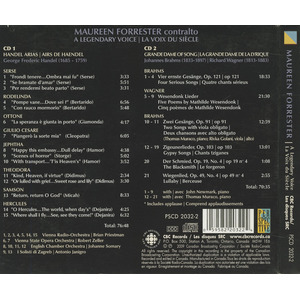
CD-Forrester, Maureen - A Legendary Voice - La Voix du Siecle BACK
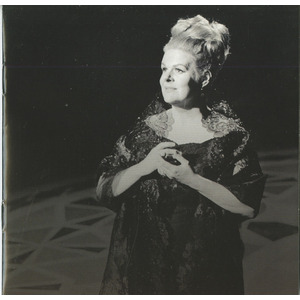
CD-Forrester, Maureen - A Legendary Voice - La Voix du Siecle BOOKLET FRONT
CD-Forrester, Maureen - A Legendary Voice - La Voix du Siecle BOOKLET PAGES 01-02
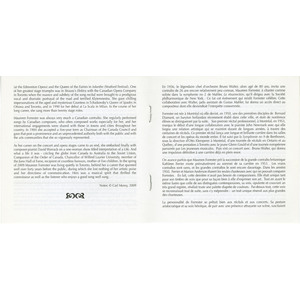
CD-Forrester, Maureen - A Legendary Voice - La Voix du Siecle BOOKLET PAGES 03-04
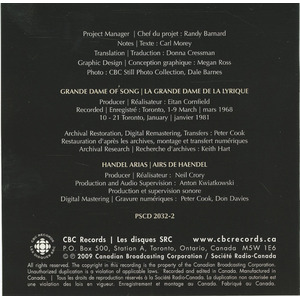
CD-Forrester, Maureen - A Legendary Voice - La Voix du Siecle BOOKLET BACK
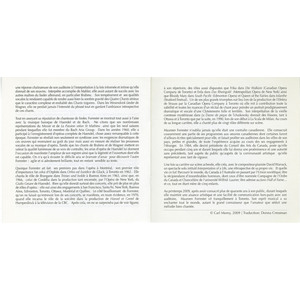
CD-Forrester, Maureen - A Legendary Voice - La Voix du Siecle BOOKLET PAGES 05-06
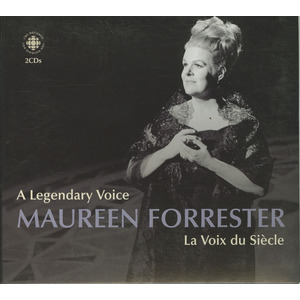
A Legendary Voice - La Voix du Siecle
Media
Videos
0 videos
No videos available for this title.
Credits
In Transit
No Comments